Loading cart…
No products in the cart.

Original price was: $518.00.$299.00Current price is: $299.00.
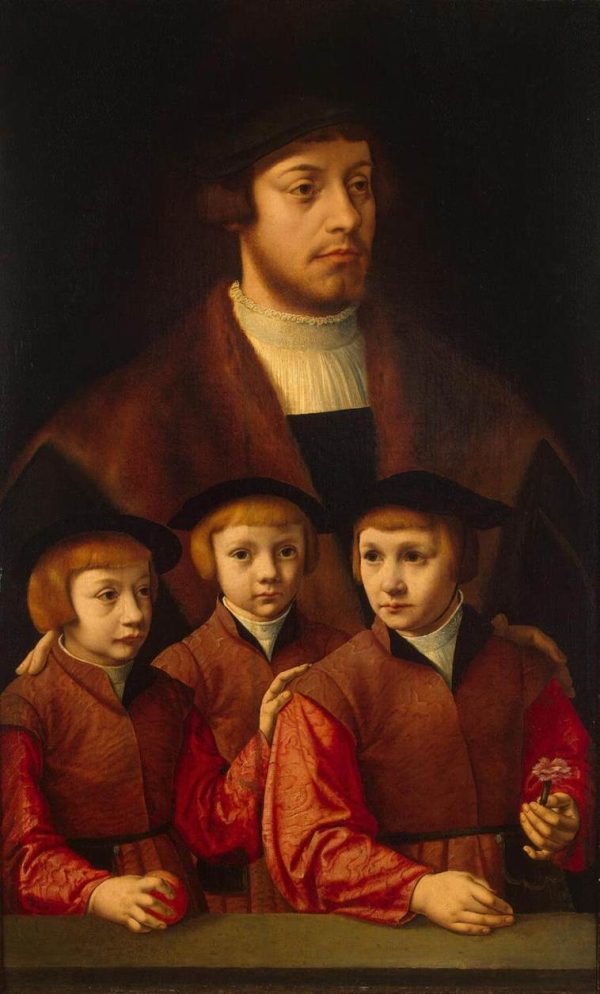
Own Portrait of a Man with Three Sons by Barthel Bruyn as a hand-painted oil on canvas, its restrained palette and visible brushwork rebuilt layer by layer.
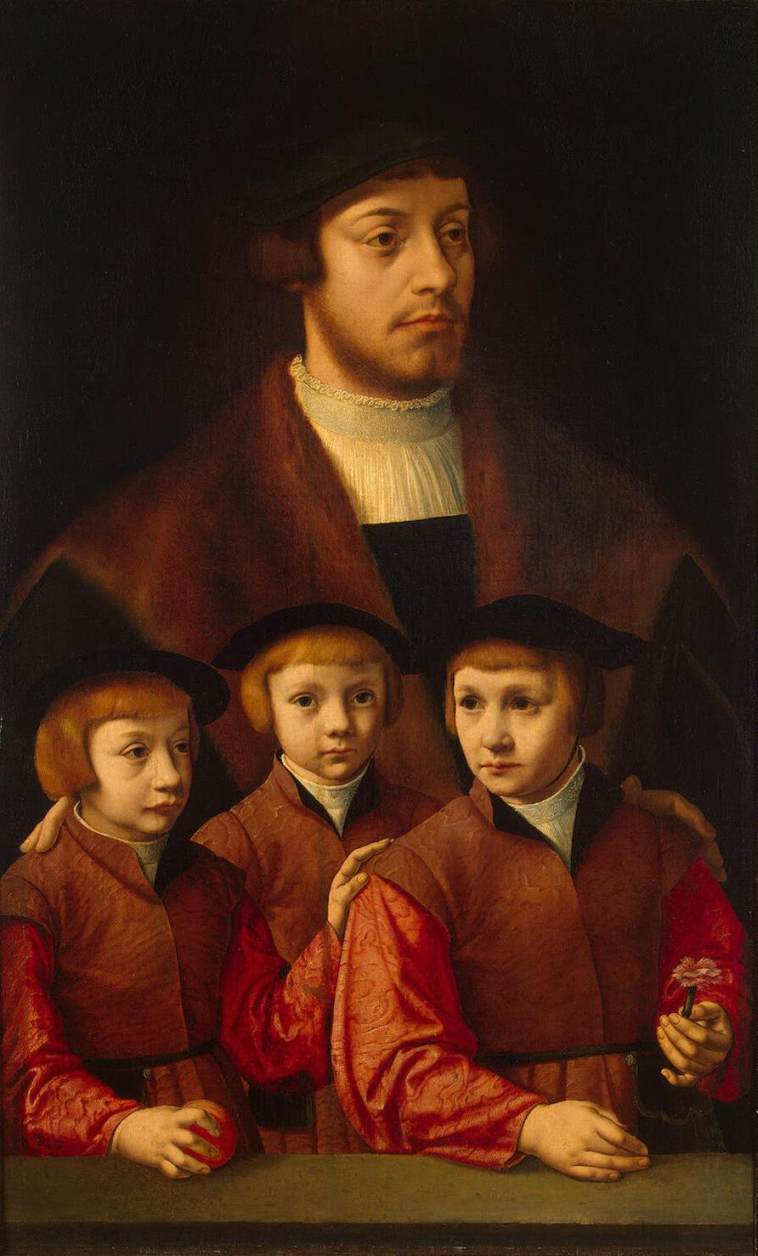
Thin glazes build the flesh tones here, laid one over another so that the underlying ground still warms the surface, while the darker passages of costume and background are worked more thickly to hold the eye on the figures. Edges are handled with a Renaissance discipline: firm around the outline of the man and his three sons, softer where the modelling falls into shadow at the temple or along the jaw. Out of this careful construction of paint the group emerges, four figures set close together in a composition built for quiet, sustained looking rather than immediate drama.
The painting belongs to the tradition of North German portraiture in which Barthel Bruyn worked through the second quarter of the sixteenth century, a period when merchant and patrician families in Cologne commissioned exactly this kind of sober, direct likeness. The father is placed slightly forward of his sons, his gaze meeting the viewer while the boys are arranged in a descending rhythm that suggests both lineage and order. Costume is rendered with a restrained palette, blacks and muted browns relieved by pale linen at the collar and cuff, and it is in these passages of white that the brushwork becomes most visible, thin and exact against the darker fabric around it.
Light in the picture is even rather than theatrical, falling across the faces with little cast shadow, a choice that keeps attention on feature and expression instead of atmosphere. This flatness of illumination, paired with the close, almost airless arrangement of the sitters, gives the group a formality suited to a family record rather than a narrative scene. The surrounding space is kept plain, free of incident, so that nothing competes with the four heads and the hands that punctuate the lower half of the composition.
ByMuseum artists rebuild this structure by hand, working in oil on artist-grade canvas rather than reproducing the image mechanically. Each oil painting reproduction is painted layer by layer to match the original palette, from the pale linen to the near-black costume, and the brushwork is kept visible so the surface carries the same texture a viewer would find in the source painting. What is carried across is not only the likeness of the four sitters but the balance between them, the placement of light, and the restraint of the palette, since it is this fidelity to structure and surface, more than colour alone, that makes an oil on canvas reproduction convincing at close range.
Empty walls flatten a room. A classical artwork restores structure and visual hierarchy. One painting defines the space, anchors furniture, and establishes identity.
Worldwide shipping included. Each painting is produced to order and safely packed for international transport.
All payments are encrypted and processed through trusted payment providers.
Real brushwork, layered oil paint, and durable pigments on museum-quality canvas.
If the result does not meet expectations, return it for a full refund.


Your artwork is painted on premium cotton canvas, then shipped safely rolled in a rigid tube with extra blank canvas border — ready for stretching or framing locally.
Select a handcrafted frame and we’ll deliver your painting fully assembled, protected, and ready to hang.
For safe shipping, framing is available up to a maximum size. Larger sizes will automatically disable the frame option.


Choose “Stretched” to receive your canvas mounted on wooden stretcher bars — perfect if you’ll frame it later or display it as-is.
Gallery Wrap is a deeper, 1.5" style stretcher. The canvas wraps around the sides and is stapled on the back for a clean, modern, frameless look.
We ship with UPS, FedEx, or DHL straight to your door. You’ll receive a tracking number as soon as your order leaves our studio. Typical delivery is 5 to 7 days after dispatch; large, framed, or stretched pieces may take longer depending on the safest shipping route.


Unframed canvases are protected with a film, carefully rolled, and secured inside a rigid shipping tube.

Stretched, Gallery Wrapped, and Framed paintings are wrapped, cushioned with foam protection, and boxed for safe transit.