Loading cart…
No products in the cart.

Original price was: $599.00.$299.00Current price is: $299.00.
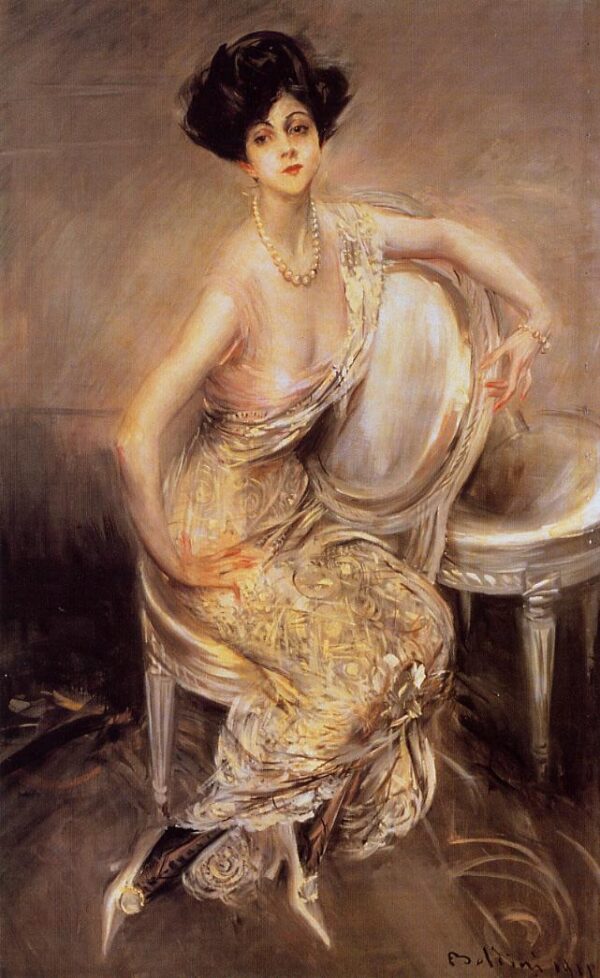
Portrait of Rita de Acosta Lydig by Giovanni Boldini, recreated as a hand-painted oil reproduction that keeps its confident brushwork and quiet elegance intact.

A woman in black meets the eye first, her figure rising against a ground kept deliberately spare so nothing competes with her presence. The dress falls in long dark folds that catch a cool, silvered light along their edges, while the face and hands emerge with a warmth that draws the gaze upward and holds it there. Elegance in this portrait is built from restraint: a narrow range of tones, an economy of gesture, and a sitter who seems entirely at ease being looked at.
Rita de Acosta Lydig was among the most photographed and admired women of her circle, known for a personal style that designers and artists studied closely, and Boldini responds to that reputation with a portrait of evident sympathy rather than formal distance. The brushwork loosens across the fabric of the gown into rapid, slashing strokes that suggest movement and volume without ever describing every fold, a shorthand typical of his mature manner. Where the paint tightens, around the face and the set of the shoulders, the touch becomes more exact, and it is this contrast between the quick and the deliberate that gives the sitter her particular vitality.
The picture belongs to the period when Boldini had become the portraitist of choice for fashionable society in Paris, his reputation built on an ability to catch likeness and bearing in the same rapid, confident hand associated with Impressionist practice. Light moves unevenly across the surface, pooling on skin and jewellery and thinning to near nothing in the shadowed recesses of the dress, a device that keeps the eye travelling rather than settling. It is a portrait built for close looking, where the apparent spontaneity of the brush conceals a very deliberate structure underneath.
ByMuseum artists recreate this composition as a hand-painted oil painting reproduction, working in oil on artist-grade canvas to match the original palette and to keep the brushwork and surface texture legible under raking light, rather than flattening them into a printed surface. Some collectors prefer to think of the result as a replica painting made stroke by stroke, since every canvas is worked individually rather than mechanically copied, which is why no two examples are ever quite identical. The aim throughout is fidelity of surface as much as of image, so the finished canvas rewards the same close inspection the original invites. Hung where afternoon light can move across it, in a study, a reading room, or a quiet corner of a formal sitting room, the portrait brings a sense of composed, confident presence to the space, its dark tonality settling well against pale walls and its restrained elegance suited to a room meant for lingering rather than passing through.
Empty walls flatten a room. A classical artwork restores structure and visual hierarchy. One painting defines the space, anchors furniture, and establishes identity.
Worldwide shipping included. Each painting is produced to order and safely packed for international transport.
All payments are encrypted and processed through trusted payment providers.
Real brushwork, layered oil paint, and durable pigments on museum-quality canvas.
If the result does not meet expectations, return it for a full refund.


Your artwork is painted on premium cotton canvas, then shipped safely rolled in a rigid tube with extra blank canvas border — ready for stretching or framing locally.
Select a handcrafted frame and we’ll deliver your painting fully assembled, protected, and ready to hang.
For safe shipping, framing is available up to a maximum size. Larger sizes will automatically disable the frame option.


Choose “Stretched” to receive your canvas mounted on wooden stretcher bars — perfect if you’ll frame it later or display it as-is.
Gallery Wrap is a deeper, 1.5" style stretcher. The canvas wraps around the sides and is stapled on the back for a clean, modern, frameless look.
We ship with UPS, FedEx, or DHL straight to your door. You’ll receive a tracking number as soon as your order leaves our studio. Typical delivery is 5 to 7 days after dispatch; large, framed, or stretched pieces may take longer depending on the safest shipping route.


Unframed canvases are protected with a film, carefully rolled, and secured inside a rigid shipping tube.

Stretched, Gallery Wrapped, and Framed paintings are wrapped, cushioned with foam protection, and boxed for safe transit.

Man Writing a Letter
Gabriel Metsu, c. 1664
The gallery list
Every painting is already 50% off. Join the list and we will send you an extra $15 code, plus first access to new collections.
No spam. Unsubscribe anytime. · Privacy Policy
Welcome
Your $15 code is on its way. Explore the gallery while you wait.