Loading cart…
No products in the cart.

Original price was: $599.00.$299.00Current price is: $299.00.
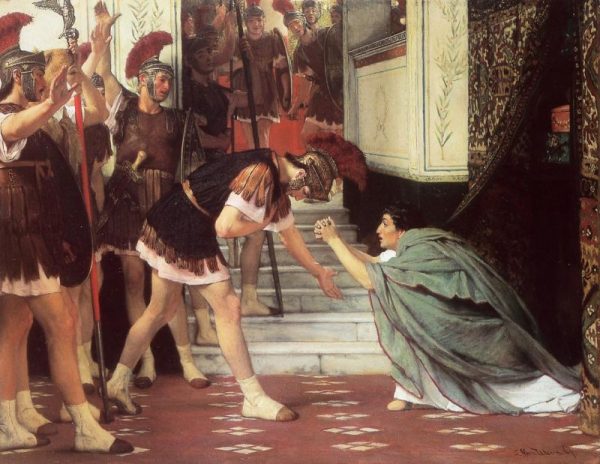
A raised spear catches the light in this hand-painted replica of Proclaiming Claudius Empero by Lawrence Alma-Tadema, its marble stillness rebuilt stroke by stroke in oil on canvas.

A soldier lifts a spear overhead, its point catching the light against the pale marble of a palace corridor, and in that single raised arm the whole drama of a succession is decided. This is the moment Lawrence Alma-Tadema chose for Proclaiming Claudius Empero, and it is the small, exact gesture rather than any grand rhetorical flourish that carries the weight of the scene.
The painting stages a crowded interior with the discipline that made Alma-Tadema one of the more exacting painters of antiquity in his generation. Figures cluster and shift across the marble floor, their togas and armour rendered with a close attention to surface that lets stone, cloth, and skin each read as a distinct material under the same cool light. The architecture is not backdrop but structure: colonnades and steps organise the crowd into groups, and the eye is guided from the foreground incident back through the depth of the hall by nothing more than the placement of a few pale columns.
Colour is used sparingly and to purpose, with warm flesh tones and the occasional note of red or gold set against long passages of white and grey stone. This restraint is characteristic of the period in the career of Alma-Tadema when his research into Roman life had matured into a personal, almost archaeological style, one in which historical accuracy and painterly composure carry equal weight. As a hand-painted oil painting reproduction, the canvas is built up in layers of colour by a trained painter working directly from the original image, matching its tonal balance and preserving the texture of individual brushstrokes rather than flattening them into a printed surface. The result is a replica painting with genuine depth: raised paint where the artist worked the marble highlights, thinner colour in the shadowed folds of drapery, the kind of variation only a hand-painted canvas retains.
Given a wall with even, indirect light, ideally away from direct sun so the surface keeps its subtlety, the painting settles well into a study, a library, or a formal sitting room, somewhere it can be approached slowly rather than glanced at in passing. Its quiet architecture and controlled colour make it a steady presence rather than a demanding one, the kind of picture that rewards being lived with.
Empty walls flatten a room. A classical artwork restores structure and visual hierarchy. One painting defines the space, anchors furniture, and establishes identity.
Worldwide shipping included. Each painting is produced to order and safely packed for international transport.
All payments are encrypted and processed through trusted payment providers.
Real brushwork, layered oil paint, and durable pigments on museum-quality canvas.
If the result does not meet expectations, return it for a full refund.


Your artwork is painted on premium cotton canvas, then shipped safely rolled in a rigid tube with extra blank canvas border — ready for stretching or framing locally.
Select a handcrafted frame and we’ll deliver your painting fully assembled, protected, and ready to hang.
For safe shipping, framing is available up to a maximum size. Larger sizes will automatically disable the frame option.


Choose “Stretched” to receive your canvas mounted on wooden stretcher bars — perfect if you’ll frame it later or display it as-is.
Gallery Wrap is a deeper, 1.5" style stretcher. The canvas wraps around the sides and is stapled on the back for a clean, modern, frameless look.
We ship with UPS, FedEx, or DHL straight to your door. You’ll receive a tracking number as soon as your order leaves our studio. Typical delivery is 5 to 7 days after dispatch; large, framed, or stretched pieces may take longer depending on the safest shipping route.


Unframed canvases are protected with a film, carefully rolled, and secured inside a rigid shipping tube.

Stretched, Gallery Wrapped, and Framed paintings are wrapped, cushioned with foam protection, and boxed for safe transit.

Man Writing a Letter
Gabriel Metsu, c. 1664
The gallery list
Every painting is already 50% off. Join the list and we will send you an extra $15 code, plus first access to new collections.
No spam. Unsubscribe anytime. · Privacy Policy
Welcome
Your $15 code is on its way. Explore the gallery while you wait.