Loading cart…
No products in the cart.

Original price was: $599.00.$299.00Current price is: $299.00.
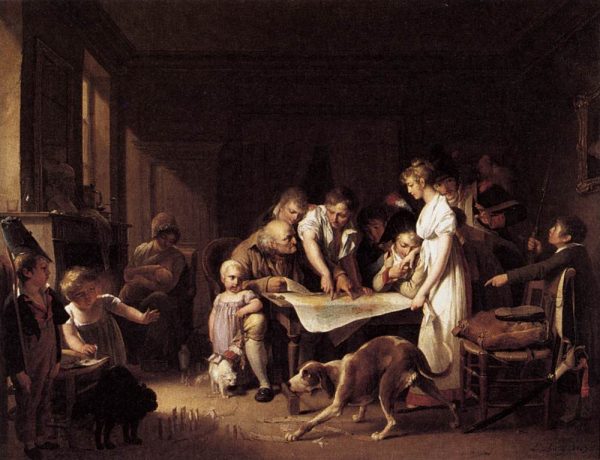
A hand-painted replica of Reading of the Bulletin of the Grand Army by Boilly, its warm ochres and muted blues rebuilt in oil for a surface that rewards close, repeated looking.
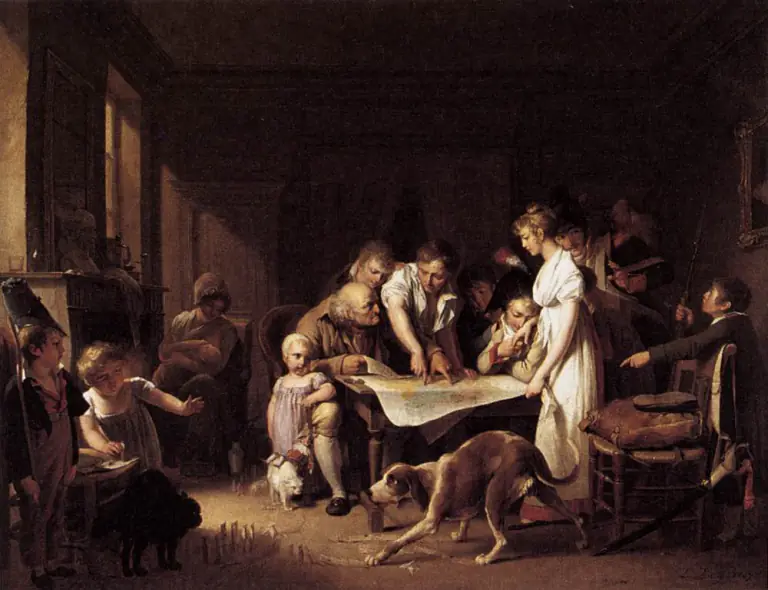
Warm ochres and deep browns settle against the muted blues and greys of military coats, while pale flesh tones catch what light falls across the gathered faces. It is a painting built from the friction of these colours: the earthy neutrality of interior walls pressed close to the bright accents of a cockade or a flushed cheek, so that attention moves naturally toward the points where warmth interrupts shadow.
The scene gathers a crowd of ordinary Parisians around a public notice, their expressions ranging from anxious to expectant as news of the army reaches the street. Boilly, working in the years when Napoleonic campaigns dominated daily life, turns what could have been a stiff civic tableau into something closer to observed life, each figure given a distinct posture and a private reaction rather than a uniform pose. This attentiveness to individual character, set within a carefully controlled group arrangement, is characteristic of his particular contribution to French painting of the period, a bridge between the formal clarity of Neoclassicism and the more anecdotal, socially observant genre scenes that would follow.
Light falls unevenly through the composition, picking out a raised hand here, a lowered gaze there, and this uneven illumination does much of the storytelling. Boilly handles the transitions between lit and shadowed passages with a smoothness that owes something to his training in portraiture, where the modelling of a face under changing light was itself the subject. The brushwork tightens around faces and hands, then loosens into broader, more economical strokes for coats and background, a hierarchy of finish that keeps the eye moving through the crowd without losing the sense of a single, unified moment.
Reproducing this painting well means respecting that same hierarchy of touch. Our painters work in oil on artist-grade canvas, matching the ochres and blues by eye and rebuilding the layered transitions of light across the crowd with the same variation in brushwork, tighter where the original tightens, looser where it opens out. The result is a hand-painted replica rather than a mechanically produced copy, an oil painting reproduction whose surface holds real texture and depth, closer in spirit to the object Boilly himself would have made than to anything printed.
Lived with over time, the painting keeps offering small discoveries: a face at the edge of the crowd noticed only after repeated viewing, a passage of colour that shifts under different light through the day. That slow unfolding is part of what makes it worth having on a wall rather than a screen.
Empty walls flatten a room. A classical artwork restores structure and visual hierarchy. One painting defines the space, anchors furniture, and establishes identity.
Worldwide shipping included. Each painting is produced to order and safely packed for international transport.
All payments are encrypted and processed through trusted payment providers.
Real brushwork, layered oil paint, and durable pigments on museum-quality canvas.
If the result does not meet expectations, return it for a full refund.


Your artwork is painted on premium cotton canvas, then shipped safely rolled in a rigid tube with extra blank canvas border — ready for stretching or framing locally.
Select a handcrafted frame and we’ll deliver your painting fully assembled, protected, and ready to hang.
For safe shipping, framing is available up to a maximum size. Larger sizes will automatically disable the frame option.


Choose “Stretched” to receive your canvas mounted on wooden stretcher bars — perfect if you’ll frame it later or display it as-is.
Gallery Wrap is a deeper, 1.5" style stretcher. The canvas wraps around the sides and is stapled on the back for a clean, modern, frameless look.
We ship with UPS, FedEx, or DHL straight to your door. You’ll receive a tracking number as soon as your order leaves our studio. Typical delivery is 5 to 7 days after dispatch; large, framed, or stretched pieces may take longer depending on the safest shipping route.


Unframed canvases are protected with a film, carefully rolled, and secured inside a rigid shipping tube.

Stretched, Gallery Wrapped, and Framed paintings are wrapped, cushioned with foam protection, and boxed for safe transit.

Man Writing a Letter
Gabriel Metsu, c. 1664
The gallery list
Every painting is already 50% off. Join the list and we will send you an extra $15 code, plus first access to new collections.
No spam. Unsubscribe anytime. · Privacy Policy
Welcome
Your $15 code is on its way. Explore the gallery while you wait.