Loading cart…
No products in the cart.

Original price was: $599.00.$299.00Current price is: $299.00.
Rolling Mill by Karl Blechen turns an early iron works into a scene of heat, smoke, and firelight, one of the first Romantic paintings to take industry seriously as a subject.
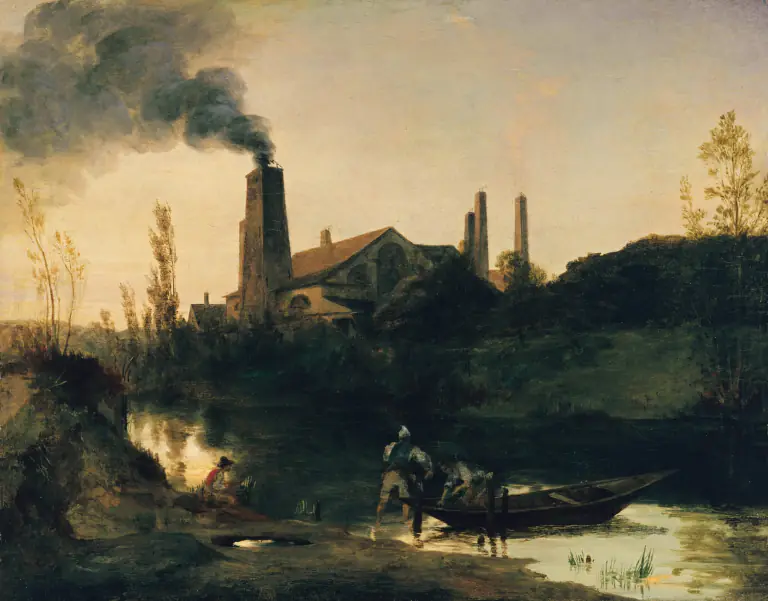
In the early nineteenth century, Germany was beginning to industrialise, and a handful of artists started looking at factories and mills the way earlier generations had looked at mountains and storms. Karl Blechen was one of them. Rolling Mill grew out of that shift in attention, a moment when he turned from picturesque ruins and forest scenes toward the noise and heat of a working iron mill, treating the subject with the same seriousness he had once reserved for nature at its most dramatic.
The composition puts the viewer close to the machinery, inside the heat rather than observing it from a safe distance. Heavy iron equipment fills the middle ground, and smoke rises to blot out much of the sky, so that the mill seems to generate its own weather. Blechen builds the scene from dark, warm tones broken by the glow of fire and hot metal, letting light do the work of describing shapes that would otherwise dissolve into shadow. It is a scene built on contrast: cold iron and hot flame, human labour and mechanical force, a natural sky pressed down by artificial smoke.
What makes the picture hold together is restraint. Blechen does not moralise about industry or turn the mill into spectacle; he simply paints what heat and smoke do to light, and lets the drama come from that. The brushwork stays loose where the smoke thickens and tightens where the metal catches a flame, a technique that gives the whole scene a sense of motion even though nothing in it is exaggerated. It belongs to the period when Blechen was moving away from strict Romantic convention toward something closer to direct observation, a step that later painters of industrial and urban subjects would build on.
ByMuseum recreates Rolling Mill as a hand-painted oil painting reproduction, worked in oil on canvas by a trained painter rather than printed by machine. The artist matches the original palette of rust, ember, and smoke grey, and rebuilds the brushwork layer by layer so the surface carries real texture, the kind of raised paint and visible stroke that a fine art reproduction should have and a print cannot. Every canvas is painted to order, which is why it takes time and why no two are quite identical.
This is a picture suited to a study, a library, or any room where someone wants to think rather than simply decorate. It rewards a collector drawn to early industrial subjects, or anyone who wants a Romantic painting that looks forward instead of back.
Empty walls flatten a room. A classical artwork restores structure and visual hierarchy. One painting defines the space, anchors furniture, and establishes identity.
Worldwide shipping included. Each painting is produced to order and safely packed for international transport.
All payments are encrypted and processed through trusted payment providers.
Real brushwork, layered oil paint, and durable pigments on museum-quality canvas.
If the result does not meet expectations, return it for a full refund.


Your artwork is painted on premium cotton canvas, then shipped safely rolled in a rigid tube with extra blank canvas border — ready for stretching or framing locally.
Select a handcrafted frame and we’ll deliver your painting fully assembled, protected, and ready to hang.
For safe shipping, framing is available up to a maximum size. Larger sizes will automatically disable the frame option.


Choose “Stretched” to receive your canvas mounted on wooden stretcher bars — perfect if you’ll frame it later or display it as-is.
Gallery Wrap is a deeper, 1.5" style stretcher. The canvas wraps around the sides and is stapled on the back for a clean, modern, frameless look.
We ship with UPS, FedEx, or DHL straight to your door. You’ll receive a tracking number as soon as your order leaves our studio. Typical delivery is 5 to 7 days after dispatch; large, framed, or stretched pieces may take longer depending on the safest shipping route.


Unframed canvases are protected with a film, carefully rolled, and secured inside a rigid shipping tube.

Stretched, Gallery Wrapped, and Framed paintings are wrapped, cushioned with foam protection, and boxed for safe transit.

Man Writing a Letter
Gabriel Metsu, c. 1664
The gallery list
Every painting is already 50% off. Join the list and we will send you an extra $15 code, plus first access to new collections.
No spam. Unsubscribe anytime. · Privacy Policy
Welcome
Your $15 code is on its way. Explore the gallery while you wait.