Loading cart…
No products in the cart.

Original price was: $599.00.$299.00Current price is: $299.00.
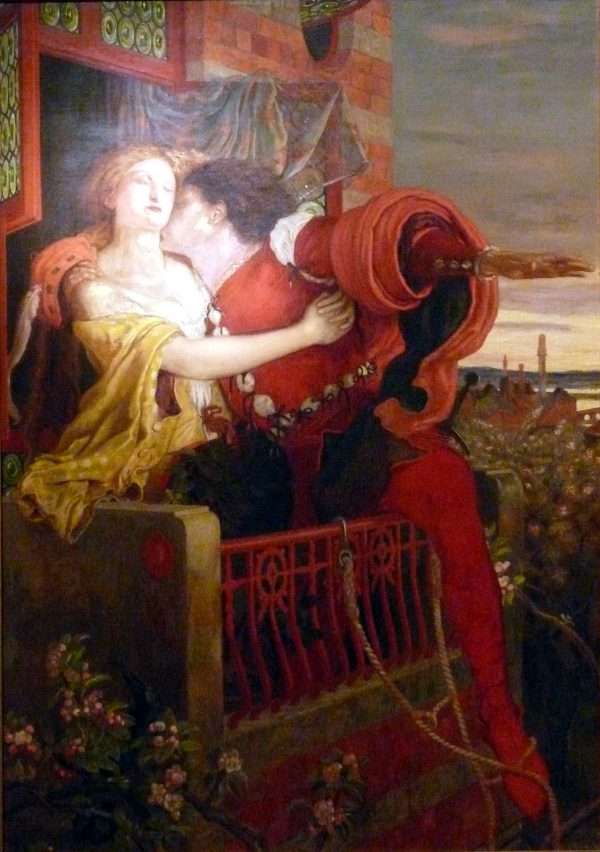
A hand-painted Romeo and Juliet reproduction after Ford Madox Brown, its dawn-grey sky and dusty crimson drapery built up in real oil on canvas.
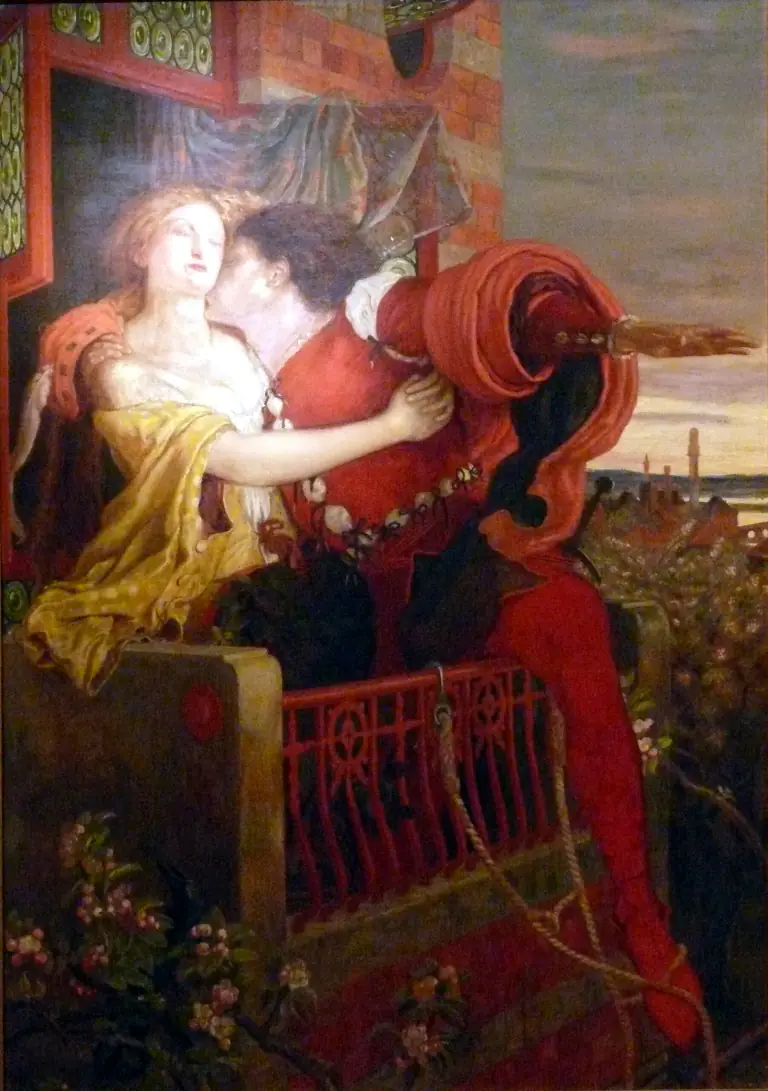
Dawn grey and dull rose press together across this balcony scene, the sky washed in a cold slate blue that makes the warmer flesh tones of the lovers look almost feverish by comparison. The Romeo and Juliet reproduction carries that same collision of temperature through every passage of drapery: a dusty crimson sleeve catches the eye against the stone parapet, while greens in the climbing foliage sit low and bitter, refusing to soften the scene into anything pretty.
Brown set the two figures on a balcony so narrow and so steep in its angle that the embrace reads as effort rather than idealised romance. Romeo has one leg already swung over the rail, his torso twisted back toward Juliet in a pose that strains rather than poses, and the rope ladder hanging from its two iron hooks makes plain how he is meant to leave. Flowers spill over the stone in the close, almost botanical attention typical of Pre-Raphaelite painting, each bloom separately observed rather than generalised into decoration. The costume, cut in an early Renaissance Italian style, locates the scene in a Verona built from research rather than theatrical convention, and the city laid out below the balcony recedes into that same grey dawn light that governs the whole canvas.
This picture belongs to the mature end of the career of Brown, painted between 1869 and 1870 when his interest in compressed, almost claustrophobic composition had sharpened well past his earlier Pre-Raphaelite work. The steepness of the balcony and the awkward angle of the bodies are deliberate choices, built to carry urgency rather than grace, and the brushwork around the hands and faces is worked tighter than the looser, more atmospheric handling of the sky. It now forms part of the Samuel and Mary R. Bancroft Memorial collection at the Delaware Art Museum in Wilmington.
Our painters build this oil painting reproduction the same way the original canvas was built, layer over layer, rather than printing the image flat onto a surface. A trained artist matches the slate blues of the sky and the particular dusty crimson of the drapery stroke by stroke, letting the paint sit with real body where Brown laid it thick and thinning it where he let the canvas show through. The result is a hand-painted replica with its own raised surface and visible brushwork, something a collector can study up close the way they would the original, rather than a flat printed image standing in for one.
| artists |
|---|
Empty walls flatten a room. A classical artwork restores structure and visual hierarchy. One painting defines the space, anchors furniture, and establishes identity.
Worldwide shipping included. Each painting is produced to order and safely packed for international transport.
All payments are encrypted and processed through trusted payment providers.
Real brushwork, layered oil paint, and durable pigments on museum-quality canvas.
If the result does not meet expectations, return it for a full refund.


Your artwork is painted on premium cotton canvas, then shipped safely rolled in a rigid tube with extra blank canvas border — ready for stretching or framing locally.
Select a handcrafted frame and we’ll deliver your painting fully assembled, protected, and ready to hang.
For safe shipping, framing is available up to a maximum size. Larger sizes will automatically disable the frame option.


Choose “Stretched” to receive your canvas mounted on wooden stretcher bars — perfect if you’ll frame it later or display it as-is.
Gallery Wrap is a deeper, 1.5" style stretcher. The canvas wraps around the sides and is stapled on the back for a clean, modern, frameless look.
We ship with UPS, FedEx, or DHL straight to your door. You’ll receive a tracking number as soon as your order leaves our studio. Typical delivery is 5 to 7 days after dispatch; large, framed, or stretched pieces may take longer depending on the safest shipping route.


Unframed canvases are protected with a film, carefully rolled, and secured inside a rigid shipping tube.

Stretched, Gallery Wrapped, and Framed paintings are wrapped, cushioned with foam protection, and boxed for safe transit.

Man Writing a Letter
Gabriel Metsu, c. 1664
The gallery list
Every painting is already 50% off. Join the list and we will send you an extra $15 code, plus first access to new collections.
No spam. Unsubscribe anytime. · Privacy Policy
Welcome
Your $15 code is on its way. Explore the gallery while you wait.