Loading cart…
No products in the cart.

Original price was: $518.00.$259.00Current price is: $259.00.
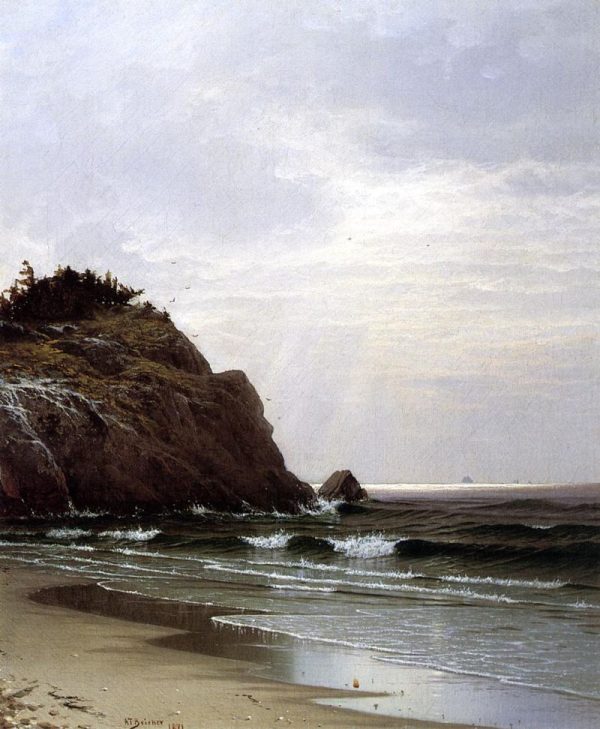
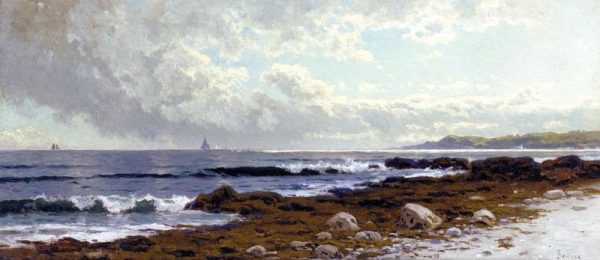
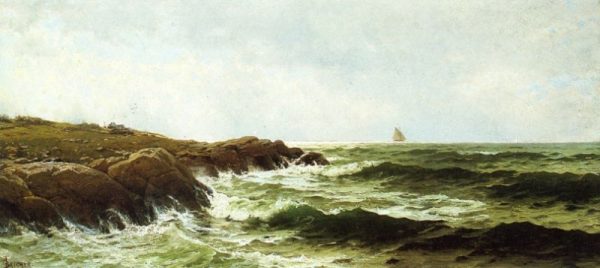
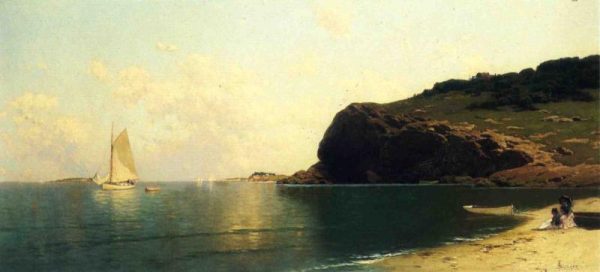
Sailboats off a Rocky Coast by Alfred Thompson Bricher, reproduced as a hand-painted oil replica that captures the grey rock, cool sea, and warm coastal light of the original.
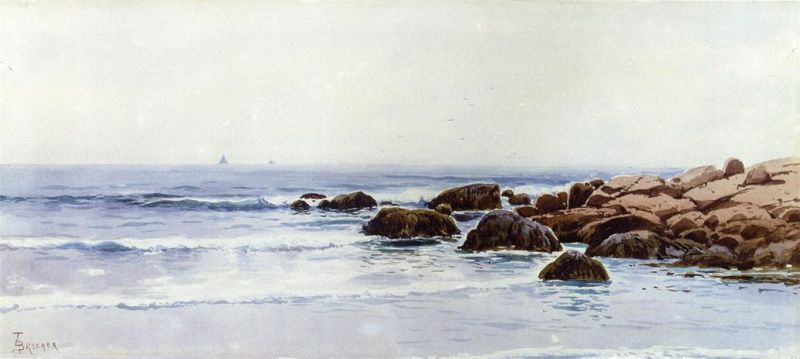
Slate grey rocks meet a sea worked in cool blue-greens and soft pewter, the two tones pushing against each other until a low run of warm cream and ochre in the sky settles the argument. White sails catch what light there is, small bright accents against the darker water, and it is this quiet friction of colour, stone against wave, warm sky against cool sea, that gives the painting its pull.
Alfred Thompson Bricher built his reputation on exactly this kind of coastal observation, and Sailboats off a Rocky Coast shows him working at the height of that skill. The composition sets its rocky outcrop firmly to one side, letting the open water and the scattered sailboats carry the rest of the canvas, so the eye moves from the solid mass of stone out toward the thinner, more atmospheric distance. Bricher had trained his attention on the New England and Atlantic shoreline for years by this point in his career, and the picture carries that familiarity: the rocks are rendered with a firmness that never turns heavy, and the water shifts in value and temperature as it recedes, thinning toward the horizon in a way that suggests humidity and distance rather than simply depicting them.
Light does most of the emotional work here. Bricher lets it fall unevenly across the water, catching a wave crest, dimming a shadowed hollow in the rock, so that the sea reads as something moving rather than fixed. The sailboats are painted with a lighter, quicker touch than the shoreline, their canvases picked out in a few economical strokes that suggest sail and wind without overworking the detail. It is a technique typical of the Hudson River School painters as they turned toward marine subjects, trusting restraint and observed light over dramatic incident.
ByMuseum artists recreate this painting as a hand-painted oil painting reproduction, working in oil on artist-grade canvas to match Bricher palette of grey stone, blue-green sea, and warm sky, and to preserve the brushwork that gives the water its movement and the rock its weight. This is not a printed replica but a painted one, built up in layers the way the original was, so the surface holds real texture and the colour keeps its depth under changing light.
Live with it for a while and the picture keeps offering more: a wave you had not noticed breaking, a second sail further out, the way the ochre sky warms the whole composition once your eye adjusts to it. That slow reveal is part of what makes a hand-painted replica worth having on a wall rather than a screen.
Empty walls flatten a room. A classical artwork restores structure and visual hierarchy. One painting defines the space, anchors furniture, and establishes identity.
Worldwide shipping included. Each painting is produced to order and safely packed for international transport.
All payments are encrypted and processed through trusted payment providers.
Real brushwork, layered oil paint, and durable pigments on museum-quality canvas.
If the result does not meet expectations, return it for a full refund.


Your artwork is painted on premium cotton canvas, then shipped safely rolled in a rigid tube with extra blank canvas border — ready for stretching or framing locally.
Select a handcrafted frame and we’ll deliver your painting fully assembled, protected, and ready to hang.
For safe shipping, framing is available up to a maximum size. Larger sizes will automatically disable the frame option.


Choose “Stretched” to receive your canvas mounted on wooden stretcher bars — perfect if you’ll frame it later or display it as-is.
Gallery Wrap is a deeper, 1.5" style stretcher. The canvas wraps around the sides and is stapled on the back for a clean, modern, frameless look.
We ship with UPS, FedEx, or DHL straight to your door. You’ll receive a tracking number as soon as your order leaves our studio. Typical delivery is 4–5 business days after dispatch; large, framed, or stretched pieces may take longer depending on the safest shipping route.


Unframed canvases are protected with a film, carefully rolled, and secured inside a rigid shipping tube.

Stretched, Gallery Wrapped, and Framed paintings are wrapped, cushioned with foam protection, and boxed for safe transit.
A note from the studio
Our studio is working through an exceptional number of commissions, so we have paused new orders for a short time. We will start taking orders again on 1 October.
Every painting is made entirely by hand, and we would rather pause than rush one. Thank you for your patience and your trust.
Leave your details and we will reserve your place: we will write to you as soon as orders reopen.
Thank you
Your request is saved. We will write to you on 1 October, and a confirmation is on its way to your inbox.