Loading cart…
No products in the cart.

Original price was: $599.00.$299.00Current price is: $299.00.
George Catlin recorded Shon ka ki he ga, Horse Chief, Grand Pawnee Head Chief with documentary clarity; this hand-painted oil on canvas reproduction preserves that surface and palette for a serious collection.
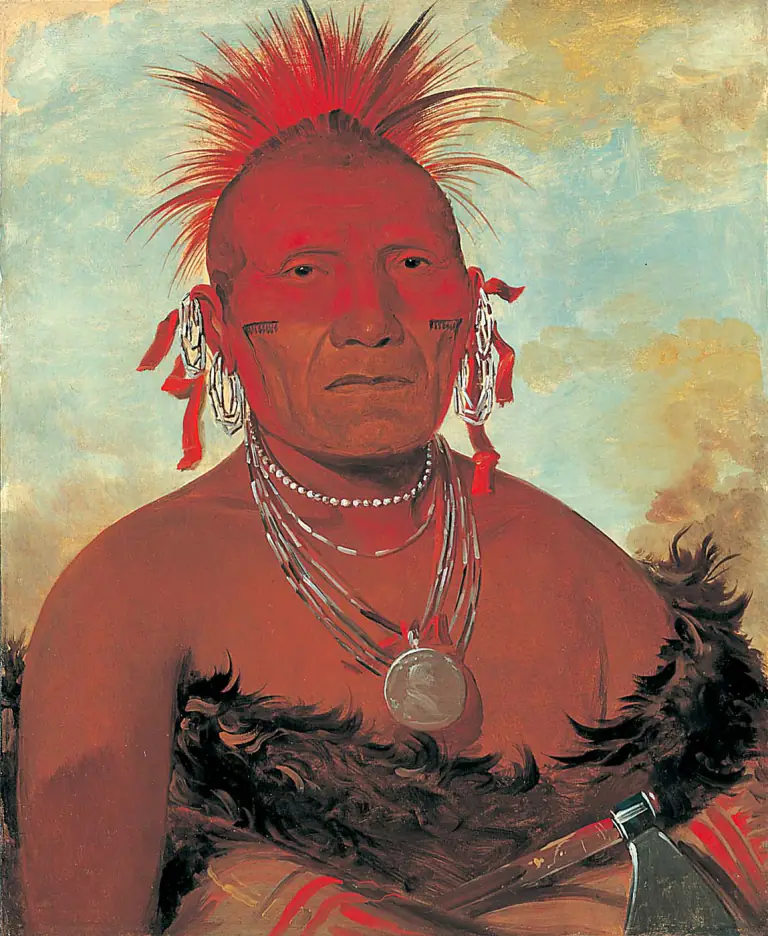
American frontier portraiture in the nineteenth century rarely aimed for ethnographic record and painterly ambition at once, but that dual purpose defines the work of George Catlin among the Plains nations. Shon ka ki he ga, Horse Chief, Grand Pawnee Head Chief, belongs to the body of portraits Catlin produced during his travels among Native American peoples in the 1830s, a project undertaken with the explicit intent of preserving likenesses and customs he believed were vanishing under the pressure of westward expansion.
The portrait presents its subject with a directness typical of the series: the chief is set against a plain or lightly worked ground, so that nothing competes with the face, the posture, and the regalia that mark his rank. Catlin favoured a restrained palette in these works, built from earth tones and muted reds and ochres, punctuated by the brighter accents of paint, feather, or ornament that signal status within Pawnee society. Light falls evenly across the sitter, avoiding dramatic shadow in favour of clarity, a choice that suits the documentary ambition behind the picture while still leaving room for individual character in the set of the mouth and the steadiness of the gaze.
What distinguishes this and comparable portraits in the series is the balance Catlin struck between speed and observation. Working often in the field, under real constraints of time and access, he nonetheless built a coherent design in which the central figure and the supporting passages of costume and background hold together as a single visual statement, rewarding the kind of sustained looking a serious collector brings to any historical portrait.
Every reproduction ByMuseum produces of this composition begins with a painter working directly in oil on canvas, not from a mechanical process. The palette is matched by eye against the original, the transitions Catlin built between flesh, ornament, and ground are reworked stroke by stroke, and the resulting surface carries the same layered depth and quiet variation that any oil on canvas reproduction of a historical portrait should show. Because a trained hand is behind every brushmark, no two canvases leaving the studio are perfectly identical, which is precisely the quality that separates a genuine oil painting reproduction from a printed copy and gives the work presence on a wall rather than mere resemblance to one.
Empty walls flatten a room. A classical artwork restores structure and visual hierarchy. One painting defines the space, anchors furniture, and establishes identity.
Worldwide shipping included. Each painting is produced to order and safely packed for international transport.
All payments are encrypted and processed through trusted payment providers.
Real brushwork, layered oil paint, and durable pigments on museum-quality canvas.
If the result does not meet expectations, return it for a full refund.


Your artwork is painted on premium cotton canvas, then shipped safely rolled in a rigid tube with extra blank canvas border — ready for stretching or framing locally.
Select a handcrafted frame and we’ll deliver your painting fully assembled, protected, and ready to hang.
For safe shipping, framing is available up to a maximum size. Larger sizes will automatically disable the frame option.


Choose “Stretched” to receive your canvas mounted on wooden stretcher bars — perfect if you’ll frame it later or display it as-is.
Gallery Wrap is a deeper, 1.5" style stretcher. The canvas wraps around the sides and is stapled on the back for a clean, modern, frameless look.
We ship with UPS, FedEx, or DHL straight to your door. You’ll receive a tracking number as soon as your order leaves our studio. Typical delivery is 5 to 7 days after dispatch; large, framed, or stretched pieces may take longer depending on the safest shipping route.


Unframed canvases are protected with a film, carefully rolled, and secured inside a rigid shipping tube.

Stretched, Gallery Wrapped, and Framed paintings are wrapped, cushioned with foam protection, and boxed for safe transit.


Man Writing a Letter
Gabriel Metsu, c. 1664
The gallery list
Every painting is already 50% off. Join the list and we will send you an extra $15 code, plus first access to new collections.
No spam. Unsubscribe anytime. · Privacy Policy
Welcome
Your $15 code is on its way. Explore the gallery while you wait.