Loading cart…
No products in the cart.

Original price was: $599.00.$299.00Current price is: $299.00.
Spanish Village by William Merritt Chase, featuring a dusty village street.
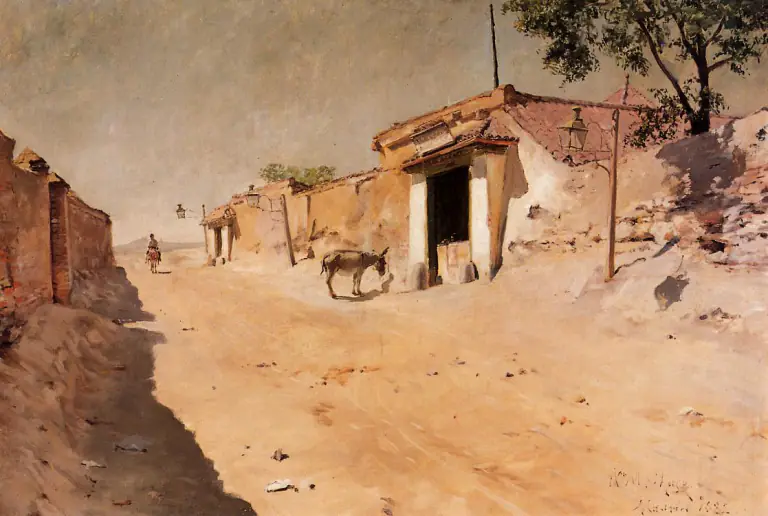
Spanish Village by William Merritt Chase shows a dusty street running between pale buildings. The road bends through the center, with a small cart or animal visible in the distance. Low stone walls and simple facades border the sandy path. Warm light falls across the ground and walls, while shadows gather along the building edges.
The village structures are irregular, with flat walls, doorways and rooflines set at different angles. The path widens in the foreground and narrows as it approaches the distant figure or cart.
Chase uses pale ochre, sand and brown to unify the scene. The open street gives the buildings and small distant movement room to read.
This ByMuseum reproduction is hand-painted in oil on canvas. The sandy street, simple village facades and distant cart define this view.
The street is light sand color and widens across the foreground before narrowing toward a small cart or animal in the distance. On either side, low buildings have uneven walls and simple doorways. A wooden gate or shadowed entrance interrupts one facade. The rooflines step down the street, creating depth. Warm sunlight reaches the upper walls and sandy ground, while cool shadows collect near the edges. Small scattered objects and rough stone surfaces add texture without filling the road. The scene is viewed from within the village, so the path leads the eye forward between the buildings. The palette remains earthy and muted.
The distant cart is small but distinct against the sunlit street, while shadows along the walls form long shapes on the ground. Doorways and roof edges vary from one building to the next, giving the village an irregular outline. The lane remains the main route through the composition.
Empty walls flatten a room. A classical artwork restores structure and visual hierarchy. One painting defines the space, anchors furniture, and establishes identity.
Worldwide shipping included. Each painting is produced to order and safely packed for international transport.
All payments are encrypted and processed through trusted payment providers.
Real brushwork, layered oil paint, and durable pigments on museum-quality canvas.
If the result does not meet expectations, return it for a full refund.


Your artwork is painted on premium cotton canvas, then shipped safely rolled in a rigid tube with extra blank canvas border — ready for stretching or framing locally.
Select a handcrafted frame and we’ll deliver your painting fully assembled, protected, and ready to hang.
For safe shipping, framing is available up to a maximum size. Larger sizes will automatically disable the frame option.


Choose “Stretched” to receive your canvas mounted on wooden stretcher bars — perfect if you’ll frame it later or display it as-is.
Gallery Wrap is a deeper, 1.5" style stretcher. The canvas wraps around the sides and is stapled on the back for a clean, modern, frameless look.
We ship with UPS, FedEx, or DHL straight to your door. You’ll receive a tracking number as soon as your order leaves our studio. Typical delivery is 5 to 7 days after dispatch; large, framed, or stretched pieces may take longer depending on the safest shipping route.


Unframed canvases are protected with a film, carefully rolled, and secured inside a rigid shipping tube.

Stretched, Gallery Wrapped, and Framed paintings are wrapped, cushioned with foam protection, and boxed for safe transit.

Man Writing a Letter
Gabriel Metsu, c. 1664
The gallery list
Every painting is already 50% off. Join the list and we will send you an extra $15 code, plus first access to new collections.
No spam. Unsubscribe anytime. · Privacy Policy
Welcome
Your $15 code is on its way. Explore the gallery while you wait.