Loading cart…
No products in the cart.

Original price was: $599.00.$299.00Current price is: $299.00.
Spuistraat Den Haag by Floris Arntzenius, a hand-painted oil reproduction that brings the grey light and quiet rhythm of The Hague to a canvas built for lasting display.
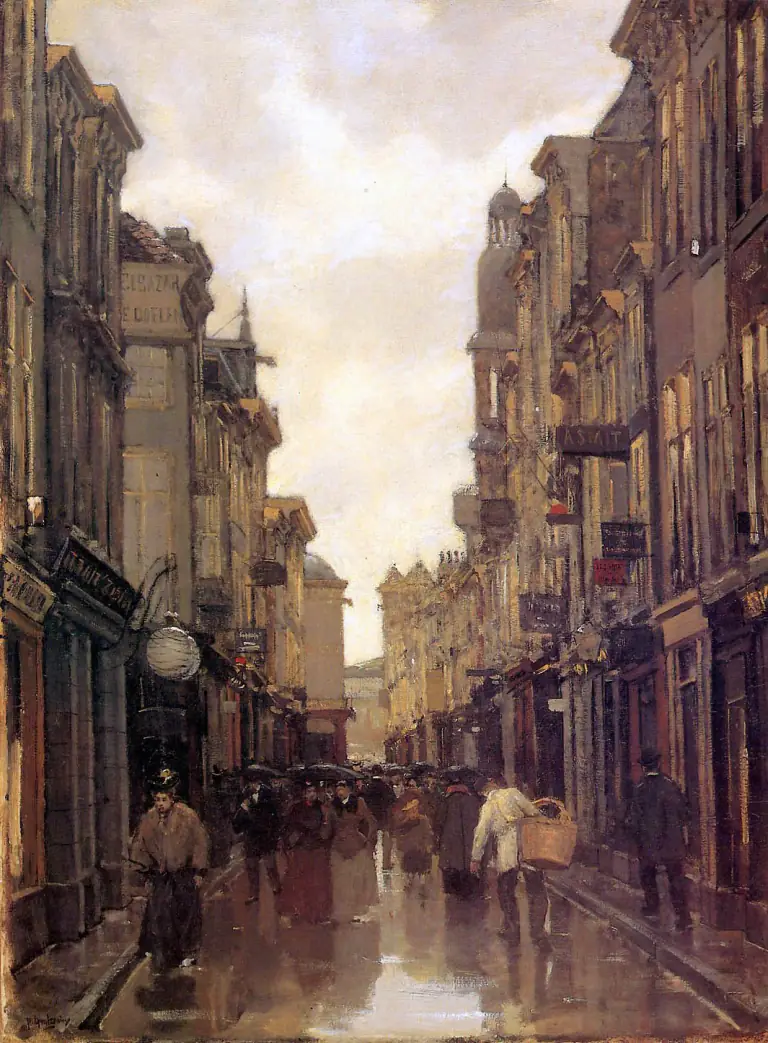
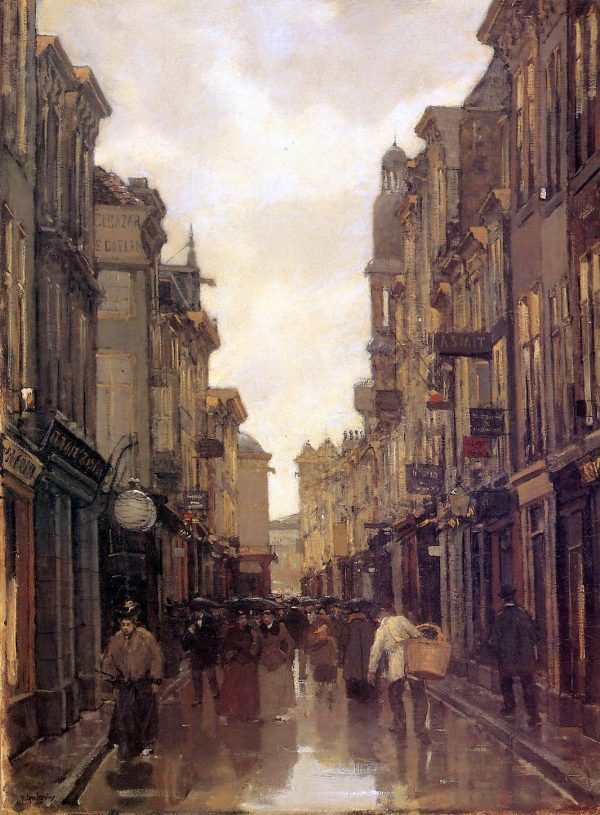
Figures move along the cobbles under a sky thick with Hague grey, and for a moment the street holds still, caught between one errand and the next. This is the world Floris Arntzenius returns to again and again: the ordinary theatre of a city passage, rendered with a painters attention to weather and light rather than incident.
Spuistraat Den Haag belongs to the tradition of urban painting that flourished among the Hague School artists, who found their subjects not in dramatic landscape but in the daily rhythm of streets, canals, and market squares. Arntzenius composes the scene in measured stages, leading the eye from the immediate foreground through a sequence of figures and architecture toward a softened distance. The buildings are suggested rather than described in detail, their edges dissolving into the damp atmosphere that this artist handled with particular sensitivity throughout his career.
The tonal range stays close and restrained, built from silvery greys, muted browns, and the occasional chromatic accent that gives a passing figure or a shopfront its weight. This coordination of decisive passages and quieter supporting areas gives the composition its depth without ever flattening the mood of the street. It is a working method typical of Dutch Impressionism at the close of the nineteenth century, when painters sought to capture transient light and atmosphere with a loaded brush rather than a careful line, and it has kept this particular street scene ranked among the more quietly admired examples of the genre, a famous painting within the circle of Hague School city views.
Each ByMuseum oil painting reproduction of this work is built by hand rather than printed, with a trained painter working in successive layers of oil colour on artist-grade canvas to match the original palette and preserve the surface texture that gives the scene its atmosphere. The brushwork is laid down stroke by stroke, so the raised impasto and the subtle variation across the canvas remain visible, the way they would in an original oil painting rather than a mechanically reproduced image. The result is a painted object with its own depth and presence, not a flat facsimile.
It suits a collector drawn to the quieter register of the Hague School, or a room that benefits from the grey light and slow motion of a nineteenth century street rather than a louder statement piece.
Empty walls flatten a room. A classical artwork restores structure and visual hierarchy. One painting defines the space, anchors furniture, and establishes identity.
Worldwide shipping included. Each painting is produced to order and safely packed for international transport.
All payments are encrypted and processed through trusted payment providers.
Real brushwork, layered oil paint, and durable pigments on museum-quality canvas.
If the result does not meet expectations, return it for a full refund.


Your artwork is painted on premium cotton canvas, then shipped safely rolled in a rigid tube with extra blank canvas border — ready for stretching or framing locally.
Select a handcrafted frame and we’ll deliver your painting fully assembled, protected, and ready to hang.
For safe shipping, framing is available up to a maximum size. Larger sizes will automatically disable the frame option.


Choose “Stretched” to receive your canvas mounted on wooden stretcher bars — perfect if you’ll frame it later or display it as-is.
Gallery Wrap is a deeper, 1.5" style stretcher. The canvas wraps around the sides and is stapled on the back for a clean, modern, frameless look.
We ship with UPS, FedEx, or DHL straight to your door. You’ll receive a tracking number as soon as your order leaves our studio. Typical delivery is 5 to 7 days after dispatch; large, framed, or stretched pieces may take longer depending on the safest shipping route.


Unframed canvases are protected with a film, carefully rolled, and secured inside a rigid shipping tube.

Stretched, Gallery Wrapped, and Framed paintings are wrapped, cushioned with foam protection, and boxed for safe transit.

Man Writing a Letter
Gabriel Metsu, c. 1664
The gallery list
Every painting is already 50% off. Join the list and we will send you an extra $15 code, plus first access to new collections.
No spam. Unsubscribe anytime. · Privacy Policy
Welcome
Your $15 code is on its way. Explore the gallery while you wait.


