Loading cart…
No products in the cart.

Original price was: $599.00.$299.00Current price is: $299.00.
Deep shadow meets warm flesh tones in this Bassetti scene of martyrdom and mercy, St Sebastian Tended by St Irene, now available as a hand-painted oil reproduction.
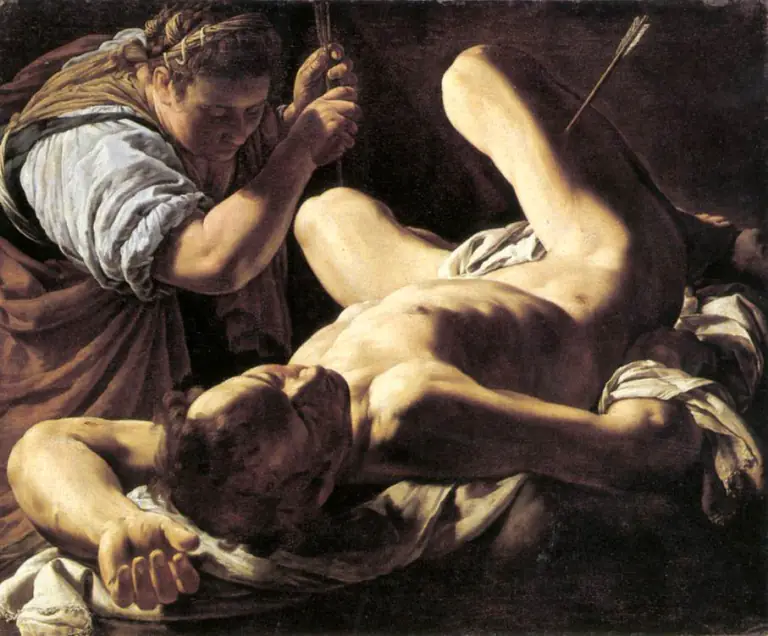
Deep umbers and near-black shadow press against passages of warm ivory flesh, the two extremes meeting along the wounded body of Sebastian with almost no transition between them. A muted olive and rust surround the figures, quiet enough to let the eye travel straight to the pale torso and the concerned faces bent over it, while small notes of warm ochre in the drapery keep the darkness from turning flat. The colour does the emotional work here, closing in around the martyr like a room with the light nearly gone.
The composition gathers Irene and her companions in a tight cluster around the injured saint, their attention and their hands directed inward, so that the viewer is drawn into an act of tending rather than a spectacle of suffering. Bassetti arranges the figures with a sculptural weight, bodies overlapping and turning in shallow space, and lets a single unseen source of light fall across Sebastian, carving his form out of the surrounding dark. The effect owes an evident debt to Caravaggio, filtered through a Veronese sensibility for touch and gesture that softens the violence of the subject into something closer to grief and care.
This is a painting from a moment when northern Italian artists were absorbing the new Roman naturalism and testing how far it could carry devotional feeling, and the result sits between drama and tenderness rather than settling into either. The brushwork in the flesh passages is notably controlled, built up in thin, blended layers that let the underlying warmth show through the shadow, while the drapery and background are handled more loosely, with visible, confident strokes. That contrast between finish and looseness is part of what gives the picture its charge, and it is exactly the kind of surface detail a discerning eye looks for when judging whether a later hand has flattened or smoothed away the original touch.
ByMuseum recreates this balance through a hand-painted oil painting reproduction, worked by a trained painter in artist-grade oil on canvas rather than printed by machine. The palette is matched pigment by pigment against the muted tones and warm highlights described above, and the brush is allowed to build the same layered depth in the flesh and the same freer touch in the surrounding dark, so the canvas holds real impasto and a surface that shifts under changing light. Buyers who want a museum quality reproduction rather than a flat facsimile will find that texture is where the difference actually lives, not in the image alone. Four centuries on, the picture still holds attention because its tenderness has not dated, and a version painted by hand, rather than printed, is the way to keep that quality of care on a wall rather than behind glass.
Empty walls flatten a room. A classical artwork restores structure and visual hierarchy. One painting defines the space, anchors furniture, and establishes identity.
Worldwide shipping included. Each painting is produced to order and safely packed for international transport.
All payments are encrypted and processed through trusted payment providers.
Real brushwork, layered oil paint, and durable pigments on museum-quality canvas.
If the result does not meet expectations, return it for a full refund.


Your artwork is painted on premium cotton canvas, then shipped safely rolled in a rigid tube with extra blank canvas border — ready for stretching or framing locally.
Select a handcrafted frame and we’ll deliver your painting fully assembled, protected, and ready to hang.
For safe shipping, framing is available up to a maximum size. Larger sizes will automatically disable the frame option.


Choose “Stretched” to receive your canvas mounted on wooden stretcher bars — perfect if you’ll frame it later or display it as-is.
Gallery Wrap is a deeper, 1.5" style stretcher. The canvas wraps around the sides and is stapled on the back for a clean, modern, frameless look.
We ship with UPS, FedEx, or DHL straight to your door. You’ll receive a tracking number as soon as your order leaves our studio. Typical delivery is 5 to 7 days after dispatch; large, framed, or stretched pieces may take longer depending on the safest shipping route.


Unframed canvases are protected with a film, carefully rolled, and secured inside a rigid shipping tube.

Stretched, Gallery Wrapped, and Framed paintings are wrapped, cushioned with foam protection, and boxed for safe transit.

Man Writing a Letter
Gabriel Metsu, c. 1664
The gallery list
Every painting is already 50% off. Join the list and we will send you an extra $15 code, plus first access to new collections.
No spam. Unsubscribe anytime. · Privacy Policy
Welcome
Your $15 code is on its way. Explore the gallery while you wait.