Loading cart…
No products in the cart.

Original price was: $599.00.$299.00Current price is: $299.00.
A hunter crouches low in tall grass, closing on his prey: Stalking Buffalo, Arkansas by Catlin, recreated as a hand-painted oil reproduction faithful to its muted palette and quiet tension.
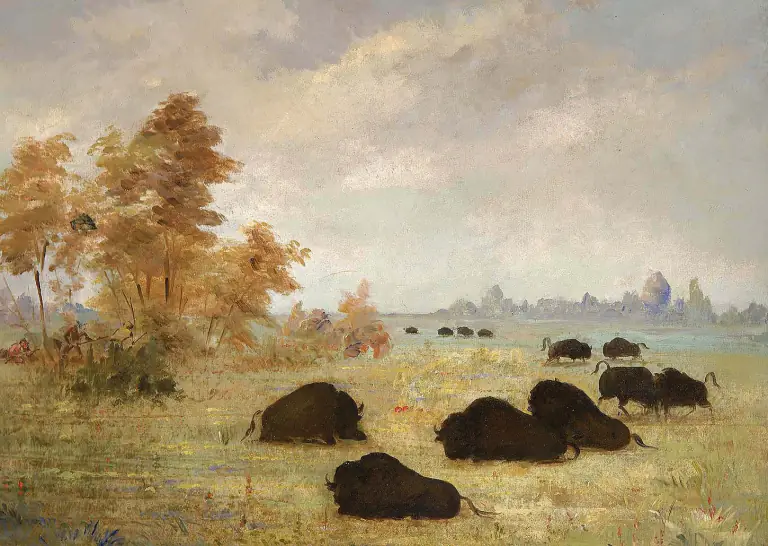
A lone hunter crouches low against the tall grass, his body angled into the wind so the buffalo ahead cannot catch his scent. That single crouching posture, half hidden, wholly intent, sets the tone for the whole scene and gives the painting its quiet tension.
George Catlin built his career on scenes like this one, painted during his travels through the American West in the 1830s, when he set out to record the lives and customs of Plains peoples before those ways of life changed beyond recognition. Stalking Buffalo, Arkansas belongs to that documentary project, though it never reads as mere record. The composition opens onto a wide plain, the horizon set low so the sky carries much of the visual weight, and the hunter and his quarry occupy a narrow band of activity within an otherwise still landscape. Catlin handles the light with a flattened, even clarity, avoiding dramatic shadow in favour of a steady daylight that lets every figure and contour remain legible, a choice suited to his purpose as an observer rather than an inventor of drama.
Colour in the picture stays close to the tones of the terrain itself, ochres and dust greens and the pale brown of hide, so that the figures seem to grow out of the ground they cross rather than being placed upon it. This restraint is characteristic of the artist at this stage of his working life, when direct observation mattered more to him than painterly flourish, and it is one reason the picture still functions today as both a famous artwork of the American frontier and a document of a particular hunting method. The broad passages of open plain and the close, careful detail of the hunter crouched in the grass work together, giving the eye somewhere to rest and somewhere to linger.
Producing a faithful oil painting reproduction of this work means matching that same restraint by hand. A trained painter builds the composition in successive layers of oil colour on artist-grade cotton canvas, holding to the low horizon, the muted palette of grass and hide, and the particular tilt of the hunter figure that carries the narrative of the scene. Brushwork stays visible across the surface, and small variations from one canvas to the next are part of working in oil rather than a departure from the original.
Empty walls flatten a room. A classical artwork restores structure and visual hierarchy. One painting defines the space, anchors furniture, and establishes identity.
Worldwide shipping included. Each painting is produced to order and safely packed for international transport.
All payments are encrypted and processed through trusted payment providers.
Real brushwork, layered oil paint, and durable pigments on museum-quality canvas.
If the result does not meet expectations, return it for a full refund.


Your artwork is painted on premium cotton canvas, then shipped safely rolled in a rigid tube with extra blank canvas border — ready for stretching or framing locally.
Select a handcrafted frame and we’ll deliver your painting fully assembled, protected, and ready to hang.
For safe shipping, framing is available up to a maximum size. Larger sizes will automatically disable the frame option.


Choose “Stretched” to receive your canvas mounted on wooden stretcher bars — perfect if you’ll frame it later or display it as-is.
Gallery Wrap is a deeper, 1.5" style stretcher. The canvas wraps around the sides and is stapled on the back for a clean, modern, frameless look.
We ship with UPS, FedEx, or DHL straight to your door. You’ll receive a tracking number as soon as your order leaves our studio. Typical delivery is 5 to 7 days after dispatch; large, framed, or stretched pieces may take longer depending on the safest shipping route.


Unframed canvases are protected with a film, carefully rolled, and secured inside a rigid shipping tube.

Stretched, Gallery Wrapped, and Framed paintings are wrapped, cushioned with foam protection, and boxed for safe transit.

Man Writing a Letter
Gabriel Metsu, c. 1664
The gallery list
Every painting is already 50% off. Join the list and we will send you an extra $15 code, plus first access to new collections.
No spam. Unsubscribe anytime. · Privacy Policy
Welcome
Your $15 code is on its way. Explore the gallery while you wait.