Loading cart…
No products in the cart.

Original price was: $599.00.$299.00Current price is: $299.00.
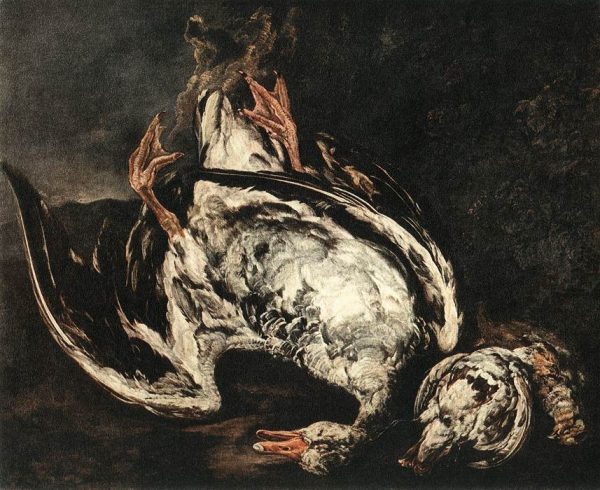
Still-Life with Dead Wild-Duck by Pieter Boel, recreated as a museum quality hand-painted oil reproduction with the close-toned palette and worked surface of the original still life.

A canvas of generous scale sets the terms for this picture before the subject even registers. The dead wild duck hangs at close to life size, so a viewer stands near it rather than looking across a room at it, and the horizontal format asks for a slow pass from left to right rather than one glance from a distance. That closeness is the point: this is a picture built to be examined at arm-length, the way a hunter or a collector would have handled the animal itself.
Pieter Boel gives the duck weight and stillness through a careful arrangement of dark plumage against a plainer ground, letting a narrow run of light fall along the feathers to separate one form from the shadow behind it. The palette stays close to earth tones, brown, grey, dull ochre, with the white of an underbelly or a scrap of cloth used sparingly to hold the eye. This is the kind of subject Flemish and Dutch painters returned to across the seventeenth century, game and hunting trophies rendered with a naturalist eye, and Boel worked in that tradition alongside his better known contemporaries, contributing still lifes and animal studies that valued close observation over anecdote.
The handling rewards a near view as much as the subject does. Brushwork thickens where the light catches a wing or a beak and thins to almost nothing in the darker passages, a technique common to still-life painting of the period, where restraint in one area makes the worked passages read as more solid. Boel was painting during a stretch of his career when animal and game subjects were in demand from patrons who wanted evidence of the hunt rendered with the same seriousness given to portraiture, and this picture belongs to that current of work.
Recreating it as a museum quality hand-painted oil painting reproduction means a trained painter works from the original palette and rebuilds the picture layer by layer on canvas, matching the warmth of the browns and the cooler greys of the feathers rather than approximating them. The painter follows the same logic of thick paint and thin paint that Boel used, so the surface of the reproduction holds real texture where the original does, and the finished canvas reads as a painted object rather than a flat copy.
Empty walls flatten a room. A classical artwork restores structure and visual hierarchy. One painting defines the space, anchors furniture, and establishes identity.
Worldwide shipping included. Each painting is produced to order and safely packed for international transport.
All payments are encrypted and processed through trusted payment providers.
Real brushwork, layered oil paint, and durable pigments on museum-quality canvas.
If the result does not meet expectations, return it for a full refund.


Your artwork is painted on premium cotton canvas, then shipped safely rolled in a rigid tube with extra blank canvas border — ready for stretching or framing locally.
Select a handcrafted frame and we’ll deliver your painting fully assembled, protected, and ready to hang.
For safe shipping, framing is available up to a maximum size. Larger sizes will automatically disable the frame option.


Choose “Stretched” to receive your canvas mounted on wooden stretcher bars — perfect if you’ll frame it later or display it as-is.
Gallery Wrap is a deeper, 1.5" style stretcher. The canvas wraps around the sides and is stapled on the back for a clean, modern, frameless look.
We ship with UPS, FedEx, or DHL straight to your door. You’ll receive a tracking number as soon as your order leaves our studio. Typical delivery is 5 to 7 days after dispatch; large, framed, or stretched pieces may take longer depending on the safest shipping route.


Unframed canvases are protected with a film, carefully rolled, and secured inside a rigid shipping tube.

Stretched, Gallery Wrapped, and Framed paintings are wrapped, cushioned with foam protection, and boxed for safe transit.

Man Writing a Letter
Gabriel Metsu, c. 1664
The gallery list
Every painting is already 50% off. Join the list and we will send you an extra $15 code, plus first access to new collections.
No spam. Unsubscribe anytime. · Privacy Policy
Welcome
Your $15 code is on its way. Explore the gallery while you wait.