Loading cart…
No products in the cart.

Original price was: $599.00.$299.00Current price is: $299.00.
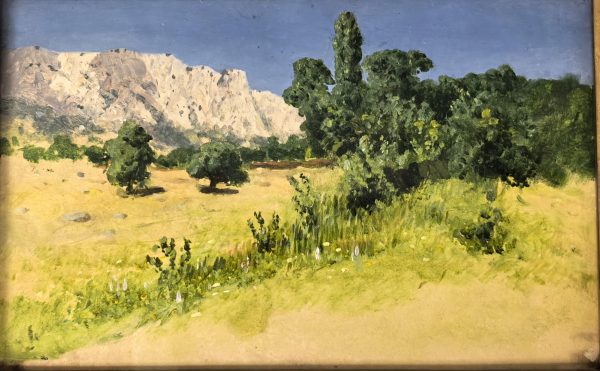
A quieter side of Arhip Kuindzhi: this hand-painted oil reproduction recreates the layered sunset gradient of the steppe and sea in real pigment and visible brushwork.

You may already know Arhip Kuindzhi for his moonlit nights over the Dnieper, the canvases that made him famous for a light so uncanny that viewers once suspected trickery. Sunset in the steppes to the sea belongs to a quieter register of his work, painted in the later, more reclusive years he spent experimenting privately rather than exhibiting. Where the Dnieper pictures startle, this one settles; it asks you to stay with a single, expansive horizon rather than a dramatic effect.
The composition is built almost entirely from the meeting of land and sky, the steppe running flat toward a distant sea under a band of colour that Kuindzhi clearly worked and reworked to get right. Warm oranges and rose tones dissolve gradually into cooler blues at the upper register, and the transition carries the whole picture; there is little incident on the ground to distract from it. This is the kind of subject Kuindzhi returned to again and again in private study, testing how far a limited palette could be pushed to hold a viewer through tonal relationship alone rather than narrative or detail.
What holds the eye, once you look closely, is the restraint. The horizon line is placed with real deliberation, low enough to give the sky its full weight, and the brushwork in the sky is looser and more atmospheric than in the band of steppe below, which stays comparatively still and grounded. It is a painting about light changing over emptiness, made by an artist who spent a whole career studying exactly that problem, and this canvas shows him working it out on his own terms, away from public exhibition, purely for the sake of getting the colour right.
When our painter takes on a piece like this, the sunset gradient is the part that demands the most patience: the shift from warm to cool has to be built up in layers, the way Kuindzhi built it, rather than blended flat in a single pass. We match the palette against the original as closely as oil pigment allows, and the canvas is worked by hand so the surface keeps real variation, thicker in places, thinner in others, the way an oil on canvas reproduction should read up close and not just from across a room. It is a painted object, made by a trained hand, not a printed copy of one.
Empty walls flatten a room. A classical artwork restores structure and visual hierarchy. One painting defines the space, anchors furniture, and establishes identity.
Worldwide shipping included. Each painting is produced to order and safely packed for international transport.
All payments are encrypted and processed through trusted payment providers.
Real brushwork, layered oil paint, and durable pigments on museum-quality canvas.
If the result does not meet expectations, return it for a full refund.


Your artwork is painted on premium cotton canvas, then shipped safely rolled in a rigid tube with extra blank canvas border — ready for stretching or framing locally.
Select a handcrafted frame and we’ll deliver your painting fully assembled, protected, and ready to hang.
For safe shipping, framing is available up to a maximum size. Larger sizes will automatically disable the frame option.


Choose “Stretched” to receive your canvas mounted on wooden stretcher bars — perfect if you’ll frame it later or display it as-is.
Gallery Wrap is a deeper, 1.5" style stretcher. The canvas wraps around the sides and is stapled on the back for a clean, modern, frameless look.
We ship with UPS, FedEx, or DHL straight to your door. You’ll receive a tracking number as soon as your order leaves our studio. Typical delivery is 5 to 7 days after dispatch; large, framed, or stretched pieces may take longer depending on the safest shipping route.


Unframed canvases are protected with a film, carefully rolled, and secured inside a rigid shipping tube.

Stretched, Gallery Wrapped, and Framed paintings are wrapped, cushioned with foam protection, and boxed for safe transit.

Man Writing a Letter
Gabriel Metsu, c. 1664
The gallery list
Every painting is already 50% off. Join the list and we will send you an extra $15 code, plus first access to new collections.
No spam. Unsubscribe anytime. · Privacy Policy
Welcome
Your $15 code is on its way. Explore the gallery while you wait.