Loading cart…
No products in the cart.

Original price was: $599.00.$299.00Current price is: $299.00.
A quiet, ochre-toned field portrait by George Catlin, reproduced as a hand-painted oil on canvas that keeps the plain, direct light of the original sitting.
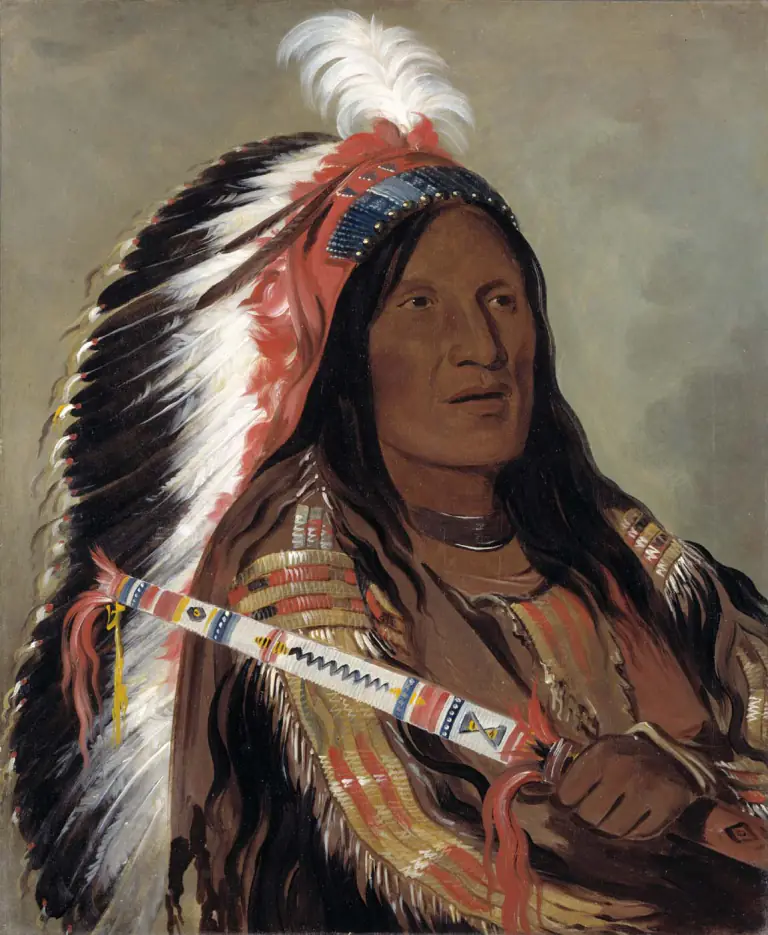
Ochre skin tones sit against a ground of muted browns and greyed greens, with small passages of red pigment marking ornament and paint at the temple and ear. The colour does not compete with itself; it settles into quiet zones, warm flesh against a cool, undemonstrative background, so that the eye rests on the sitter without distraction. There is a plainness to the palette that reads as respect rather than reticence, and it is exactly this restraint that makes the painting worth having close at hand.
Tah teck a da hair, Steep Wind, was recorded by George Catlin during his travels among the Plains peoples in the 1830s, a period when he worked at speed to set down likenesses before circumstance or distance made a second sitting impossible. The composition is direct: a half-length figure, the Bad Arrow Points brave identified by name and title, set against a shallow, unparticularized ground that keeps every degree of attention on the man himself. Catlin was not a portraitist trained in the academies of Europe, and his brushwork carries the evidence, plain and economical, more concerned with likeness and record than with polish.
What the painting loses in painterly refinement it gains in candour. The face is built from a small number of tonal steps rather than a fine gradation of colour, and the effect is a kind of directness that later, more finished ethnographic portraits often smooth away. Light falls evenly, without the theatrical shadow that a studio painter might have introduced, and this even light is part of the documentary intention behind the whole series Catlin undertook. The picture belongs to a body of work made in the field, among its subjects, and that circumstance shapes its every visible decision.
The ByMuseum reproduction is built to carry that same restraint into a painted surface rather than a printed one. A trained painter works in oil on artist-grade canvas, matching the ochre and umber ground stroke by stroke and letting the brush build the same shallow relief that Catlin himself relied on, so that the finished object reads as an oil painting reproduction and not a flattened copy. Handled this way, as an oil on canvas reproduction rather than a scan or a print, the surface keeps a genuine tactility: light catches the ridges of applied paint exactly as it would on the original, and the palette is judged by eye against the source rather than reproduced by mechanical colour matching.
Empty walls flatten a room. A classical artwork restores structure and visual hierarchy. One painting defines the space, anchors furniture, and establishes identity.
Worldwide shipping included. Each painting is produced to order and safely packed for international transport.
All payments are encrypted and processed through trusted payment providers.
Real brushwork, layered oil paint, and durable pigments on museum-quality canvas.
If the result does not meet expectations, return it for a full refund.


Your artwork is painted on premium cotton canvas, then shipped safely rolled in a rigid tube with extra blank canvas border — ready for stretching or framing locally.
Select a handcrafted frame and we’ll deliver your painting fully assembled, protected, and ready to hang.
For safe shipping, framing is available up to a maximum size. Larger sizes will automatically disable the frame option.


Choose “Stretched” to receive your canvas mounted on wooden stretcher bars — perfect if you’ll frame it later or display it as-is.
Gallery Wrap is a deeper, 1.5" style stretcher. The canvas wraps around the sides and is stapled on the back for a clean, modern, frameless look.
We ship with UPS, FedEx, or DHL straight to your door. You’ll receive a tracking number as soon as your order leaves our studio. Typical delivery is 5 to 7 days after dispatch; large, framed, or stretched pieces may take longer depending on the safest shipping route.


Unframed canvases are protected with a film, carefully rolled, and secured inside a rigid shipping tube.

Stretched, Gallery Wrapped, and Framed paintings are wrapped, cushioned with foam protection, and boxed for safe transit.

Man Writing a Letter
Gabriel Metsu, c. 1664
The gallery list
Every painting is already 50% off. Join the list and we will send you an extra $15 code, plus first access to new collections.
No spam. Unsubscribe anytime. · Privacy Policy
Welcome
Your $15 code is on its way. Explore the gallery while you wait.