Loading cart…
No products in the cart.

Original price was: $599.00.$299.00Current price is: $299.00.
A corpse rendered without mercy in a narrow stone tomb: this hand-painted reproduction of the Dead Christ by Hans Holbein the Younger brings one of the starkest images in Northern Renaissance art to canvas.

Northern Renaissance painting rarely turned its attention to the body with this degree of clinical nerve, and few works went as far as this one in refusing any trace of the divine. Hans Holbein the Younger, working in Basel in the early 1520s, set aside the resurrection and the grieving mourners that usually frame this subject and painted instead a single fact: a corpse, stretched out and beginning to decay.
The panel is unusually shaped, a mere 30.5 centimetres high against a width of roughly two metres, so that the eye is pinned to one narrow band running the full length of a shallow stone tomb. Christ lies supine on a white burial cloth, life-size, his head turned toward the viewer at the right edge, mouth parted, eyes half open and fixed on nothing. The wounds at the hands, feet, and side carry the grey-green tinge of early decomposition, rendered without flinching. An inscription along the top, IESVS NAZARENVS REX IVDAEORVM, is the only concession to narrative; everything else is surface, cloth, bone, and discoloured flesh held in a palette of browns, greys, and bloodless skin tones against the black of the tomb interior. The work is said to have unsettled Dostoevsky so badly when he saw it in Basel that it shook his faith, and the record of mortality on the panel still carries that force.
This hand-painted oil painting reproduction is built directly from that composition, not copied by machine but worked by hand, brush by brush, by a professional artist trained to match tone against tone until the muted register of the original reappears on canvas. The elongated format is kept intact, as is the modelling of the flesh, the shift from pale skin to the darker shadow of the tomb, and the slow buildup of grey and green at the wound edges that gives the body its sense of decay. Oil is laid onto artist-grade cotton canvas in the same sequence a painter would use on panel, so the surface carries real texture rather than a flat printed image, a handmade oil painting rather than a facsimile.
What is carried across is not only the drawing but the restraint: no added colour, no softened wounds, no gesture toward glory that Holbein himself withheld. The reproduction aims to hold that same austerity, so the version on the wall reads with the same discomfort as the panel in Basel.
| artists |
|---|
Empty walls flatten a room. A classical artwork restores structure and visual hierarchy. One painting defines the space, anchors furniture, and establishes identity.
Worldwide shipping included. Each painting is produced to order and safely packed for international transport.
All payments are encrypted and processed through trusted payment providers.
Real brushwork, layered oil paint, and durable pigments on museum-quality canvas.
If the result does not meet expectations, return it for a full refund.


Your artwork is painted on premium cotton canvas, then shipped safely rolled in a rigid tube with extra blank canvas border — ready for stretching or framing locally.
Select a handcrafted frame and we’ll deliver your painting fully assembled, protected, and ready to hang.
For safe shipping, framing is available up to a maximum size. Larger sizes will automatically disable the frame option.


Choose “Stretched” to receive your canvas mounted on wooden stretcher bars — perfect if you’ll frame it later or display it as-is.
Gallery Wrap is a deeper, 1.5" style stretcher. The canvas wraps around the sides and is stapled on the back for a clean, modern, frameless look.
We ship with UPS, FedEx, or DHL straight to your door. You’ll receive a tracking number as soon as your order leaves our studio. Typical delivery is 5 to 7 days after dispatch; large, framed, or stretched pieces may take longer depending on the safest shipping route.


Unframed canvases are protected with a film, carefully rolled, and secured inside a rigid shipping tube.

Stretched, Gallery Wrapped, and Framed paintings are wrapped, cushioned with foam protection, and boxed for safe transit.

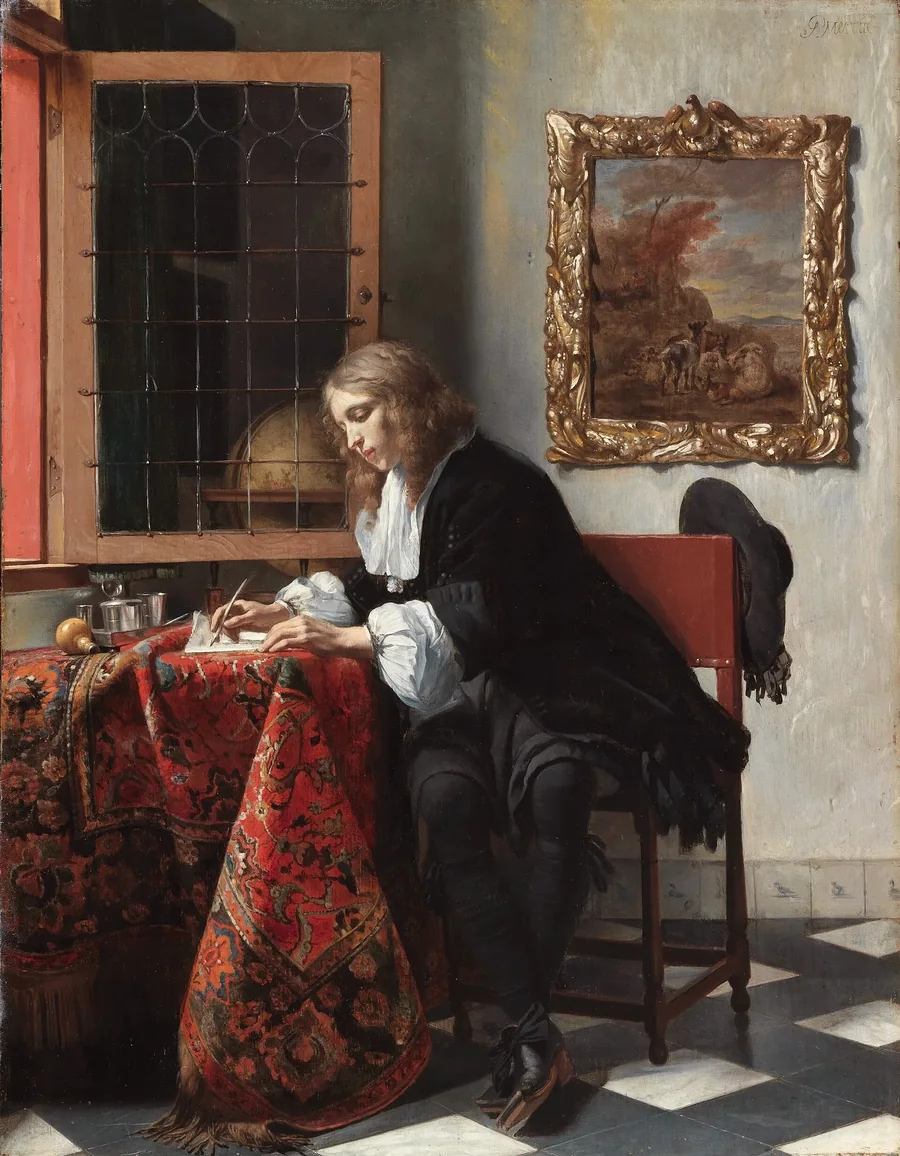
Man Writing a Letter
Gabriel Metsu, c. 1664
The gallery list
Every painting is already 50% off. Join the list and we will send you an extra $15 code, plus first access to new collections.
No spam. Unsubscribe anytime. · Privacy Policy
Welcome
Your $15 code is on its way. Explore the gallery while you wait.