Loading cart…
No products in the cart.

Original price was: $599.00.$299.00Current price is: $299.00.
A hand-painted replica of The Campo Vaccino with a Gypsy Woman Reading a Palm by Paul Bril, painted in oil on canvas with the layered light and texture of the original Roman ruin scene.
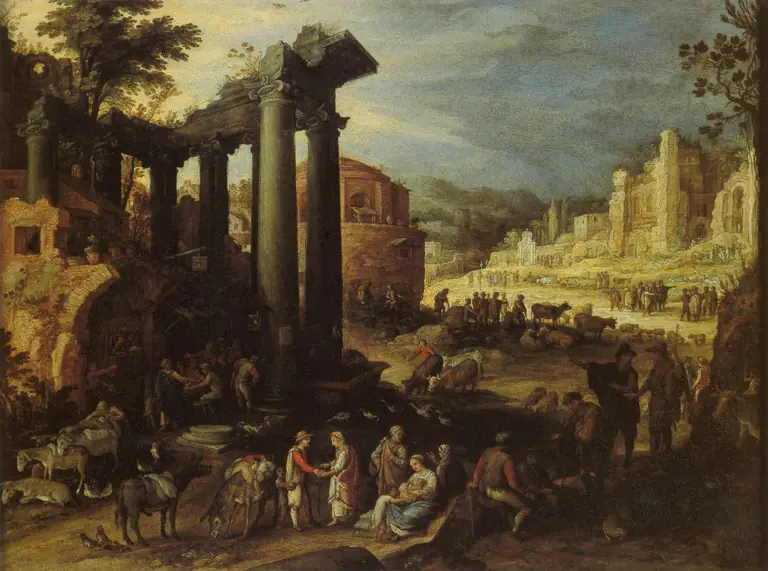
Thin layers of oil build the light in this picture before any figure or ruin comes into focus. Paul Bril worked the sky in soft, close tones, then let the architecture rise out of that ground in warmer, drier strokes, so the eye settles on the fallen columns and grazing cattle only after the atmosphere has done its work. Edges soften where distance calls for it and sharpen where the eye needs an anchor, a technique typical of the northern painters who settled in Rome and learned to paint heat and haze together.
The subject is the Campo Vaccino, the cattle market that the Roman Forum had become by the time Bril painted it, with ancient stone repurposed as pasture and the gypsy woman reading a palm set among herders and grazing animals as a small human drama within a larger ruin. Bril arranges the composition in loose bands, foreground figures and animals, a middle ground of broken columns and worn masonry, then a pale rise of sky that carries most of the light. The palette stays close throughout, ochres, warm greys, and muted greens, so that colour never competes with the slow recession of space.
This picture belongs to the mature phase of the career of Bril, when his Roman ruin scenes had settled into a fluent, unhurried manner, less concerned with topographical exactness than with the mood of a landscape carrying its own history. The gypsy woman, a stock figure in genre painting of the period, gives the scene a note of chance and fortune-telling against the fixed backdrop of a fallen empire, a contrast that would have appealed to collectors reading ruins as meditations on time.
ByMuseum artists reproduce this composition as a hand-painted oil painting reproduction, working in oil on canvas rather than print, matching the palette of Bril stroke by stroke and preserving the texture of the original brushwork. Each order becomes a replica painting built by hand, with visible layering and the raised surface of real paint, not a flat facsimile. The aim is a canvas that holds up to close viewing the way the original does, with the same shifts of tone and the same quiet architecture of light.
Four centuries on, the picture still rewards a long look, the ruins settled into ordinary use, the light doing more than the story. Owning a painted version means living with that same slow attention rather than a printed copy of it.
Empty walls flatten a room. A classical artwork restores structure and visual hierarchy. One painting defines the space, anchors furniture, and establishes identity.
Worldwide shipping included. Each painting is produced to order and safely packed for international transport.
All payments are encrypted and processed through trusted payment providers.
Real brushwork, layered oil paint, and durable pigments on museum-quality canvas.
If the result does not meet expectations, return it for a full refund.


Your artwork is painted on premium cotton canvas, then shipped safely rolled in a rigid tube with extra blank canvas border — ready for stretching or framing locally.
Select a handcrafted frame and we’ll deliver your painting fully assembled, protected, and ready to hang.
For safe shipping, framing is available up to a maximum size. Larger sizes will automatically disable the frame option.


Choose “Stretched” to receive your canvas mounted on wooden stretcher bars — perfect if you’ll frame it later or display it as-is.
Gallery Wrap is a deeper, 1.5" style stretcher. The canvas wraps around the sides and is stapled on the back for a clean, modern, frameless look.
We ship with UPS, FedEx, or DHL straight to your door. You’ll receive a tracking number as soon as your order leaves our studio. Typical delivery is 5 to 7 days after dispatch; large, framed, or stretched pieces may take longer depending on the safest shipping route.


Unframed canvases are protected with a film, carefully rolled, and secured inside a rigid shipping tube.

Stretched, Gallery Wrapped, and Framed paintings are wrapped, cushioned with foam protection, and boxed for safe transit.

Man Writing a Letter
Gabriel Metsu, c. 1664
The gallery list
Every painting is already 50% off. Join the list and we will send you an extra $15 code, plus first access to new collections.
No spam. Unsubscribe anytime. · Privacy Policy
Welcome
Your $15 code is on its way. Explore the gallery while you wait.