Loading cart…
No products in the cart.

Original price was: $518.00.$259.00Current price is: $259.00.
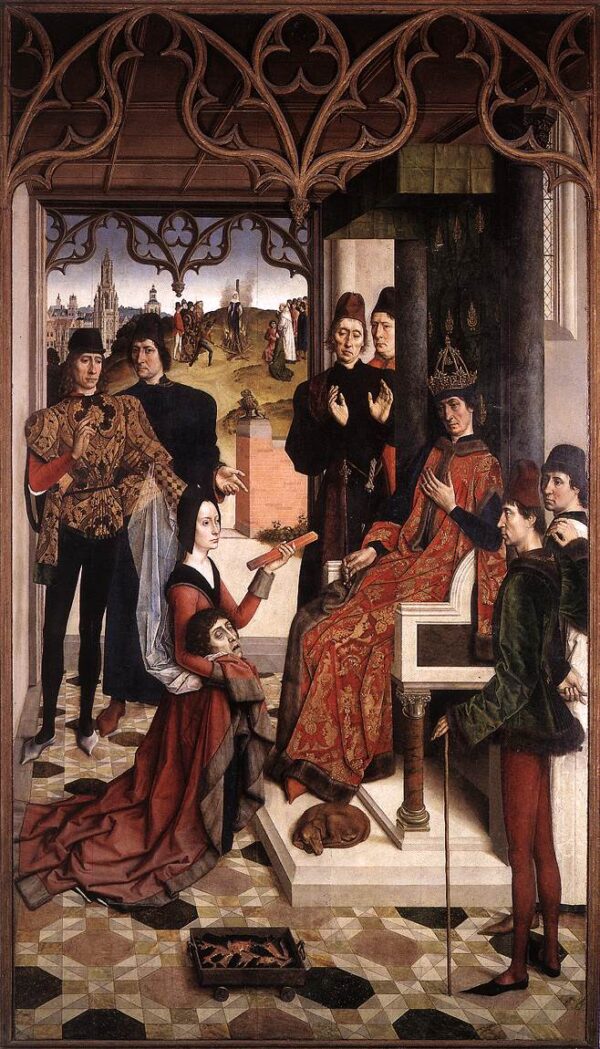
A hand-painted oil reproduction of The Capture of Christ by Dirk Bouts, prized for its torchlit palette and the quiet tension of its composition.

A single hand grips a lantern in the dark, its small flame the only warmth in a scene otherwise given over to torchlight, armour, and the pale stillness of a face that has already accepted what is coming. That flicker of illumination is where the eye lands first, and it is worth pausing there before taking in the rest of the panel, because it tells you everything about how carefully this night was constructed.
The Capture of Christ, painted by Dirk Bouts in the fifteenth century, belongs to the period when Netherlandish painters were working out how to make sacred narrative feel physically present rather than symbolically remote. The composition is tightly staged: figures press close around the central exchange, their gestures overlapping in a way that creates real spatial pressure rather than simple decoration. Bouts arranges the crowd in measured intervals, so that the eye moves from one lit face to the next, then back to the quiet centre of the arrest itself. Nothing is wasted; every fold of drapery and every angle of a raised arm contributes to the sense that this moment is closing in on its subject.
What distinguishes the panel is its handling of light against a deep, almost nocturnal palette. Bouts builds the scene from close tonal relationships rather than sharp contrast, letting torch glow and skin tone emerge from surrounding shadow with a restraint that feels closer to observation than to convention. This coordination of decisive focal passages and quieter supporting areas gives the picture its depth, and it places the work firmly within the northern tradition of exacting, contemplative religious painting that Bouts helped define.
Recreating that effect in a hand-painted oil painting reproduction means working slowly through the same layers Bouts himself relied on: thin glazes built up until the shadows hold real depth, and the lit passages left with just enough surface variation to catch the light as oil, not as print. A trained painter matches the palette panel by panel, preserving the brushwork and the quiet asymmetries that make the original feel handmade rather than mechanical, so the result reads as a museum quality reproduction rather than a flattened copy. The canvas keeps its texture under raised paint, and that texture is really the point: it is what a printed reproduction cannot offer.
Empty walls flatten a room. A classical artwork restores structure and visual hierarchy. One painting defines the space, anchors furniture, and establishes identity.
Worldwide shipping included. Each painting is produced to order and safely packed for international transport.
All payments are encrypted and processed through trusted payment providers.
Real brushwork, layered oil paint, and durable pigments on museum-quality canvas.
If the result does not meet expectations, return it for a full refund.


Your artwork is painted on premium cotton canvas, then shipped safely rolled in a rigid tube with extra blank canvas border — ready for stretching or framing locally.
Select a handcrafted frame and we’ll deliver your painting fully assembled, protected, and ready to hang.
For safe shipping, framing is available up to a maximum size. Larger sizes will automatically disable the frame option.


Choose “Stretched” to receive your canvas mounted on wooden stretcher bars — perfect if you’ll frame it later or display it as-is.
Gallery Wrap is a deeper, 1.5" style stretcher. The canvas wraps around the sides and is stapled on the back for a clean, modern, frameless look.
We ship with UPS, FedEx, or DHL straight to your door. You’ll receive a tracking number as soon as your order leaves our studio. Typical delivery is 5 to 7 days after dispatch; large, framed, or stretched pieces may take longer depending on the safest shipping route.


Unframed canvases are protected with a film, carefully rolled, and secured inside a rigid shipping tube.

Stretched, Gallery Wrapped, and Framed paintings are wrapped, cushioned with foam protection, and boxed for safe transit.