Loading cart…
No products in the cart.

Original price was: $599.00.$299.00Current price is: $299.00.
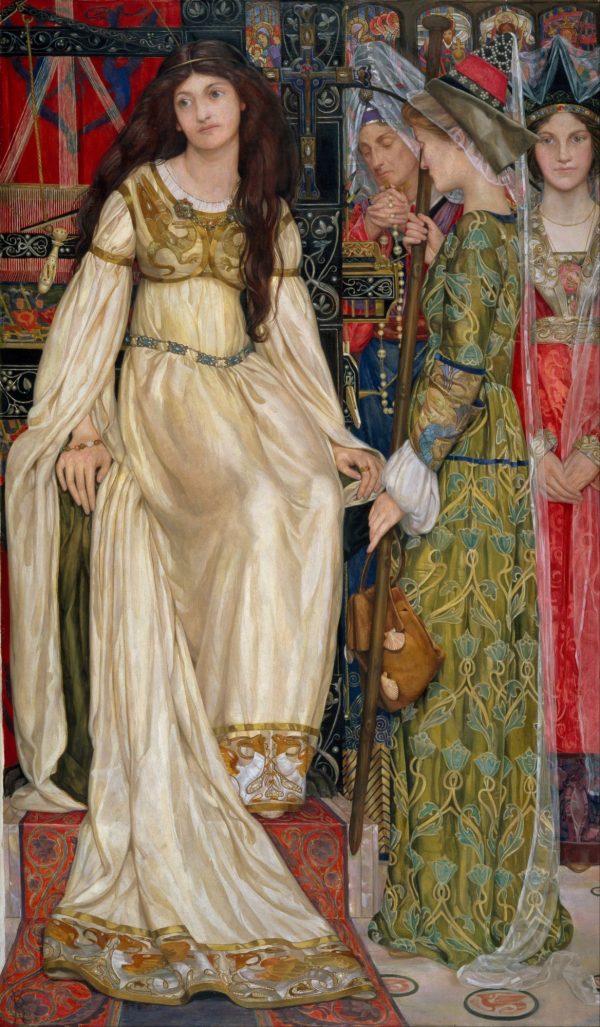
The Chance Meeting by Kate Elizabeth Bunce, hand-painted in oil on canvas with the layered glazes and decorative detail that define this famous artwork of the Birmingham Pre-Raphaelite school.
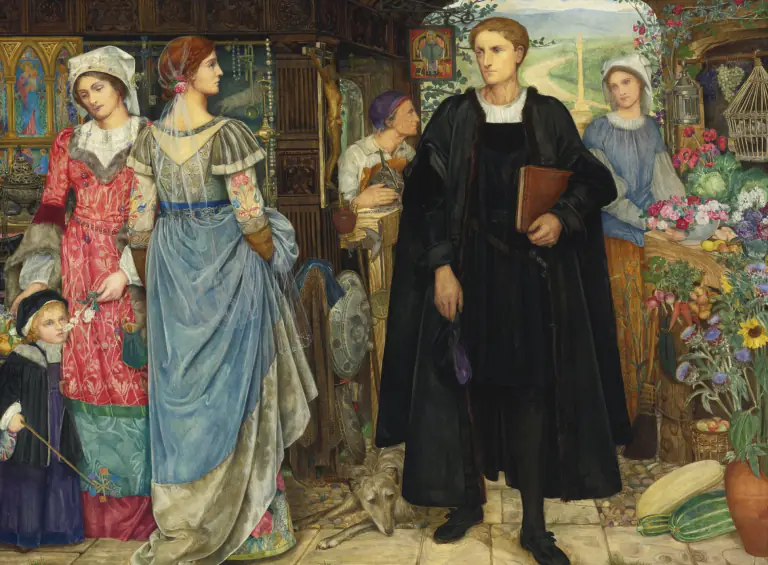
Kate Elizabeth Bunce painted in Birmingham at a moment when the city had become an unlikely stronghold of Pre-Raphaelite ideals, carried forward a generation after the movement first formed in London. The Chance Meeting belongs to this later flowering, a period in which Bunce, working alongside her sister Myra and within the circle gathered around the Birmingham Group, turned to subjects of courtly encounter and quiet emotional charge rendered with the jewel-like finish that the school demanded. The picture reads less as narrative illustration than as a suspended instant, a meeting whose significance the viewer is left to infer from posture and glance rather than incident.
The composition places its figures with the deliberate flatness and vertical stacking that Bunce inherited from Rossetti and from the Italian primitives both admired, the picture plane treated almost as a decorated surface rather than a window onto deep space. Costume and drapery are handled with the meticulous, almost embroidered attention typical of the artist, each fold and pattern given equal weight alongside the faces, so that ornament becomes part of the emotional register rather than mere decoration. Colour is kept rich and saturated, built up in the thin, jewel-toned glazes that Pre-Raphaelite technique favoured, allowing light to seem to rise from within the pigment rather than fall across it from outside.
This handling of light and the density of surface pattern are exactly what a hand-painted oil painting reproduction has to earn rather than approximate. ByMuseum artists work in oil on artist-grade canvas, building the same layered glazes and matching the original palette tone by tone, so that the brushwork and the slight raised texture of paint remain visible on the finished surface, as they would on any painted object rather than a printed one. The aim is not a flattened copy of a famous painting but a faithful reconstruction of how Bunce actually built her surface, stroke by stroke.
What is carried across into the reproduction is precisely this constructed quality: the density of the drapery patterning, the warmth of the glazed colour, and the compressed, decorative space that gives the original its distinctive stillness. Reproducing these elements by hand, rather than by mechanical print, keeps the picture recognisably itself rather than a diminished echo of it.
Empty walls flatten a room. A classical artwork restores structure and visual hierarchy. One painting defines the space, anchors furniture, and establishes identity.
Worldwide shipping included. Each painting is produced to order and safely packed for international transport.
All payments are encrypted and processed through trusted payment providers.
Real brushwork, layered oil paint, and durable pigments on museum-quality canvas.
If the result does not meet expectations, return it for a full refund.


Your artwork is painted on premium cotton canvas, then shipped safely rolled in a rigid tube with extra blank canvas border — ready for stretching or framing locally.
Select a handcrafted frame and we’ll deliver your painting fully assembled, protected, and ready to hang.
For safe shipping, framing is available up to a maximum size. Larger sizes will automatically disable the frame option.


Choose “Stretched” to receive your canvas mounted on wooden stretcher bars — perfect if you’ll frame it later or display it as-is.
Gallery Wrap is a deeper, 1.5" style stretcher. The canvas wraps around the sides and is stapled on the back for a clean, modern, frameless look.
We ship with UPS, FedEx, or DHL straight to your door. You’ll receive a tracking number as soon as your order leaves our studio. Typical delivery is 5 to 7 days after dispatch; large, framed, or stretched pieces may take longer depending on the safest shipping route.


Unframed canvases are protected with a film, carefully rolled, and secured inside a rigid shipping tube.

Stretched, Gallery Wrapped, and Framed paintings are wrapped, cushioned with foam protection, and boxed for safe transit.

Man Writing a Letter
Gabriel Metsu, c. 1664
The gallery list
Every painting is already 50% off. Join the list and we will send you an extra $15 code, plus first access to new collections.
No spam. Unsubscribe anytime. · Privacy Policy
Welcome
Your $15 code is on its way. Explore the gallery while you wait.