Loading cart…
No products in the cart.

Original price was: $518.00.$259.00Current price is: $259.00.
The Countess Ritzer by Giovanni Boldini, recreated as a hand-painted replica on canvas that keeps the restrained palette and confident brushwork of the original portrait.
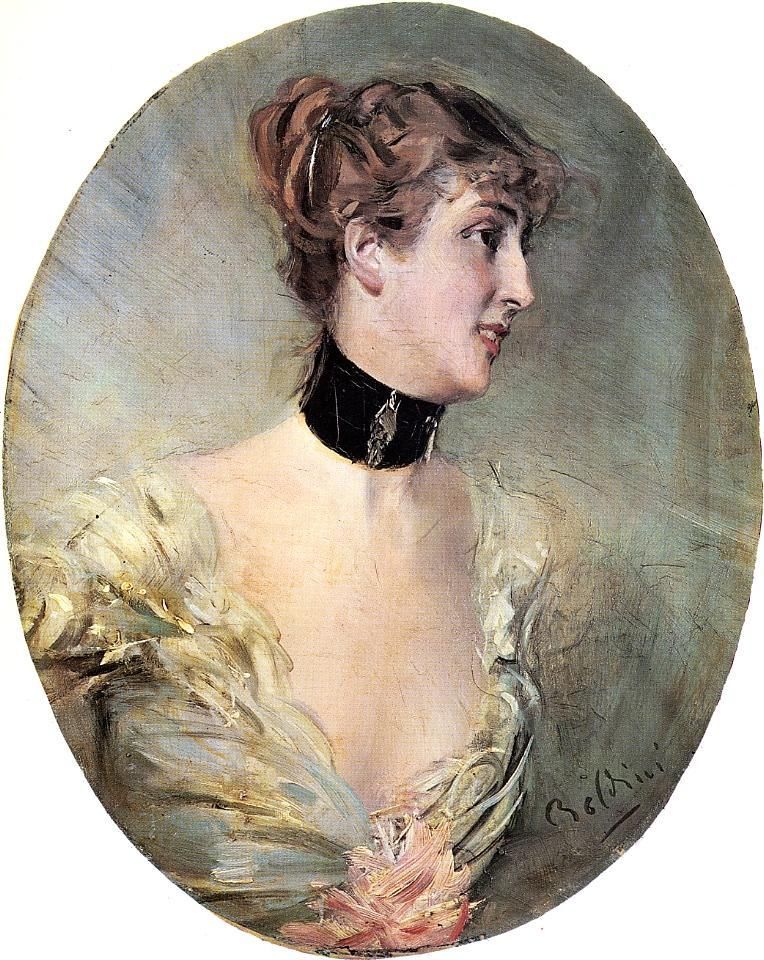
Much of the output of Giovanni Boldini is defined by movement, the swagger of a hand caught mid-gesture, fabric that seems to rustle even in stillness, a sitter posed as though interrupted in conversation. The Countess Ritzer belongs to that world of society portraiture but holds itself with more restraint than the flamboyant society likenesses that made his reputation in Paris and London. Here the emphasis falls less on theatrical flourish and more on the quiet authority of the sitter, rendered with the same fluent hand but a cooler, more measured temperature.
The composition centres on the countess herself, her posture upright and self-possessed, the surrounding space handled with enough looseness to keep the eye returning to her face and bearing. Boldini builds form through rapid, confident strokes rather than careful modelling, letting passages of loosely worked paint stand beside more resolved areas of the face and hands. This contrast between the deliberate and the spontaneous is characteristic of his mature technique, learned in part from the immediacy of the Macchiaioli painters he knew in Florence before Paris reshaped his ambitions.
Colour is kept within a restrained register, dark grounds set against the pale luminosity of skin and the sheen of fabric, so that light seems to gather around the sitter rather than flood the canvas. The brushwork carries its own rhythm, quick where the setting dissolves into shadow, tightened where the likeness demands precision, a balance that gives the portrait both immediacy and lasting presence. It is a work from the period when Boldini had fully absorbed the demands of aristocratic portraiture while retaining the painterly freedom of his earlier training.
Reproducing this balance by hand is the whole purpose of a serious oil painting reproduction. Every version is painted individually by a trained artist working in oil on artist-grade canvas, matching the tonal range of the original, the loosened passages of background, and the firmer handling of the face, so the surface carries genuine brushwork and impasto rather than a flattened printed image. The result functions as a hand-painted replica rather than a copy in name only, since the same physical decisions, where paint is thick, where it is thin, where the canvas weave shows through, are made again by hand rather than simulated.
What is carried across is not simply the image but the manner in which it was built: the direction of each stroke, the density of paint in the darker grounds, the softness where Boldini let form dissolve at the edges. That fidelity is what separates a painted reproduction from a mechanical copy, and it is why collectors who want more than an image on a wall choose one.
Empty walls flatten a room. A classical artwork restores structure and visual hierarchy. One painting defines the space, anchors furniture, and establishes identity.
Worldwide shipping included. Each painting is produced to order and safely packed for international transport.
All payments are encrypted and processed through trusted payment providers.
Real brushwork, layered oil paint, and durable pigments on museum-quality canvas.
If the result does not meet expectations, return it for a full refund.


Your artwork is painted on premium cotton canvas, then shipped safely rolled in a rigid tube with extra blank canvas border — ready for stretching or framing locally.
Select a handcrafted frame and we’ll deliver your painting fully assembled, protected, and ready to hang.
For safe shipping, framing is available up to a maximum size. Larger sizes will automatically disable the frame option.


Choose “Stretched” to receive your canvas mounted on wooden stretcher bars — perfect if you’ll frame it later or display it as-is.
Gallery Wrap is a deeper, 1.5" style stretcher. The canvas wraps around the sides and is stapled on the back for a clean, modern, frameless look.
We ship with UPS, FedEx, or DHL straight to your door. You’ll receive a tracking number as soon as your order leaves our studio. Typical delivery is 5 to 7 days after dispatch; large, framed, or stretched pieces may take longer depending on the safest shipping route.


Unframed canvases are protected with a film, carefully rolled, and secured inside a rigid shipping tube.

Stretched, Gallery Wrapped, and Framed paintings are wrapped, cushioned with foam protection, and boxed for safe transit.