Loading cart…
No products in the cart.

Original price was: $599.00.$299.00Current price is: $299.00.
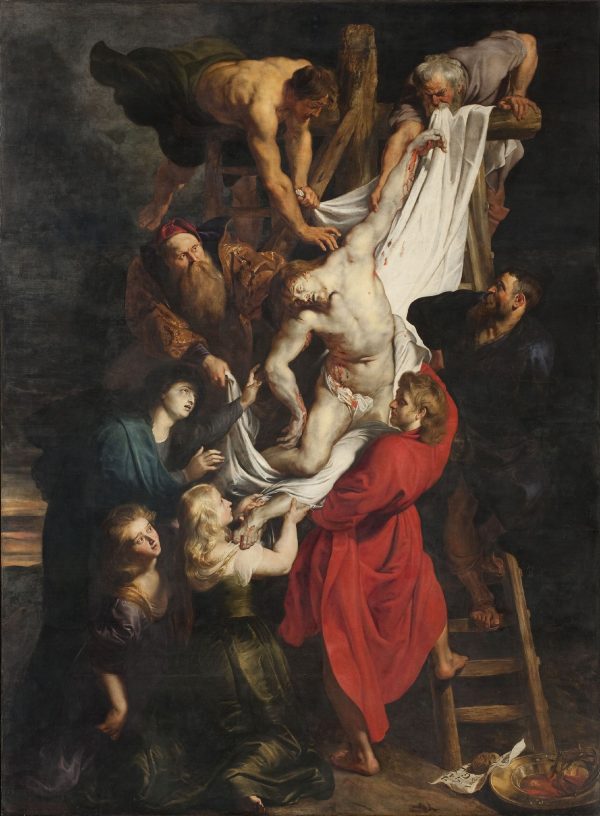
Christ is lowered from the cross in this famous painting by Rubens, hand-painted in oil on canvas with the original chiaroscuro and drapery preserved.
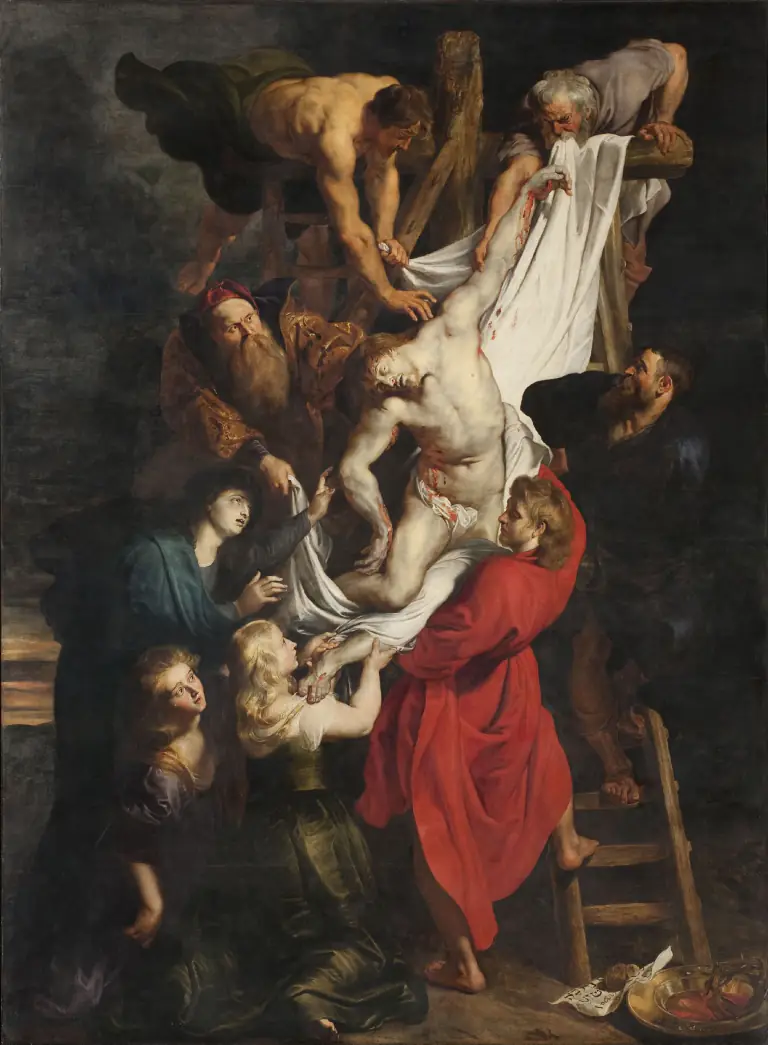
Arms strain under the weight of a body that has gone completely limp. Hands grip white linen, a knee presses against the upright of the cross, and for one suspended moment the whole group holds Christ between heaven and the ground. This Descent from the Cross reproduction returns that moment to a wall in hand-painted oil, carrying the gravity of a famous painting into a domestic or gallery setting.
Rubens painted the panel between 1612 and 1614 for the altar of the Confraternity of the Arquebusiers in Antwerp Cathedral, and the commission still shapes the composition today. Christ forms a long diagonal through the centre of the picture, his body sliding from the raised arms of the men above toward the women gathered below, Nicodemus and Joseph of Arimathea taking the strain while Saint John steadies the lower edge of the sheet. The winding cloth itself is painted almost white, pulled taut so that it catches light the surrounding figures cannot, and that single pale shape anchors the eye against a ground of deep shadow and sombre cloth.
Mary stands at the base with her arms open toward her son, her face held in a grief that never tips into display, and Mary Magdalene presses close to the feet, her red hair and warm sleeve the one note of colour breaking the chiaroscuro. The poses are choreographed with an almost architectural precision, each straining arm and bent back calculated so the descending body reads as both physically convincing and devotionally weighted, a hallmark of the years in which Rubens was absorbing the drama of Caravaggio and Italian Baroque painting into his own Flemish idiom.
Producing this oil painting reproduction means working figure by figure from the original, rebuilding the fall of light across the winding sheet, the tension in the raised arms, and the particular grief held in the face of the Virgin and of Mary Magdalene. The artist lays the paint in the same sequence Rubens would have worked, dark ground first, then the luminous white built up in passages thick enough to hold its own shadow, so the surface carries real brushwork rather than a flat printed surface.
What survives in the transfer from panel to canvas is the balance between weight and light: the strained geometry of the lowering, the one bright sheet against the dark, and the restraint in every mourning face, carried forward stroke by stroke rather than copied by machine.
| artists |
|---|
Empty walls flatten a room. A classical artwork restores structure and visual hierarchy. One painting defines the space, anchors furniture, and establishes identity.
Worldwide shipping included. Each painting is produced to order and safely packed for international transport.
All payments are encrypted and processed through trusted payment providers.
Real brushwork, layered oil paint, and durable pigments on museum-quality canvas.
If the result does not meet expectations, return it for a full refund.


Your artwork is painted on premium cotton canvas, then shipped safely rolled in a rigid tube with extra blank canvas border — ready for stretching or framing locally.
Select a handcrafted frame and we’ll deliver your painting fully assembled, protected, and ready to hang.
For safe shipping, framing is available up to a maximum size. Larger sizes will automatically disable the frame option.


Choose “Stretched” to receive your canvas mounted on wooden stretcher bars — perfect if you’ll frame it later or display it as-is.
Gallery Wrap is a deeper, 1.5" style stretcher. The canvas wraps around the sides and is stapled on the back for a clean, modern, frameless look.
We ship with UPS, FedEx, or DHL straight to your door. You’ll receive a tracking number as soon as your order leaves our studio. Typical delivery is 5 to 7 days after dispatch; large, framed, or stretched pieces may take longer depending on the safest shipping route.


Unframed canvases are protected with a film, carefully rolled, and secured inside a rigid shipping tube.

Stretched, Gallery Wrapped, and Framed paintings are wrapped, cushioned with foam protection, and boxed for safe transit.

Man Writing a Letter
Gabriel Metsu, c. 1664
The gallery list
Every painting is already 50% off. Join the list and we will send you an extra $15 code, plus first access to new collections.
No spam. Unsubscribe anytime. · Privacy Policy
Welcome
Your $15 code is on its way. Explore the gallery while you wait.