Loading cart…
No products in the cart.

Original price was: $599.00.$299.00Current price is: $299.00.
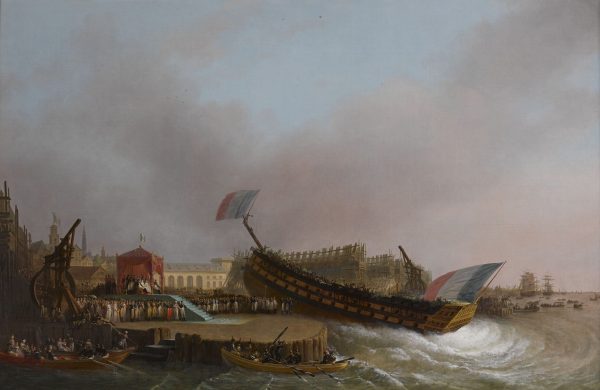
The Eagle Standards Taken at Waterloo Returned to Wellington 18th June 1815 by Mathieu Ignace van Bree, hand-painted by a professional artist in oil on canvas for lasting surface and presence.

Broad passages of warm ochre and deep crimson build steadily across the canvas, laid in with a confidence that suggests a painter working at the height of his command of the brush. Edges soften where figures recede into shadow and sharpen where gold braid and polished metal catch the light, a deliberate rhythm of focus and blur that draws the eye first to the standards themselves before releasing it into the surrounding crowd.
The scene commemorates a specific moment of ceremony: the captured eagle standards of the defeated French army presented to the Duke of Wellington on the day of victory at Waterloo. Van Bree, working within the Neoclassical tradition, organises the composition with a theatrical clarity typical of history painting of the period, arranging figures in a shallow stage-like space so that gesture and uniform read clearly even at a distance. Colour is handled with restraint in the shadows and with real richness in the passages of ceremonial dress, a contrast that gives the picture its sense of gravity without tipping into spectacle.
This attention to the moment of exchange, the tilt of a standard, the set of a shoulder, the fall of light across a sash, places the painting within Bree career as a history painter working for a public increasingly interested in the recent Napoleonic past rather than in mythological or biblical subjects. The picture belongs to a moment when European painters were asked to give recent political events the weight and permanence once reserved for classical history, and Bree meets that demand with a steady, legible hand.
ByMuseum artists reproduce this composition as a hand-painted oil painting reproduction, working in oil on artist-grade canvas rather than reproducing the image by mechanical means. Each reproduction is completed by a trained painter who studies the original palette and rebuilds it layer by layer, so the raised texture of impasto, the visible direction of the brush, and the depth of colour are present on the surface exactly as they would be on a painted object rather than a printed one. A buyer who looks closely at condition and surface, the qualities that separate a painted work from a flat image, will find the same qualities of built-up pigment and worked edge that a discerning eye looks for in any oil on canvas. The result is a piece with the presence and physical history of a real painting, made by hand for a single wall rather than issued in multiples.
Two centuries after the events it records, the picture still holds attention because it treats a moment of national ceremony with the same seriousness a painter would once have reserved for antiquity, and owning a painted version of that record means owning an object with the same weight of craft rather than a copy at one remove from it.
Empty walls flatten a room. A classical artwork restores structure and visual hierarchy. One painting defines the space, anchors furniture, and establishes identity.
Worldwide shipping included. Each painting is produced to order and safely packed for international transport.
All payments are encrypted and processed through trusted payment providers.
Real brushwork, layered oil paint, and durable pigments on museum-quality canvas.
If the result does not meet expectations, return it for a full refund.


Your artwork is painted on premium cotton canvas, then shipped safely rolled in a rigid tube with extra blank canvas border — ready for stretching or framing locally.
Select a handcrafted frame and we’ll deliver your painting fully assembled, protected, and ready to hang.
For safe shipping, framing is available up to a maximum size. Larger sizes will automatically disable the frame option.


Choose “Stretched” to receive your canvas mounted on wooden stretcher bars — perfect if you’ll frame it later or display it as-is.
Gallery Wrap is a deeper, 1.5" style stretcher. The canvas wraps around the sides and is stapled on the back for a clean, modern, frameless look.
We ship with UPS, FedEx, or DHL straight to your door. You’ll receive a tracking number as soon as your order leaves our studio. Typical delivery is 5 to 7 days after dispatch; large, framed, or stretched pieces may take longer depending on the safest shipping route.


Unframed canvases are protected with a film, carefully rolled, and secured inside a rigid shipping tube.

Stretched, Gallery Wrapped, and Framed paintings are wrapped, cushioned with foam protection, and boxed for safe transit.

Man Writing a Letter
Gabriel Metsu, c. 1664
The gallery list
Every painting is already 50% off. Join the list and we will send you an extra $15 code, plus first access to new collections.
No spam. Unsubscribe anytime. · Privacy Policy
Welcome
Your $15 code is on its way. Explore the gallery while you wait.