Loading cart…
No products in the cart.

Original price was: $518.00.$259.00Current price is: $259.00.
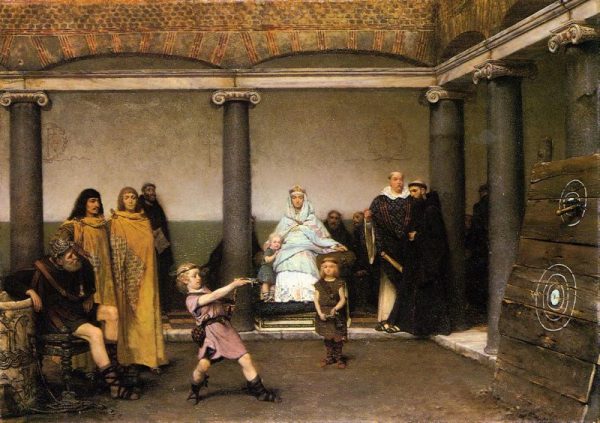
A Merovingian royal lesson rendered with the disciplined historical detail Alma-Tadema is known for, now available as a hand-painted oil on canvas reproduction for a collection that values surface and craft.

Academic history painting of the nineteenth century prized above all the discipline of reconstruction, the sense that a distant era could be made visible again through costume, architecture, and gesture studied as carefully as any archaeological record. The Education of the Children of Clovis belongs to this tradition, though it turns away from the Greco-Roman world that made Alma-Tadema famous and toward the harder, less documented terrain of Merovingian Gaul.
The scene shows young royals receiving instruction in the bearing and knowledge expected of future rulers, set within an interior that gestures toward the transitional culture of post-Roman Frankish society rather than the marble and sunlight of his classical subjects. Alma-Tadema approaches the period with the same disciplined research he brought to antiquity, working out how furniture, dress, and architectural detail might plausibly have looked in a culture caught between Roman inheritance and emerging Frankish identity. Warm interior light unifies the composition, falling across the figures in a way that softens the formality of the lesson with the natural restlessness of youth, a balance between instruction and instinct that gives the picture its quiet tension.
What holds the eye longest is the handling of surface: the tonal shifts within the interior, the modelling of fabric and skin under that warm light, the sense of weight and stillness in figures who are, after all, only children being taught to rule. A discerning collector looking at the original would attend to exactly these passages, the transitions of colour temperature and the restraint of the brushwork, and a hand-painted oil painting reproduction from ByMuseum is built around preserving that same evidence. Trained painters work in oil on this oil on canvas reproduction, matching the palette Alma-Tadema built from warm ochres and cooler shadow, and leaving the brushwork and surface texture visible rather than flattened, so the object on your wall reads as painted, not printed.
A subject this specific, drawn from a period so rarely painted with this level of conviction, has kept its hold on viewers precisely because it refuses the obvious. Owning a painted version of it means owning that conviction in physical form rather than as an image on paper. Each order includes:
Empty walls flatten a room. A classical artwork restores structure and visual hierarchy. One painting defines the space, anchors furniture, and establishes identity.
Worldwide shipping included. Each painting is produced to order and safely packed for international transport.
All payments are encrypted and processed through trusted payment providers.
Real brushwork, layered oil paint, and durable pigments on museum-quality canvas.
If the result does not meet expectations, return it for a full refund.


Your artwork is painted on premium cotton canvas, then shipped safely rolled in a rigid tube with extra blank canvas border — ready for stretching or framing locally.
Select a handcrafted frame and we’ll deliver your painting fully assembled, protected, and ready to hang.
For safe shipping, framing is available up to a maximum size. Larger sizes will automatically disable the frame option.


Choose “Stretched” to receive your canvas mounted on wooden stretcher bars — perfect if you’ll frame it later or display it as-is.
Gallery Wrap is a deeper, 1.5" style stretcher. The canvas wraps around the sides and is stapled on the back for a clean, modern, frameless look.
We ship with UPS, FedEx, or DHL straight to your door. You’ll receive a tracking number as soon as your order leaves our studio. Typical delivery is 5 to 7 days after dispatch; large, framed, or stretched pieces may take longer depending on the safest shipping route.


Unframed canvases are protected with a film, carefully rolled, and secured inside a rigid shipping tube.

Stretched, Gallery Wrapped, and Framed paintings are wrapped, cushioned with foam protection, and boxed for safe transit.