Loading cart…
No products in the cart.

Original price was: $599.00.$299.00Current price is: $299.00.
Nine straining men hoist the cross skyward in this hand-painted reproduction of the Rubens altarpiece, flanked by mourners and Roman soldiers.
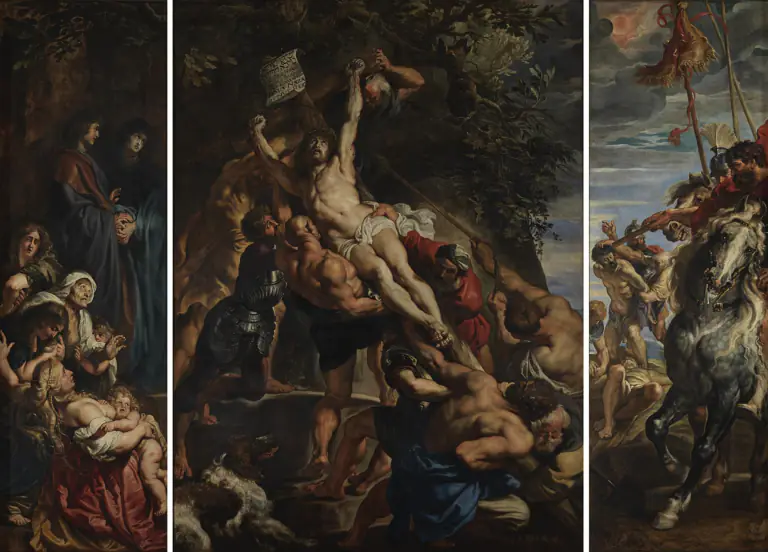
Nine men brace against the weight of raw timber, hauling an upright cross into position while the body already nailed to it swings through a sharp diagonal against a darkened sky. This Elevation of the Cross reproduction brings that instant of strain and gravity to canvas, the moment before the beam locks vertical and the full horror of the scene settles into place. A dog barks at the lower edge, oblivious, while the men above grind their bare feet into rock and soil.
Rubens painted the central panel and its two wings in 1610 and 1611 for the high altar of Saint Walburga Church in Antwerp, his first major religious commission after years in Italy studying Caravaggio, Tintoretto, and Michelangelo. That apprenticeship shows in every foreshortened torso and every passage of chiaroscuro: light falls hard across the straining backs and the pale flesh of Christ, while the rest of the scene recedes into shadow. The composition itself is built on a diagonal thrust from lower left to upper right, a device borrowed from Tintoretto and pushed further than Flemish painting had yet attempted.
The side wings extend the drama outward. On the left, the Virgin and Saint John stand among a huddle of mourners set against a somber, shadowed ground, their grief understated next to the physical violence of the central scene. On the right, a Roman officer on horseback directs soldiers readying the two thieves for crucifixion, the rearing horses adding motion and threat to an already crowded field. Together the three panels introduced large-scale Baroque painting to Flemish altarpiece tradition, and the triptych remains in the Cathedral of Our Lady in Antwerp, where it was moved in 1816.
Each hand-painted oil painting reproduction of this triptych is built the same way the original was: pigment laid in successive layers until the chiaroscuro reads with the same force, the same weight in the straining figures, the same recession into shadow on the flanking panels. A trained painter works from the central scene outward to both wings, matching the somber palette of Rubens stroke by stroke rather than reducing it to flat color. This is a handmade oil painting on artist-grade canvas, the surface built up with visible brushwork so the diagonal thrust of the composition carries the same physical presence it has on panel.
| artists |
|---|
Empty walls flatten a room. A classical artwork restores structure and visual hierarchy. One painting defines the space, anchors furniture, and establishes identity.
Worldwide shipping included. Each painting is produced to order and safely packed for international transport.
All payments are encrypted and processed through trusted payment providers.
Real brushwork, layered oil paint, and durable pigments on museum-quality canvas.
If the result does not meet expectations, return it for a full refund.


Your artwork is painted on premium cotton canvas, then shipped safely rolled in a rigid tube with extra blank canvas border — ready for stretching or framing locally.
Select a handcrafted frame and we’ll deliver your painting fully assembled, protected, and ready to hang.
For safe shipping, framing is available up to a maximum size. Larger sizes will automatically disable the frame option.


Choose “Stretched” to receive your canvas mounted on wooden stretcher bars — perfect if you’ll frame it later or display it as-is.
Gallery Wrap is a deeper, 1.5" style stretcher. The canvas wraps around the sides and is stapled on the back for a clean, modern, frameless look.
We ship with UPS, FedEx, or DHL straight to your door. You’ll receive a tracking number as soon as your order leaves our studio. Typical delivery is 5 to 7 days after dispatch; large, framed, or stretched pieces may take longer depending on the safest shipping route.


Unframed canvases are protected with a film, carefully rolled, and secured inside a rigid shipping tube.

Stretched, Gallery Wrapped, and Framed paintings are wrapped, cushioned with foam protection, and boxed for safe transit.

Man Writing a Letter
Gabriel Metsu, c. 1664
The gallery list
Every painting is already 50% off. Join the list and we will send you an extra $15 code, plus first access to new collections.
No spam. Unsubscribe anytime. · Privacy Policy
Welcome
Your $15 code is on its way. Explore the gallery while you wait.