Loading cart…
No products in the cart.

Original price was: $599.00.$299.00Current price is: $299.00.
Hans von Aachen stages the myth of Phaeton as a single violent plunge of bodies and horses, rendered here as a hand-painted oil on canvas rather than a printed copy.
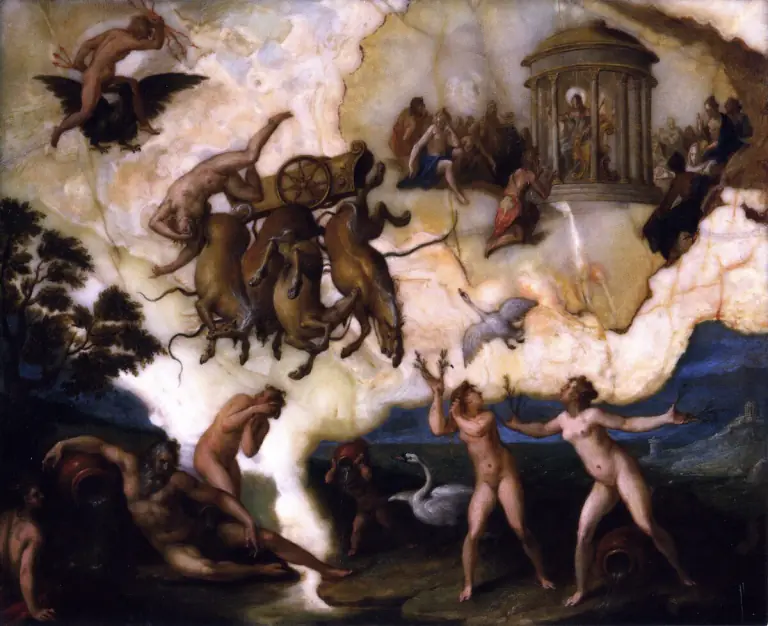
Bodies tumble through a compressed diagonal field, horses and riders and celestial figures locked together in a single downward sweep that fills the canvas edge to edge. The proportions of the composition are tight and vertical, built so that a viewer standing before it reads the fall from top to bottom in one continuous motion, the eye given no rest until it reaches the earth at the base of the frame. Within that frame Von Aachen stages the myth of Phaeton, the son of the sun god who begged to drive the solar chariot and lost command of it, plunging with the horses and the burning wreckage into open sky.
The picture belongs to the vocabulary of Late Mannerism, where the human figure is pushed toward extremes of torsion and foreshortening to carry feeling rather than description. Limbs twist against the picture plane, muscles strain in directions that serve drama over anatomy, and the horses share the same charged energy as the falling youth, their necks arched and their legs cutting hard diagonals through the air. Light falls in sharp, selective patches, catching a shoulder or a flank while the surrounding air darkens, and that contrast does much of the emotional work, turning a mythological illustration into something closer to a study of panic and collapse.
Von Aachen worked at a moment when court painters across Central Europe were absorbing Italian Mannerist invention and returning it with a harder, more theatrical edge, and this canvas shows that inheritance in its restless figure work and its appetite for physical extremity. The brushwork moves fluidly across the turbulent forms, building the sense of falling weight through gesture as much as through drawing. A hand-painted oil painting reproduction of this composition is built to keep that fluency intact: a trained painter works in oil on canvas, matching the palette of shadow and flame and preserving the visible brushwork and surface texture of the original, so the object on the wall is a painted canvas rather than a printed copy, hand-painted by a professional artist who has studied the composition closely before laying down colour.
The subject has held attention for centuries because it dramatizes a very old warning about ambition outrunning skill, and Von Aachen gives that warning a physical charge that still reads clearly across the distance of four hundred years. Living with a hand-painted version of it means keeping that unresolved motion in the room, a fall that never quite lands.
Empty walls flatten a room. A classical artwork restores structure and visual hierarchy. One painting defines the space, anchors furniture, and establishes identity.
Worldwide shipping included. Each painting is produced to order and safely packed for international transport.
All payments are encrypted and processed through trusted payment providers.
Real brushwork, layered oil paint, and durable pigments on museum-quality canvas.
If the result does not meet expectations, return it for a full refund.


Your artwork is painted on premium cotton canvas, then shipped safely rolled in a rigid tube with extra blank canvas border — ready for stretching or framing locally.
Select a handcrafted frame and we’ll deliver your painting fully assembled, protected, and ready to hang.
For safe shipping, framing is available up to a maximum size. Larger sizes will automatically disable the frame option.


Choose “Stretched” to receive your canvas mounted on wooden stretcher bars — perfect if you’ll frame it later or display it as-is.
Gallery Wrap is a deeper, 1.5" style stretcher. The canvas wraps around the sides and is stapled on the back for a clean, modern, frameless look.
We ship with UPS, FedEx, or DHL straight to your door. You’ll receive a tracking number as soon as your order leaves our studio. Typical delivery is 5 to 7 days after dispatch; large, framed, or stretched pieces may take longer depending on the safest shipping route.


Unframed canvases are protected with a film, carefully rolled, and secured inside a rigid shipping tube.

Stretched, Gallery Wrapped, and Framed paintings are wrapped, cushioned with foam protection, and boxed for safe transit.


Man Writing a Letter
Gabriel Metsu, c. 1664
The gallery list
Every painting is already 50% off. Join the list and we will send you an extra $15 code, plus first access to new collections.
No spam. Unsubscribe anytime. · Privacy Policy
Welcome
Your $15 code is on its way. Explore the gallery while you wait.