Loading cart…
No products in the cart.

Original price was: $518.00.$299.00Current price is: $299.00.
A monumental Baroque vision by Peter Paul Rubens, with the Archangel Michael driving a writhing mass of bodies into darkness, offered here as a hand-painted replica painting on canvas.
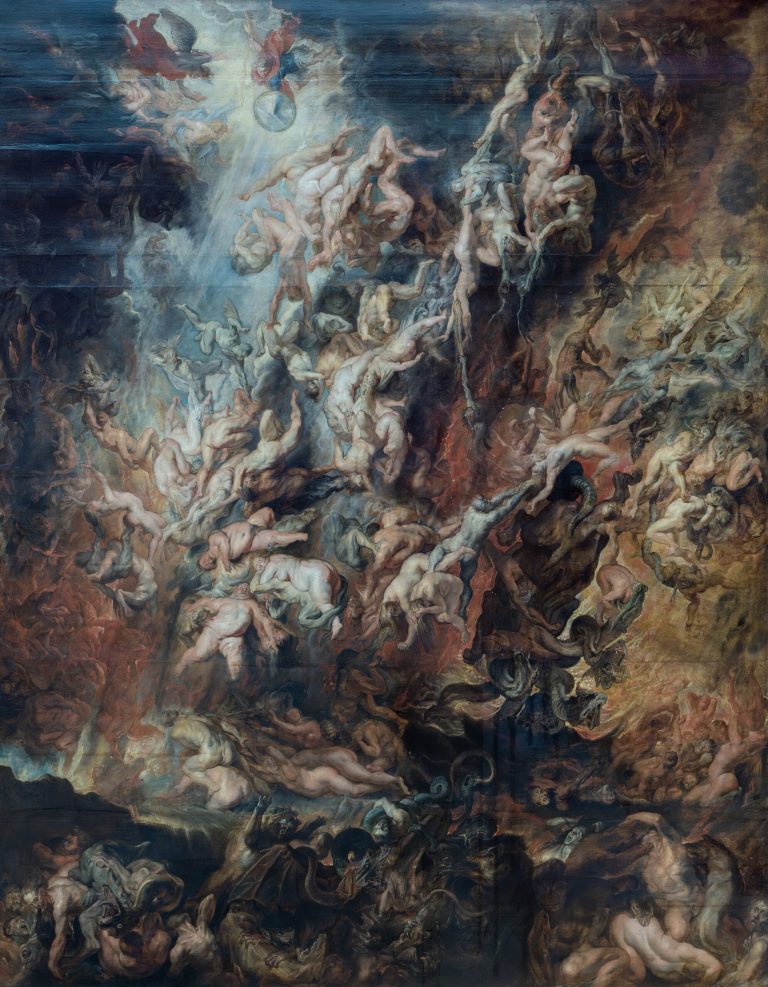
One pale foot hangs upside down at the top of the panel, caught for an instant before gravity takes it, and the whole composition of The Fall of the Damned reproduction grows out of that single falling limb. Rubens builds an entire cosmology around bodies in freefall, and this hand-painted version carries that same plunging weight onto canvas.
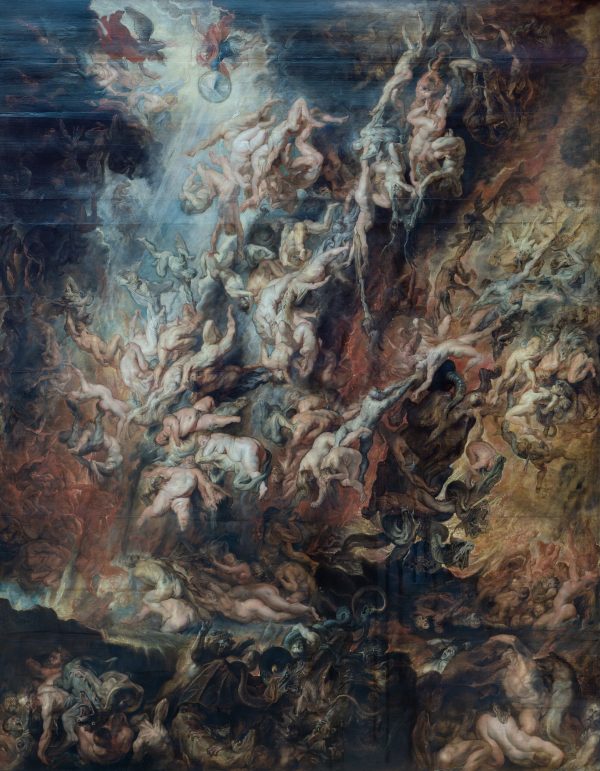
The panel shows the Archangel Michael and his attendant angels driving a mass of the damned out of the light and down into shadow. Rubens arranges perhaps a hundred nude figures along a steep diagonal spiral, limbs knotted against limbs, heads thrown back, hands grasping at nothing. The upper register glows with a cool, luminous light that catches the angels wings and the raised sword of Michael, while the lower half of the panel dissolves into a smoky brown darkness where the damned are swallowed whole. It is an exercise in extreme foreshortening and anatomical invention, painted around 1620 when Rubens was working at the height of his powers in Antwerp, fresh from his Italian years and newly confident in handling crowds of figures in violent motion.
What holds the eye is the modelling of flesh itself: pink, cream, and grey tones laid one against another so that bodies seem lit from within even as they fall into shadow. Rubens worked the panel with a freedom that later painters studied for decades, building form through colour rather than outline, letting one figure dissolve into the next so the whole mass reads as a single turning current.
The ByMuseum version of this painting is an oil painting reproduction built up stroke by stroke on artist-grade canvas, not printed or mechanically generated. A trained painter studies the original palette, the warm flesh tones against the cool upper light, and reconstructs the layered modelling and the restless brushwork of the composition by hand, so the surface carries the same ridges and passages of visible paint. Anyone who wants a replica painting of this scale rather than a flat print is getting a worked, physical object, with the same kind of built-up oil layers Rubens used to describe falling flesh.
Four centuries on, the panel still reads as a study of panic and motion rather than a static religious scene, which is why collectors of Flemish Baroque subjects keep returning to it. Owning a hand-painted version means living with that same churning spiral of bodies and light on your own wall, built in oil rather than printed flat.
| artists |
|---|
Empty walls flatten a room. A classical artwork restores structure and visual hierarchy. One painting defines the space, anchors furniture, and establishes identity.
Worldwide shipping included. Each painting is produced to order and safely packed for international transport.
All payments are encrypted and processed through trusted payment providers.
Real brushwork, layered oil paint, and durable pigments on museum-quality canvas.
If the result does not meet expectations, return it for a full refund.


Your artwork is painted on premium cotton canvas, then shipped safely rolled in a rigid tube with extra blank canvas border — ready for stretching or framing locally.
Select a handcrafted frame and we’ll deliver your painting fully assembled, protected, and ready to hang.
For safe shipping, framing is available up to a maximum size. Larger sizes will automatically disable the frame option.


Choose “Stretched” to receive your canvas mounted on wooden stretcher bars — perfect if you’ll frame it later or display it as-is.
Gallery Wrap is a deeper, 1.5" style stretcher. The canvas wraps around the sides and is stapled on the back for a clean, modern, frameless look.
We ship with UPS, FedEx, or DHL straight to your door. You’ll receive a tracking number as soon as your order leaves our studio. Typical delivery is 5 to 7 days after dispatch; large, framed, or stretched pieces may take longer depending on the safest shipping route.


Unframed canvases are protected with a film, carefully rolled, and secured inside a rigid shipping tube.

Stretched, Gallery Wrapped, and Framed paintings are wrapped, cushioned with foam protection, and boxed for safe transit.


Reviews
There are no reviews yet.