Loading cart…
No products in the cart.

Original price was: $599.00.$299.00Current price is: $299.00.
A hand-painted oil reproduction of The Finding of Moses by Alma-Tadema, prized for its archaeological detail and sun-drenched Egyptian light.
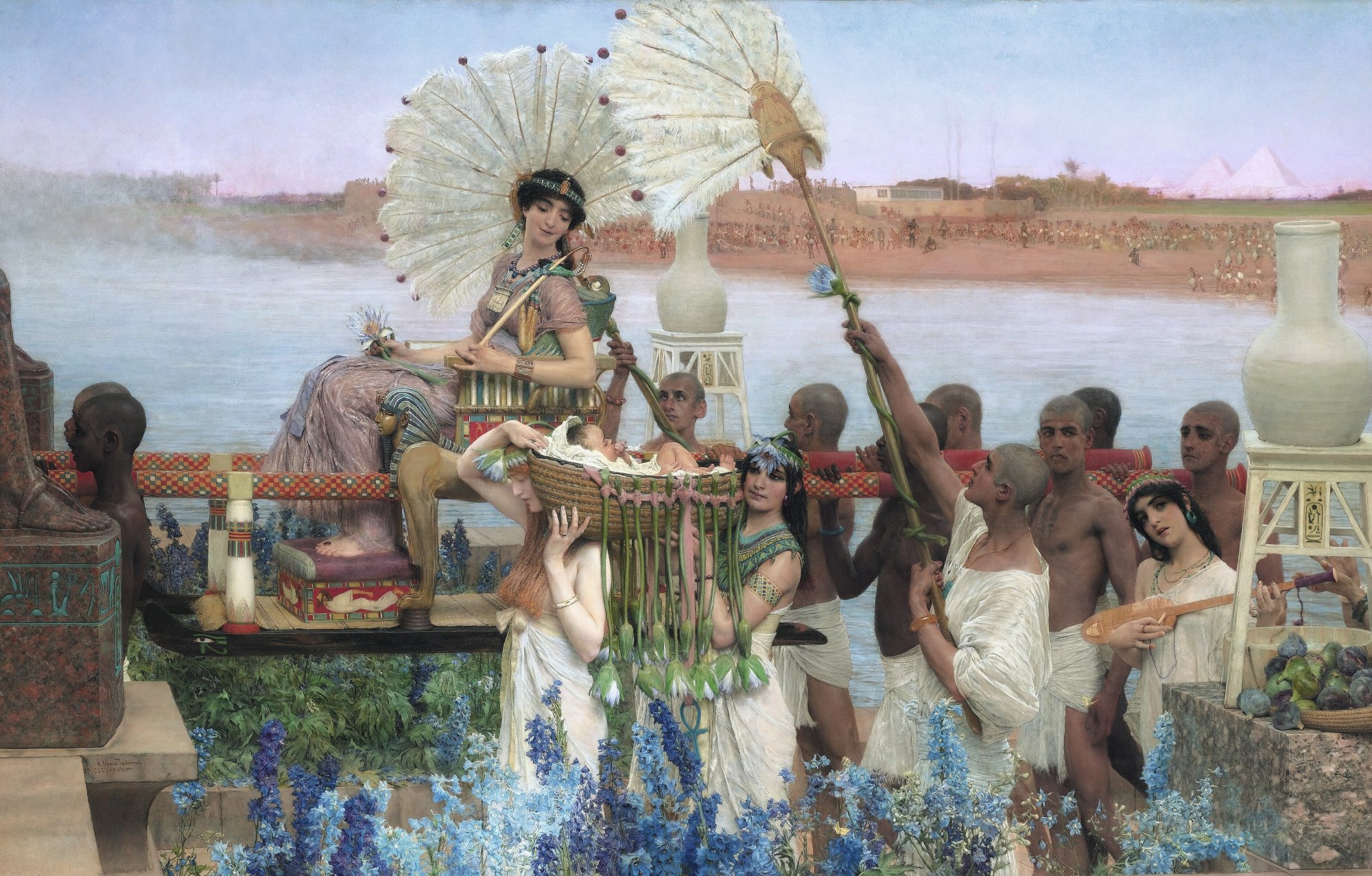
Much of the output of Lawrence Alma-Tadema settles into a familiar register of marble terraces and idle Roman afternoons, elegant but low on tension. The Finding of Moses breaks that pattern. Here the painter turns to a biblical subject staged in ancient Egypt, and the result carries a narrative charge that his gentler genre scenes rarely attempt, even as it keeps every hallmark of his archaeological precision intact.
The canvas gathers a procession of richly dressed figures along a riverbank, the infant Moses at the centre of a moment poised between danger and rescue. Alma-Tadema arranges the composition so that human drama and material splendour carry equal weight: courtly robes, patterned textiles, and carved stone share the foreground with the same exacting attention, while the river opens beyond them in a haze of reflected light. The picture plane reads almost like a stage set, but one built from genuine study of ancient Egyptian dress and architecture rather than costume-drama guesswork.
What distinguishes the handling is the way warmth and structure work together. Skin, marble, and cloth all receive the same sun-drenched color, layered in thin, confident passages that let the underlying drawing hold firm beneath the surface glow. This theatrical light, so characteristic of the artist at the height of his powers, gives the scene its tactile presence; nothing in it feels flat or merely decorative, and the academic discipline underneath keeps the spectacle grounded in believable weight and texture.
A hand-painted oil painting reproduction of this work is built by trained painters working directly in oil on canvas, matching the original palette stroke by stroke rather than reproducing it mechanically. The visible brushwork, the built-up layers of pigment, and the texture of the canvas weave all survive in the finished piece, so what arrives is a painted object with real surface depth, not a flat print standing in for one.
Few Victorian subject paintings have kept their audience as steadily as this one has, and part of the reason is precisely this fusion of scholarship and spectacle; it remains a famous painting because it rewards close looking rather than a single glance. Owning a version of it painted by hand, rather than printed, keeps that quality of attention alive on your own wall, a work made slowly to be looked at slowly.
Empty walls flatten a room. A classical artwork restores structure and visual hierarchy. One painting defines the space, anchors furniture, and establishes identity.
Worldwide shipping included. Each painting is produced to order and safely packed for international transport.
All payments are encrypted and processed through trusted payment providers.
Real brushwork, layered oil paint, and durable pigments on museum-quality canvas.
If the result does not meet expectations, return it for a full refund.


Your artwork is painted on premium cotton canvas, then shipped safely rolled in a rigid tube with extra blank canvas border — ready for stretching or framing locally.
Select a handcrafted frame and we’ll deliver your painting fully assembled, protected, and ready to hang.
For safe shipping, framing is available up to a maximum size. Larger sizes will automatically disable the frame option.


Choose “Stretched” to receive your canvas mounted on wooden stretcher bars — perfect if you’ll frame it later or display it as-is.
Gallery Wrap is a deeper, 1.5" style stretcher. The canvas wraps around the sides and is stapled on the back for a clean, modern, frameless look.
We ship with UPS, FedEx, or DHL straight to your door. You’ll receive a tracking number as soon as your order leaves our studio. Typical delivery is 5 to 7 days after dispatch; large, framed, or stretched pieces may take longer depending on the safest shipping route.


Unframed canvases are protected with a film, carefully rolled, and secured inside a rigid shipping tube.

Stretched, Gallery Wrapped, and Framed paintings are wrapped, cushioned with foam protection, and boxed for safe transit.

Man Writing a Letter
Gabriel Metsu, c. 1664
The gallery list
Every painting is already 50% off. Join the list and we will send you an extra $15 code, plus first access to new collections.
No spam. Unsubscribe anytime. · Privacy Policy
Welcome
Your $15 code is on its way. Explore the gallery while you wait.