Loading cart…
No products in the cart.

Original price was: $518.00.$259.00Current price is: $259.00.
Bring home The Last Sleep of Arthur in Avalon by Edward Burne-Jones, a hand-painted oil reproduction of his late, unfinished vision of Arthur mourned among sleeping queens.
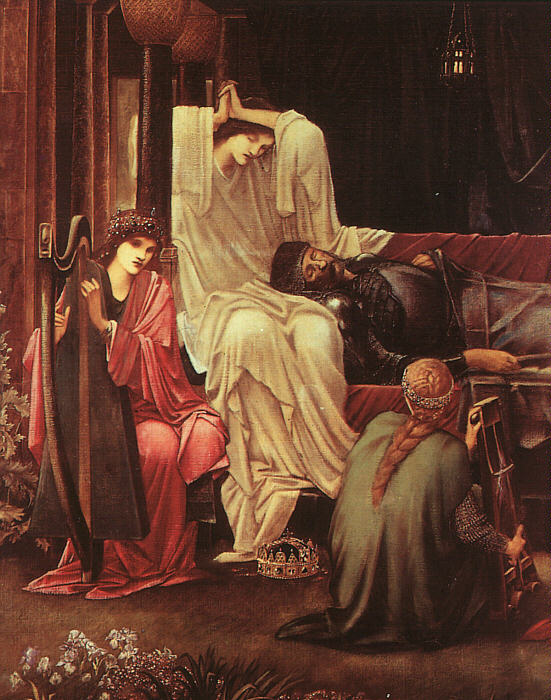
Much of the output of Edward Burne-Jones dwells on knights, angels, and sleeping maidens caught mid-story, figures suspended in a moment that never quite resolves. The Last Sleep of Arthur in Avalon pushes that tendency further than almost any other canvas he attempted, unfolding across a vast, frieze-like format that took him more than a decade to complete and left unfinished at his death. Where his smaller panels often isolate a single figure or pair, here he assembled an entire mourning court around the fallen king, turning a private death into something closer to a state ceremony.
The composition lays Arthur across the lower register of the canvas, attended by queens whose robes fall in the long, deliberate folds that Burne-Jones favoured throughout his career, echoes of Botticelli filtered through a Victorian sensibility for pattern and restraint. Behind them, apple trees heavy with fruit close off the scene, their branches and blossoms rendered with the same patient attention he gave to drapery and armour, so that no single passage of the painting asks to be read faster than another. Light enters low and even, without the theatrical contrast of a Baroque death scene; instead it settles across the whole gathering, unifying figures, foliage, and armour into a single pale harmony of green, gold, and muted rose.
That evenness of tone was deliberate. By the time he returned to this composition in the final years of his working life, Burne-Jones had moved away from narrative urgency toward a kind of suspended stillness, and Avalon became the fullest statement of that late style, a picture built from accumulated decades of drawing and revision rather than a single burst of invention. Every fold of cloth and every leaf carries the weight of that slow accretion, which is part of why the canvas rewards close, unhurried looking rather than a passing glance.
ByMuseum recreates this canvas as a hand-painted oil painting reproduction, worked by a trained artist directly onto artist-grade cotton canvas rather than produced through any printed process. The painter matches the original palette passage by passage, rebuilding the layered drapery and the soft, even light with real brushwork, so the surface carries visible texture and depth in the way oil paint alone can achieve. The result is a museum quality reproduction meant to be looked at the way the original invites looking, slowly, with the eye moving from figure to figure across the composition.
A painting this patient still holds attention because it refuses to hurry the viewer, offering instead a scene built to be returned to. Owning a hand-painted version of it means keeping that quality of stillness on your own wall, rendered in the same slow medium that made the original what it is.
Empty walls flatten a room. A classical artwork restores structure and visual hierarchy. One painting defines the space, anchors furniture, and establishes identity.
Worldwide shipping included. Each painting is produced to order and safely packed for international transport.
All payments are encrypted and processed through trusted payment providers.
Real brushwork, layered oil paint, and durable pigments on museum-quality canvas.
If the result does not meet expectations, return it for a full refund.


Your artwork is painted on premium cotton canvas, then shipped safely rolled in a rigid tube with extra blank canvas border — ready for stretching or framing locally.
Select a handcrafted frame and we’ll deliver your painting fully assembled, protected, and ready to hang.
For safe shipping, framing is available up to a maximum size. Larger sizes will automatically disable the frame option.


Choose “Stretched” to receive your canvas mounted on wooden stretcher bars — perfect if you’ll frame it later or display it as-is.
Gallery Wrap is a deeper, 1.5" style stretcher. The canvas wraps around the sides and is stapled on the back for a clean, modern, frameless look.
We ship with UPS, FedEx, or DHL straight to your door. You’ll receive a tracking number as soon as your order leaves our studio. Typical delivery is 4–5 business days after dispatch; large, framed, or stretched pieces may take longer depending on the safest shipping route.


Unframed canvases are protected with a film, carefully rolled, and secured inside a rigid shipping tube.

Stretched, Gallery Wrapped, and Framed paintings are wrapped, cushioned with foam protection, and boxed for safe transit.