Loading cart…
No products in the cart.

Original price was: $518.00.$259.00Current price is: $259.00.
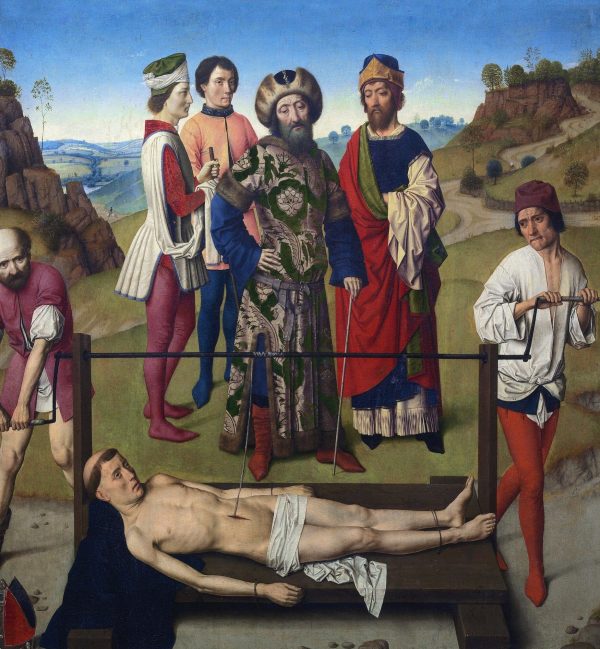
A hand-painted oil reproduction of The Martyrdom of Saint Erasmus (Elmo) by Dirk Bouts, painted on canvas to preserve its restrained composition and layered surface.
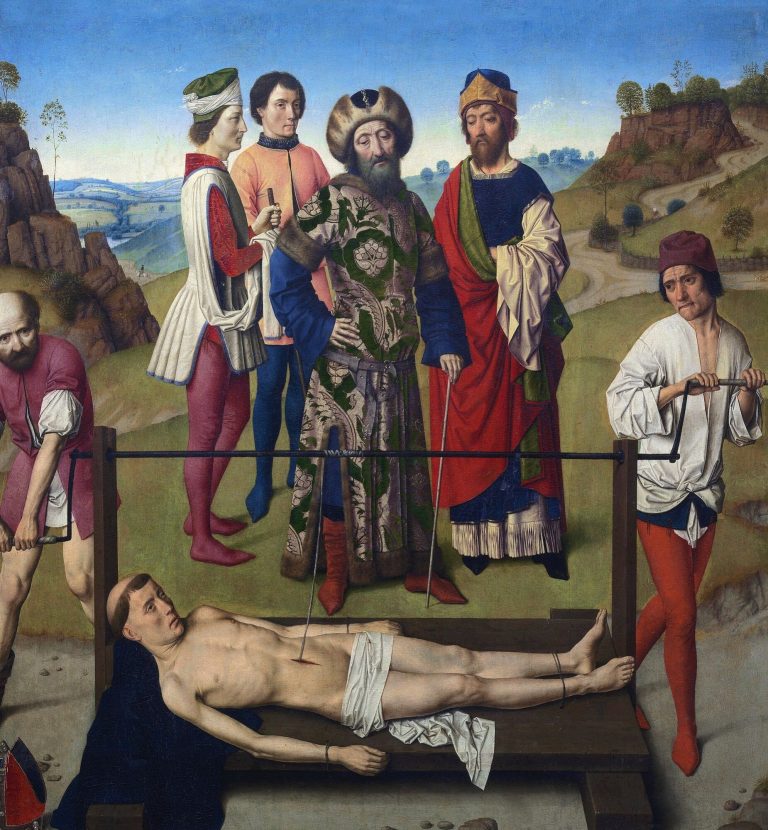
A crowd of executioners bends over a bound figure at the centre of the panel, their instruments and gestures pulling the eye inward even as the surrounding onlookers and distant landscape hold the scene in a wider, more measured frame. Light falls unevenly across the group, catching a shoulder here, a raised arm there, so that the horror of the subject is delivered in fragments rather than as a single violent mass. The calm, almost clinical spacing between figures is what gives the picture its unsettling power: nothing is rushed, and every participant in the ordeal occupies his own careful patch of ground.
This restraint belongs to the working method of Dirk Bouts, a painter active in the southern Netherlands in the middle decades of the fifteenth century, whose figures tend toward stillness even in scenes of extreme action. The martyrdom of Saint Erasmus, also venerated as Saint Elmo, was a familiar subject for churches seeking protection for sailors and for anyone suffering intestinal illness, and Bouts approaches it with the same measured geometry he brought to his devotional panels and altarpieces. Faces are drawn with a linear precision that owes something to earlier Netherlandish panel painting, while the modelling of drapery and flesh shows the slow accumulation of glazes typical of oil technique in this period.
What keeps the panel compelling across centuries is the tension between its subject and its handling: brutality rendered with the patience of a portrait painter, colour kept cool and controlled even where the narrative is not. It has earned its place among the famous paintings of the early Netherlandish school precisely because that discipline of eye and hand has rarely been matched. Owning a painted version of a work with this history means living with a surface that argues, quietly, for craft over convenience.
Each ByMuseum reproduction of this composition is painted entirely by hand in oil on canvas, not printed, by a trained artist working to match the original palette, the fall of light across each figure, and the fine linear drawing that defines the drapery and faces. As an oil painting reproduction it carries the same layered build of colour and the same visible brushwork as the source panel, so the surface catches light the way an original oil surface does rather than sitting flat under glass. The result is a physical object with genuine texture, made to be looked at closely rather than glanced at once.
Empty walls flatten a room. A classical artwork restores structure and visual hierarchy. One painting defines the space, anchors furniture, and establishes identity.
Worldwide shipping included. Each painting is produced to order and safely packed for international transport.
All payments are encrypted and processed through trusted payment providers.
Real brushwork, layered oil paint, and durable pigments on museum-quality canvas.
If the result does not meet expectations, return it for a full refund.


Your artwork is painted on premium cotton canvas, then shipped safely rolled in a rigid tube with extra blank canvas border — ready for stretching or framing locally.
Select a handcrafted frame and we’ll deliver your painting fully assembled, protected, and ready to hang.
For safe shipping, framing is available up to a maximum size. Larger sizes will automatically disable the frame option.


Choose “Stretched” to receive your canvas mounted on wooden stretcher bars — perfect if you’ll frame it later or display it as-is.
Gallery Wrap is a deeper, 1.5" style stretcher. The canvas wraps around the sides and is stapled on the back for a clean, modern, frameless look.
We ship with UPS, FedEx, or DHL straight to your door. You’ll receive a tracking number as soon as your order leaves our studio. Typical delivery is 5 to 7 days after dispatch; large, framed, or stretched pieces may take longer depending on the safest shipping route.


Unframed canvases are protected with a film, carefully rolled, and secured inside a rigid shipping tube.

Stretched, Gallery Wrapped, and Framed paintings are wrapped, cushioned with foam protection, and boxed for safe transit.