Loading cart…
No products in the cart.

Original price was: $599.00.$299.00Current price is: $299.00.
The Nativity at Night by Geertgen tot Sint Jans, a jewel-like nocturne in which the Christ Child is the only true light in the scene.
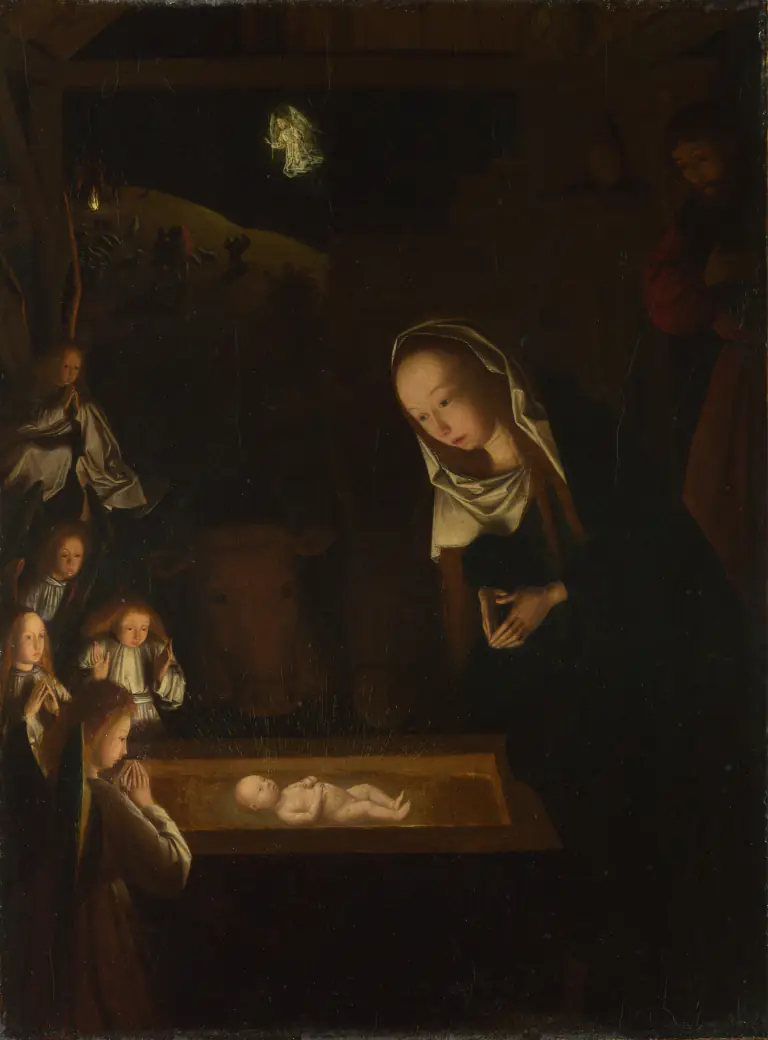
Historians of art have long treated this small panel as a turning point, the moment painters first let a single body become the only source of light in a scene. For more than a century it has been cited as one of the earliest true nocturnes in Western painting, a work that later painters studied for its handling of dark and glow long before the term chiaroscuro existed to describe it. The Nativity at Night reproduction brought into a home carries that reputation with it, but the reputation only matters because of what sits on the panel itself.
Geertgen tot Sint Jans places the newborn Christ in the manger as the single point of illumination, his body casting warmth across the faces of the Virgin Mary, Saint Joseph, and a cluster of angels pressed close around him. An ox and a donkey surface only faintly from the surrounding dark, their forms suggested rather than described. Through a broken opening in the stable wall, a second light appears at a distance: shepherds gathered at a small fire on a hillside, watching an angel descend to announce the birth, a secondary glow that answers the light of the Child without rivalling it. The arrangement follows the visionary writings of Saint Bridget of Sweden, who described the infant body of Christ giving off a light so bright it outshone the candle held by Joseph. Geertgen likely drew on a lost night-time Nativity by Hugo van der Goes, but he pushed the device of modulated darkness further than any painter working before him, built up in layers so thin and controlled that the darkness itself seems to have weight.
Each hand-painted oil painting reproduction of this composition is built by a trained painter working in oil on canvas, matching the palette passage by passage: the near-black browns of the stable interior, the warm gold at the center, the cooler blue-grey of the distant hillside fire. The painter lays the darkness down first, in thin, built-up layers, then works the light outward from the Christ Child the way the original panel does, so the glow reads as something generated by the paint itself rather than added on top of it. Brushwork stays visible across the surface, and the raised texture of the oil catches real light differently depending on where the viewer stands, which is the one effect no printed copy can produce.
| artists |
|---|
Empty walls flatten a room. A classical artwork restores structure and visual hierarchy. One painting defines the space, anchors furniture, and establishes identity.
Worldwide shipping included. Each painting is produced to order and safely packed for international transport.
All payments are encrypted and processed through trusted payment providers.
Real brushwork, layered oil paint, and durable pigments on museum-quality canvas.
If the result does not meet expectations, return it for a full refund.


Your artwork is painted on premium cotton canvas, then shipped safely rolled in a rigid tube with extra blank canvas border — ready for stretching or framing locally.
Select a handcrafted frame and we’ll deliver your painting fully assembled, protected, and ready to hang.
For safe shipping, framing is available up to a maximum size. Larger sizes will automatically disable the frame option.


Choose “Stretched” to receive your canvas mounted on wooden stretcher bars — perfect if you’ll frame it later or display it as-is.
Gallery Wrap is a deeper, 1.5" style stretcher. The canvas wraps around the sides and is stapled on the back for a clean, modern, frameless look.
We ship with UPS, FedEx, or DHL straight to your door. You’ll receive a tracking number as soon as your order leaves our studio. Typical delivery is 5 to 7 days after dispatch; large, framed, or stretched pieces may take longer depending on the safest shipping route.


Unframed canvases are protected with a film, carefully rolled, and secured inside a rigid shipping tube.

Stretched, Gallery Wrapped, and Framed paintings are wrapped, cushioned with foam protection, and boxed for safe transit.

Man Writing a Letter
Gabriel Metsu, c. 1664
The gallery list
Every painting is already 50% off. Join the list and we will send you an extra $15 code, plus first access to new collections.
No spam. Unsubscribe anytime. · Privacy Policy
Welcome
Your $15 code is on its way. Explore the gallery while you wait.