Loading cart…
No products in the cart.

Original price was: $518.00.$259.00Current price is: $259.00.
The cold stone and quiet figures of The Rock of Doom by Burne-Jones, recreated as a hand-painted oil reproduction with the tonal control and surface depth collectors look for.
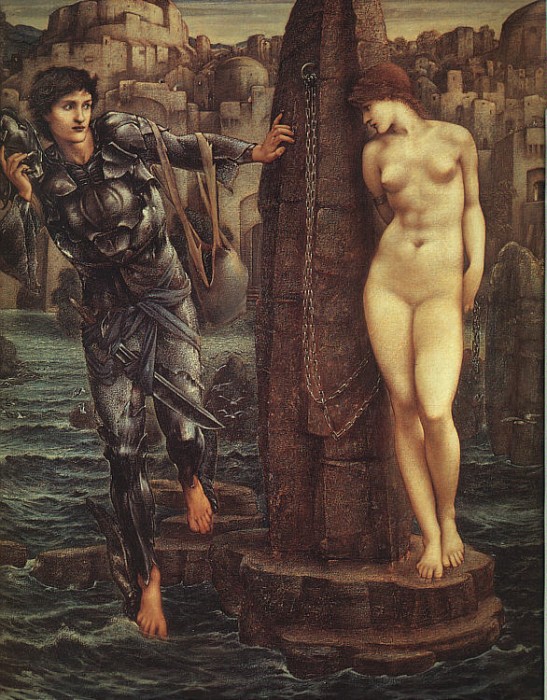
Slate grey rock, bruised violet shadow, and the pale flesh tones of Perseus and Andromeda meet across the surface in a scheme that feels deliberately restrained, almost airless. Burne-Jones lets the cold stone dominate, then breaks it with small notes of warmer colour in the figures, so the eye keeps returning to the two bodies caught against the mineral bulk behind them. It is a picture built on that tension between chill and warmth, and it rewards a wall where the light can catch the shifts in tone slowly rather than all at once.
The painting belongs to the sequence Burne-Jones developed around the Perseus legend, a cycle that occupied him intermittently across the 1870s and 1880s as he worked through the story in both painted and decorative form. Here the rock itself becomes almost a third figure, its faceted surface echoing the angularity of the bound Andromeda, while Perseus enters from the side in a pose that owes as much to Florentine sculpture as to any English painting of the period. The drawing is exact and unhurried; contours are held with the patience of an artist who trained himself on Italian precedent and never abandoned that discipline even as his subjects grew more personal and strange.
Edges are handled with particular care throughout, softened where flesh meets shadow, sharpened where rock meets sky, and this control of transition is where the picture asks for close looking rather than a passing glance. Burne-Jones was working at a point in his career when narrative had become secondary to mood, and that shows in how little incident the composition actually contains: two figures, a stone mass, a suggestion of sea, and a great deal of quiet held in the spaces between them.
ByMuseum artists paint this oil painting reproduction by hand, matching the grey and violet passages of the original stone and rebuilding the flesh tones layer by layer rather than flattening them into a single mixed hue. The painter works from the same tonal logic Burne-Jones used, laying thinner glazes where the light needs to breathe and building denser, more worked passages where the rock demands weight, so the finished canvas carries real impasto and a surface that shifts under raking light the way an oil painting should. Nothing here is printed; every plane of colour has been mixed and placed by a trained hand, and the result is a fine art reproduction with the kind of material presence a collector expects to find on close inspection, not just at a distance.
Empty walls flatten a room. A classical artwork restores structure and visual hierarchy. One painting defines the space, anchors furniture, and establishes identity.
Worldwide shipping included. Each painting is produced to order and safely packed for international transport.
All payments are encrypted and processed through trusted payment providers.
Real brushwork, layered oil paint, and durable pigments on museum-quality canvas.
If the result does not meet expectations, return it for a full refund.


Your artwork is painted on premium cotton canvas, then shipped safely rolled in a rigid tube with extra blank canvas border — ready for stretching or framing locally.
Select a handcrafted frame and we’ll deliver your painting fully assembled, protected, and ready to hang.
For safe shipping, framing is available up to a maximum size. Larger sizes will automatically disable the frame option.


Choose “Stretched” to receive your canvas mounted on wooden stretcher bars — perfect if you’ll frame it later or display it as-is.
Gallery Wrap is a deeper, 1.5" style stretcher. The canvas wraps around the sides and is stapled on the back for a clean, modern, frameless look.
We ship with UPS, FedEx, or DHL straight to your door. You’ll receive a tracking number as soon as your order leaves our studio. Typical delivery is 4–5 business days after dispatch; large, framed, or stretched pieces may take longer depending on the safest shipping route.


Unframed canvases are protected with a film, carefully rolled, and secured inside a rigid shipping tube.

Stretched, Gallery Wrapped, and Framed paintings are wrapped, cushioned with foam protection, and boxed for safe transit.