Loading cart…
No products in the cart.

Original price was: $599.00.$299.00Current price is: $299.00.
Stone ruins overlook the sea beneath a golden sky. Hand-painted oil-on-canvas reproduction.

The Ruins at Sunion, Greece by Frederic Edwin Church presents a classical temple near a coastal bluff. The sea and distant mountains extend behind the stone columns.
The temple sits near the shore, with the open water and horizon occupying much of the background. The viewer can follow the main forms from the focal area toward the surrounding setting. This sequence connects the visible parts and gives the composition balance. Differences in scale and direction also help separate the key forms without breaking the image into disconnected pieces.
Warm stone and golden sky contrast with blue water and darker coastal ground. Differences in brightness and edge help separate forms without isolating them from the larger arrangement. Tonal changes distinguish nearer elements from those farther away, keeping the image readable while retaining depth.
The remaining columns rise above the cliff edge and provide a clear landmark. A broad sky and distant shoreline make the ruins feel exposed to the open coast. The relation between near and distant forms establishes scale, while changes in light and edge lead attention through the setting without closing the view.
This hand-painted oil-on-canvas reproduction of The Ruins at Sunion, Greece by Frederic Edwin Church translates the visible scene into a painted surface. Layered brushwork follows broad color areas and smaller forms, maintaining the relationships described above. Color and line guide attention across the reproduced composition and preserve its recognizable visual structure.
Follow the temple outline toward the water and far horizon. These relationships make the subject legible as part of a complete composition, with its own balance of detail and space. The viewer can notice individual forms while still reading the full scene as one connected image.
Empty walls flatten a room. A classical artwork restores structure and visual hierarchy. One painting defines the space, anchors furniture, and establishes identity.
Worldwide shipping included. Each painting is produced to order and safely packed for international transport.
All payments are encrypted and processed through trusted payment providers.
Real brushwork, layered oil paint, and durable pigments on museum-quality canvas.
If the result does not meet expectations, return it for a full refund.


Your artwork is painted on premium cotton canvas, then shipped safely rolled in a rigid tube with extra blank canvas border — ready for stretching or framing locally.
Select a handcrafted frame and we’ll deliver your painting fully assembled, protected, and ready to hang.
For safe shipping, framing is available up to a maximum size. Larger sizes will automatically disable the frame option.


Choose “Stretched” to receive your canvas mounted on wooden stretcher bars — perfect if you’ll frame it later or display it as-is.
Gallery Wrap is a deeper, 1.5" style stretcher. The canvas wraps around the sides and is stapled on the back for a clean, modern, frameless look.
We ship with UPS, FedEx, or DHL straight to your door. You’ll receive a tracking number as soon as your order leaves our studio. Typical delivery is 5 to 7 days after dispatch; large, framed, or stretched pieces may take longer depending on the safest shipping route.


Unframed canvases are protected with a film, carefully rolled, and secured inside a rigid shipping tube.

Stretched, Gallery Wrapped, and Framed paintings are wrapped, cushioned with foam protection, and boxed for safe transit.

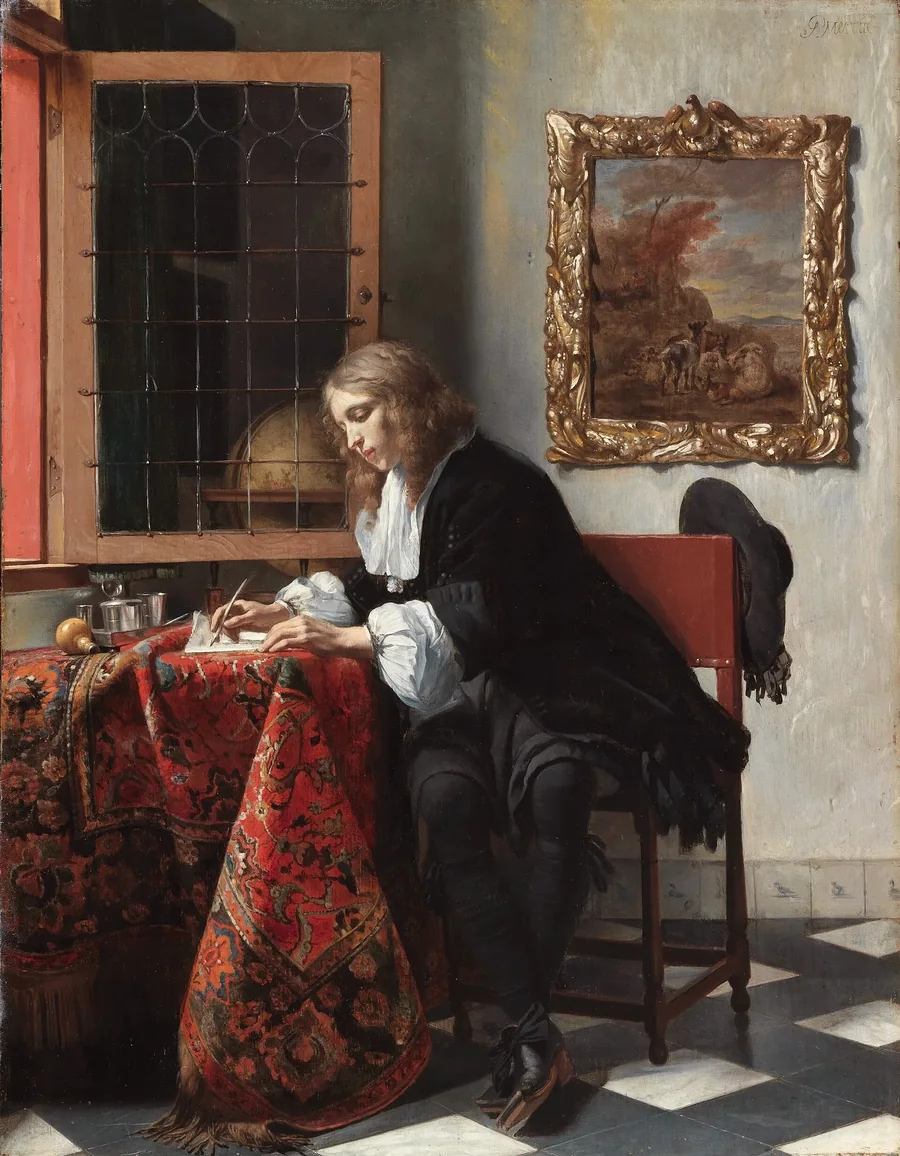
Man Writing a Letter
Gabriel Metsu, c. 1664
The gallery list
Every painting is already 50% off. Join the list and we will send you an extra $15 code, plus first access to new collections.
No spam. Unsubscribe anytime. · Privacy Policy
Welcome
Your $15 code is on its way. Explore the gallery while you wait.