Loading cart…
No products in the cart.

Original price was: $599.00.$299.00Current price is: $299.00.
A hand-painted oil reproduction of The Stonemason’s Yard by Canaletto, its worked stone and uneven Venetian light rebuilt brushstroke by brushstroke on canvas.
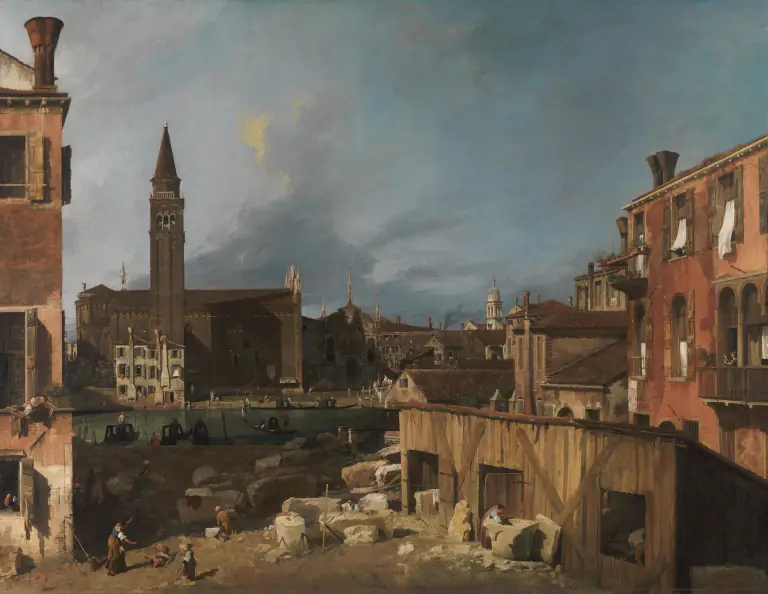
Thin washes of grey and ochre build the paving stones first, then a dry, broken brush drags across them to leave the paint slightly ragged at the edges, the way old stone actually breaks the light. Warmer touches of red and umber pick out the roof tiles and the timber propped against the masonry, while the sky behind is laid in with a cooler, more fluid hand, so the whole scene reads as a study in contrast between worked surface and open air. Out of this handling the subject gathers itself gradually: a modest campo in Venice, given over not to ceremony but to ordinary labour.
What makes The Stonemason’s Yard unusual within the career of Canaletto is exactly this refusal of spectacle. Rather than a grand processional view of the city, he set his easel before a working yard stacked with blocks of stone, a well, drying laundry, a woman at a spinning wheel, figures bent to their tasks. The canal beyond is glimpsed rather than announced, and the church that rises in the distance is kept modest in scale, subordinate to the foreground activity. Light falls unevenly across the scene, catching the pale stone and the white sheets while leaving doorways and lower walls in shadow, and it is this uneven fall of light that gives the picture its sense of a particular afternoon rather than an idealised one.
The paint handling throughout rewards close looking: edges are worked and reworked, some crisp and some allowed to dissolve into the surrounding tone, and the architecture is built from small, considered intervals rather than a single sweeping perspective scheme. This is Canaletto before the export trade for English patrons pushed him toward more polished, souvenir-like views of Venice, working instead in a looser, more searching manner. Our painters study these qualities directly when preparing an oil painting reproduction, matching the tonal shifts stone by stone and rebuilding the drag and lift of the original brushwork rather than copying a flattened image. The result is an oil on canvas reproduction with real paint sitting above the weave of the canvas, its surface catching light the way the original does, which is something no printed version can offer a buyer who looks closely at condition and surface.
Hung where the afternoon light crosses it at an angle, the picture keeps changing through the day, the pale stones brightening and the shadowed corners deepening, so it suits a study, a library wall, or a quiet stretch of hallway rather than a room lit flat and even. It asks for a certain patience from whoever lives with it, rewarding a second and third look rather than announcing itself at a glance, and it settles well into rooms already furnished with older wood and worn textiles.
Empty walls flatten a room. A classical artwork restores structure and visual hierarchy. One painting defines the space, anchors furniture, and establishes identity.
Worldwide shipping included. Each painting is produced to order and safely packed for international transport.
All payments are encrypted and processed through trusted payment providers.
Real brushwork, layered oil paint, and durable pigments on museum-quality canvas.
If the result does not meet expectations, return it for a full refund.


Your artwork is painted on premium cotton canvas, then shipped safely rolled in a rigid tube with extra blank canvas border — ready for stretching or framing locally.
Select a handcrafted frame and we’ll deliver your painting fully assembled, protected, and ready to hang.
For safe shipping, framing is available up to a maximum size. Larger sizes will automatically disable the frame option.


Choose “Stretched” to receive your canvas mounted on wooden stretcher bars — perfect if you’ll frame it later or display it as-is.
Gallery Wrap is a deeper, 1.5" style stretcher. The canvas wraps around the sides and is stapled on the back for a clean, modern, frameless look.
We ship with UPS, FedEx, or DHL straight to your door. You’ll receive a tracking number as soon as your order leaves our studio. Typical delivery is 5 to 7 days after dispatch; large, framed, or stretched pieces may take longer depending on the safest shipping route.


Unframed canvases are protected with a film, carefully rolled, and secured inside a rigid shipping tube.

Stretched, Gallery Wrapped, and Framed paintings are wrapped, cushioned with foam protection, and boxed for safe transit.

Man Writing a Letter
Gabriel Metsu, c. 1664
The gallery list
Every painting is already 50% off. Join the list and we will send you an extra $15 code, plus first access to new collections.
No spam. Unsubscribe anytime. · Privacy Policy
Welcome
Your $15 code is on its way. Explore the gallery while you wait.