Loading cart…
No products in the cart.

Original price was: $518.00.$259.00Current price is: $259.00.
The Three Domes, Clay Bluffs 15 Miles above the Mandan Village by George Catlin, hand-painted in oil on canvas with the restraint and plain observation of his river studies.
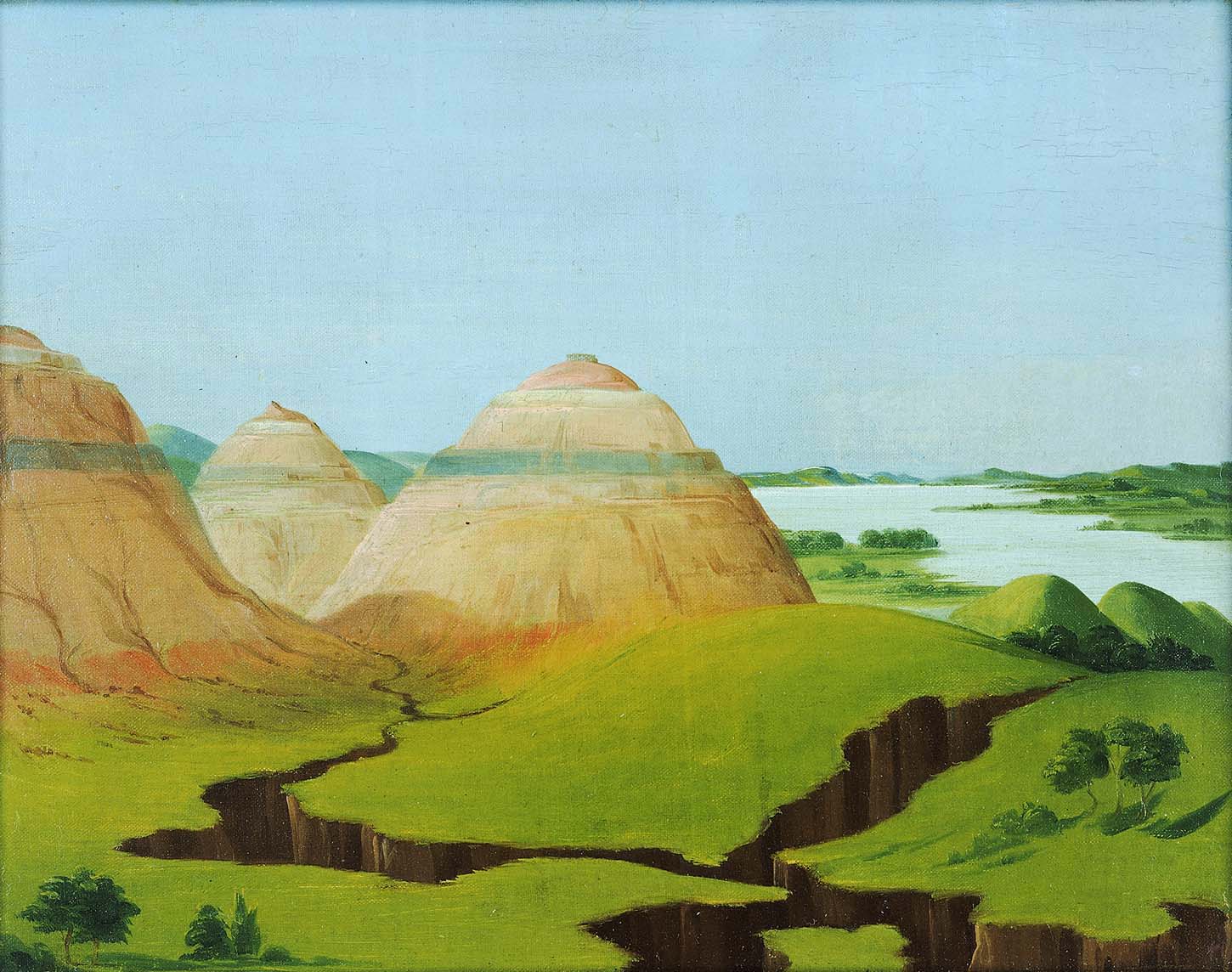
In the early 1830s George Catlin travelled up the Missouri River on the American Fur Company steamboat Yellowstone, determined to record the peoples and landscapes of the northern plains before, as he feared, they vanished under the pressure of settlement. Along the way he filled sketchbooks with the bluffs, buttes, and river cliffs that framed the villages he visited, and The Three Domes, Clay Bluffs 15 Miles above the Mandan Village belongs to that campaign: a landscape study made in the field, close to the Mandan settlements on the upper Missouri, at a moment when Catlin was as much a topographer as a portraitist.
The three rounded rises that give the picture its title sit against a wide sky, their pale clay faces catching light in a way that separates them from the darker vegetation and river flats below. Catlin builds the composition in horizontal bands, water, bank, bluff, sky, so that the eye reads the scene the way a traveller on the river would have seen it unfold, one rising shape after another along the shoreline. The palette stays close to the tones of the land itself, ochres and warm greys against a cooler sky, with the paint handled thinly and directly in the manner Catlin used throughout his plains work, more record than embellishment.
What holds the picture together is restraint. There is no incident competing for attention, no figures to soften the strangeness of the terrain; the bluffs themselves carry the composition, and Catlin trusts them to do so. That confidence in plain observation, learned on the river and rarely abandoned afterward, is part of why these landscape studies still read as documents rather than as invented scenery.
Our painters translate that same directness into an oil on canvas reproduction built by hand rather than printed. Working from the original palette, they lay in the ochres and greys of the bluffs in real oil, keeping the visible brushwork and the slightly uneven surface that thin, direct paint handling produces, so the canvas carries the texture of a painted object and not a flat facsimile. Each hand-painted oil painting reproduction is worked individually, which means small variations in touch are part of the finished piece rather than a flaw to be corrected.
It suits a reader drawn to the American west before it was settled, or to landscape painting that trusts plain fact over drama, and it sits comfortably in a study, a hallway, or any room where a quieter, considered image is wanted rather than a loud one.
Empty walls flatten a room. A classical artwork restores structure and visual hierarchy. One painting defines the space, anchors furniture, and establishes identity.
Worldwide shipping included. Each painting is produced to order and safely packed for international transport.
All payments are encrypted and processed through trusted payment providers.
Real brushwork, layered oil paint, and durable pigments on museum-quality canvas.
If the result does not meet expectations, return it for a full refund.


Your artwork is painted on premium cotton canvas, then shipped safely rolled in a rigid tube with extra blank canvas border — ready for stretching or framing locally.
Select a handcrafted frame and we’ll deliver your painting fully assembled, protected, and ready to hang.
For safe shipping, framing is available up to a maximum size. Larger sizes will automatically disable the frame option.


Choose “Stretched” to receive your canvas mounted on wooden stretcher bars — perfect if you’ll frame it later or display it as-is.
Gallery Wrap is a deeper, 1.5" style stretcher. The canvas wraps around the sides and is stapled on the back for a clean, modern, frameless look.
We ship with UPS, FedEx, or DHL straight to your door. You’ll receive a tracking number as soon as your order leaves our studio. Typical delivery is 4–5 business days after dispatch; large, framed, or stretched pieces may take longer depending on the safest shipping route.


Unframed canvases are protected with a film, carefully rolled, and secured inside a rigid shipping tube.

Stretched, Gallery Wrapped, and Framed paintings are wrapped, cushioned with foam protection, and boxed for safe transit.