Loading cart…
No products in the cart.

Original price was: $518.00.$259.00Current price is: $259.00.
A hand-painted oil reproduction of The Three Graces by Edward Burne-Jones, painted on canvas to preserve its restrained palette and layered brushwork.
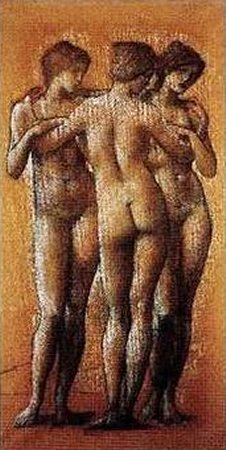
By the late 1880s, Edward Burne-Jones had settled into a mature idiom, one drawn less from direct observation than from an inner repertoire of classical form, mythic subject and Renaissance memory. The Three Graces belongs to this period of quiet consolidation, when the artist, already established through his association with the Arts and Crafts movement and with Morris and Company, turned repeatedly to subjects that let him explore the human figure as pure rhythm and pattern rather than as portrait or narrative event.
The three attendant figures of classical myth, traditionally emblems of grace, joy and beauty, are arranged here in the close, interlocking poses that Burne-Jones favoured throughout his later career. Drapery falls in long vertical folds that echo the verticals of the composition itself, while the figures are bound together by touching hands and inclined heads, so that the group reads as a single continuous form rather than three separate bodies. Light is handled with restraint: rather than modelling flesh with strong contrast, Burne-Jones lets tone shift gradually across the surface, giving the figures a cool, almost marble pallor that recalls sculpture as much as painting.
Colour is kept deliberately narrow, built from muted greens, dull golds and pale flesh tones that never compete with the drawing beneath them, a discipline typical of his mature work and of the wider Pre-Raphaelite interest in surface and symbol over illusionistic depth. The result is an image that rewards slow looking, its quieter passages of drapery and background only becoming legible after the eye has settled. Each ByMuseum reproduction of this composition is a hand-painted oil painting reproduction, worked in oil on artist-grade canvas by a trained painter who studies the original palette and brush handling before laying in a single stroke. Rather than mechanical reproduction, this is a handmade oil painting built up in layers, so the raised texture of impasto and the visible pull of the brush remain part of the finished surface, giving the picture a physical presence that a printed sheet cannot offer.
Such a piece suits a collector drawn to the more contemplative corner of the Pre-Raphaelite circle, or a room where a large, quietly toned figure composition can anchor a wall without demanding constant attention. It works equally well as a considered gift for someone who already knows the Burne-Jones idiom and wants to live with it rather than simply admire it in reproduction.
Empty walls flatten a room. A classical artwork restores structure and visual hierarchy. One painting defines the space, anchors furniture, and establishes identity.
Worldwide shipping included. Each painting is produced to order and safely packed for international transport.
All payments are encrypted and processed through trusted payment providers.
Real brushwork, layered oil paint, and durable pigments on museum-quality canvas.
If the result does not meet expectations, return it for a full refund.


Your artwork is painted on premium cotton canvas, then shipped safely rolled in a rigid tube with extra blank canvas border — ready for stretching or framing locally.
Select a handcrafted frame and we’ll deliver your painting fully assembled, protected, and ready to hang.
For safe shipping, framing is available up to a maximum size. Larger sizes will automatically disable the frame option.


Choose “Stretched” to receive your canvas mounted on wooden stretcher bars — perfect if you’ll frame it later or display it as-is.
Gallery Wrap is a deeper, 1.5" style stretcher. The canvas wraps around the sides and is stapled on the back for a clean, modern, frameless look.
We ship with UPS, FedEx, or DHL straight to your door. You’ll receive a tracking number as soon as your order leaves our studio. Typical delivery is 4–5 business days after dispatch; large, framed, or stretched pieces may take longer depending on the safest shipping route.


Unframed canvases are protected with a film, carefully rolled, and secured inside a rigid shipping tube.

Stretched, Gallery Wrapped, and Framed paintings are wrapped, cushioned with foam protection, and boxed for safe transit.


