Loading cart…
No products in the cart.

$1,499.00
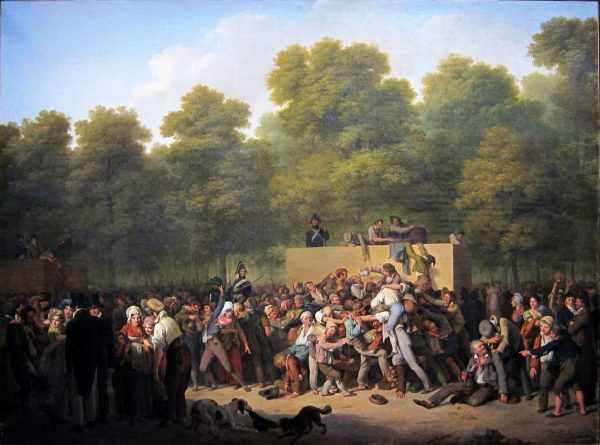
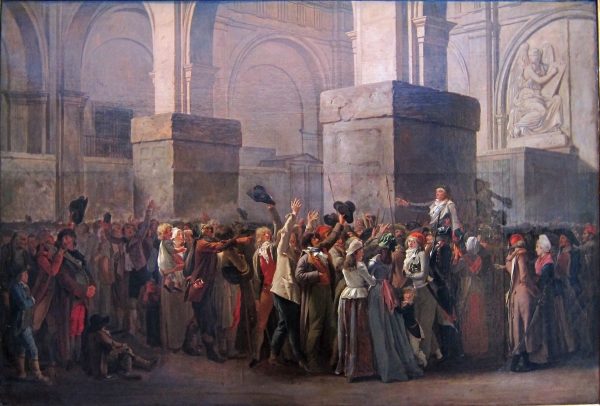
A crowded, closely observed scene by Louis Leopold Boilly, recreated as a hand-painted oil on canvas reproduction rather than a printed copy.
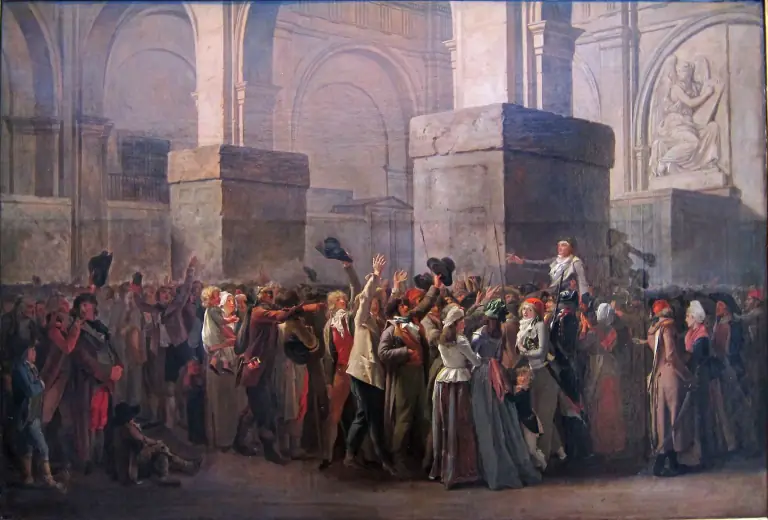
A dense crowd gathers around a central figure whose elevation above the surrounding heads gives the scene its immediate charge. Bodies press close together, faces turn upward or sideways in a scatter of individual reactions, and the eye moves through the throng in a series of small discoveries rather than a single sweep. Light falls unevenly across the group, catching a raised arm here, a bared shoulder there, so that the composition reads less as a formal tableau than as a moment caught mid-motion.
Louis Leopold Boilly built his reputation on precisely this kind of crowded, socially observant scene, and The Triumph of Marat belongs to a period when French painting was absorbing the pressures of revolutionary politics into everyday pictorial subjects. Rather than staging an allegory, Boilly records something closer to public spectacle: the mixture of curiosity, enthusiasm and unease that a political moment could provoke in ordinary people. The handling is precise without being stiff, each face given enough individuality to suggest a real bystander rather than a symbolic type.
Colour is kept largely within a controlled, naturalistic range, with warmer flesh tones and muted garments allowing the few brighter accents to carry weight. The drawing is tight, the transitions between figures carefully judged, and the whole scene held together by a compositional logic that never lets the crowd dissolve into chaos. It is a painting built on observation as much as invention, and that groundedness is part of why it continues to reward close looking.
ByMuseum artists recreate this composition as a hand-painted oil painting reproduction, working in oil on artist-grade canvas rather than reproducing the image by print. Each figure, each passage of light and shadow, is rebuilt by hand, so the finished oil on canvas reproduction carries real brushwork, layered pigment and the slight variations in surface that a printed image cannot hold. The palette is matched with care, and the texture of the paint is left visible, giving the work the presence of an object made rather than manufactured.
Two centuries on, the painting still holds attention because it treats a charged political moment with the eye of a careful observer rather than a propagandist, and that restraint gives it a durability that louder images often lack. Owning a version of it painted by hand, rather than printed, keeps that quality of attention intact on the wall.
Empty walls flatten a room. A classical artwork restores structure and visual hierarchy. One painting defines the space, anchors furniture, and establishes identity.
Worldwide shipping included. Each painting is produced to order and safely packed for international transport.
All payments are encrypted and processed through trusted payment providers.
Real brushwork, layered oil paint, and durable pigments on museum-quality canvas.
If the result does not meet expectations, return it for a full refund.


Your artwork is painted on premium cotton canvas, then shipped safely rolled in a rigid tube with extra blank canvas border — ready for stretching or framing locally.
Select a handcrafted frame and we’ll deliver your painting fully assembled, protected, and ready to hang.
For safe shipping, framing is available up to a maximum size. Larger sizes will automatically disable the frame option.


Choose “Stretched” to receive your canvas mounted on wooden stretcher bars — perfect if you’ll frame it later or display it as-is.
Gallery Wrap is a deeper, 1.5" style stretcher. The canvas wraps around the sides and is stapled on the back for a clean, modern, frameless look.
We ship with UPS, FedEx, or DHL straight to your door. You’ll receive a tracking number as soon as your order leaves our studio. Typical delivery is 5 to 7 days after dispatch; large, framed, or stretched pieces may take longer depending on the safest shipping route.


Unframed canvases are protected with a film, carefully rolled, and secured inside a rigid shipping tube.

Stretched, Gallery Wrapped, and Framed paintings are wrapped, cushioned with foam protection, and boxed for safe transit.

Man Writing a Letter
Gabriel Metsu, c. 1664
The gallery list
Every painting is already 50% off. Join the list and we will send you an extra $15 code, plus first access to new collections.
No spam. Unsubscribe anytime. · Privacy Policy
Welcome
Your $15 code is on its way. Explore the gallery while you wait.