Loading cart…
No products in the cart.


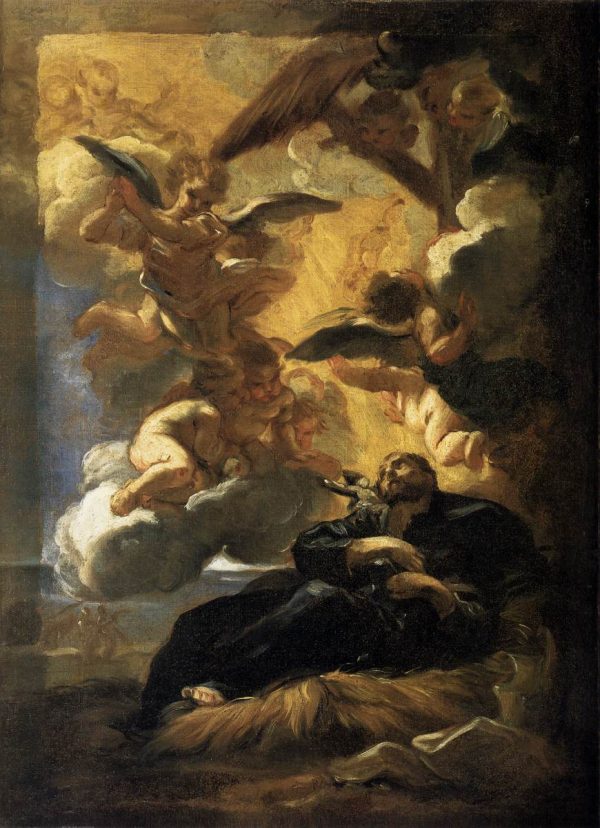
A missionary saint caught mid-vision, his body angled upward as though pulled by something beyond the canvas: this is the moment that drew Baciccio to the subject of Francis Xavier, whose ecstatic encounters with the divine gave Baroque painters exactly the material they wanted, bodies straining against gravity, faces lit from within by conviction rather than daylight.
The composition organises itself around the saint gaze, which tilts toward a heavenly zone rendered in the glowing, almost molten light that Baciccio handled with particular skill. Drapery billows in response to no earthly wind, and the figures around the saint register the vision through gesture and expression rather than shared sight, a device that heightens the sense of a private revelation breaking into the physical world. Baciccio, working in Rome during the height of the Baroque and closely associated with the decorative ambitions of the Jesuit order, brought to this kind of subject a fluency in contrast: dense, earthbound shadow set against passages of near-incandescent glaze, so the eye is pulled through the canvas the same way the saint is pulled toward the light above him.
The paint handling itself rewards close looking. Layers of glaze sit over more solid underpainting, a technique that gives the luminous areas their particular depth, while the drapery and flesh are built with visible, confident brushwork that a discerning eye will look for in any reproduction claiming fidelity to the original surface. A trained painter working on an oil on canvas reproduction has to match not just the colour but the order in which those layers were laid down, since the glow depends on it.
ByMuseum artists paint this oil painting reproduction by hand, working in oil on artist-grade canvas to rebuild the palette glaze by glaze rather than approximating it in a single flat pass. The brushwork stays visible under raking light, the impasto in the drapery keeps its raised texture, and the canvas weave itself contributes to how the surface catches light, much as it would have in the original studio practice. The result is a painted object with genuine material presence, not a flat facsimile, suited to a wall where its surface will be seen up close as well as from across a room.
Empty walls flatten a room. A classical artwork restores structure and visual hierarchy. One painting defines the space, anchors furniture, and establishes identity.
Worldwide shipping included. Each painting is produced to order and safely packed for international transport.
All payments are encrypted and processed through trusted payment providers.
Real brushwork, layered oil paint, and durable pigments on museum-quality canvas.
If the result does not meet expectations, return it for a full refund.


Your artwork is painted on premium cotton canvas, then shipped safely rolled in a rigid tube with extra blank canvas border — ready for stretching or framing locally.
Select a handcrafted frame and we’ll deliver your painting fully assembled, protected, and ready to hang.
For safe shipping, framing is available up to a maximum size. Larger sizes will automatically disable the frame option.


Choose “Stretched” to receive your canvas mounted on wooden stretcher bars — perfect if you’ll frame it later or display it as-is.
Gallery Wrap is a deeper, 1.5" style stretcher. The canvas wraps around the sides and is stapled on the back for a clean, modern, frameless look.
We ship with UPS, FedEx, or DHL straight to your door. You’ll receive a tracking number as soon as your order leaves our studio. Typical delivery is 4–5 business days after dispatch; large, framed, or stretched pieces may take longer depending on the safest shipping route.


Unframed canvases are protected with a film, carefully rolled, and secured inside a rigid shipping tube.

Stretched, Gallery Wrapped, and Framed paintings are wrapped, cushioned with foam protection, and boxed for safe transit.
A note from the studio
Our studio is working through an exceptional number of commissions, so we have paused new orders for a short time. We will start taking orders again on 1 October.
Every painting is made entirely by hand, and we would rather pause than rush one. Thank you for your patience and your trust.
Leave your details and we will reserve your place: we will write to you as soon as orders reopen.
Thank you
Your request is saved. We will write to you on 1 October, and a confirmation is on its way to your inbox.