Loading cart…
No products in the cart.

Original price was: $518.00.$259.00Current price is: $259.00.
A hand-painted reproduction of The White Cloud, Head Chief of the Iowas by George Catlin, prized for its direct gaze and the discipline of its restrained palette.
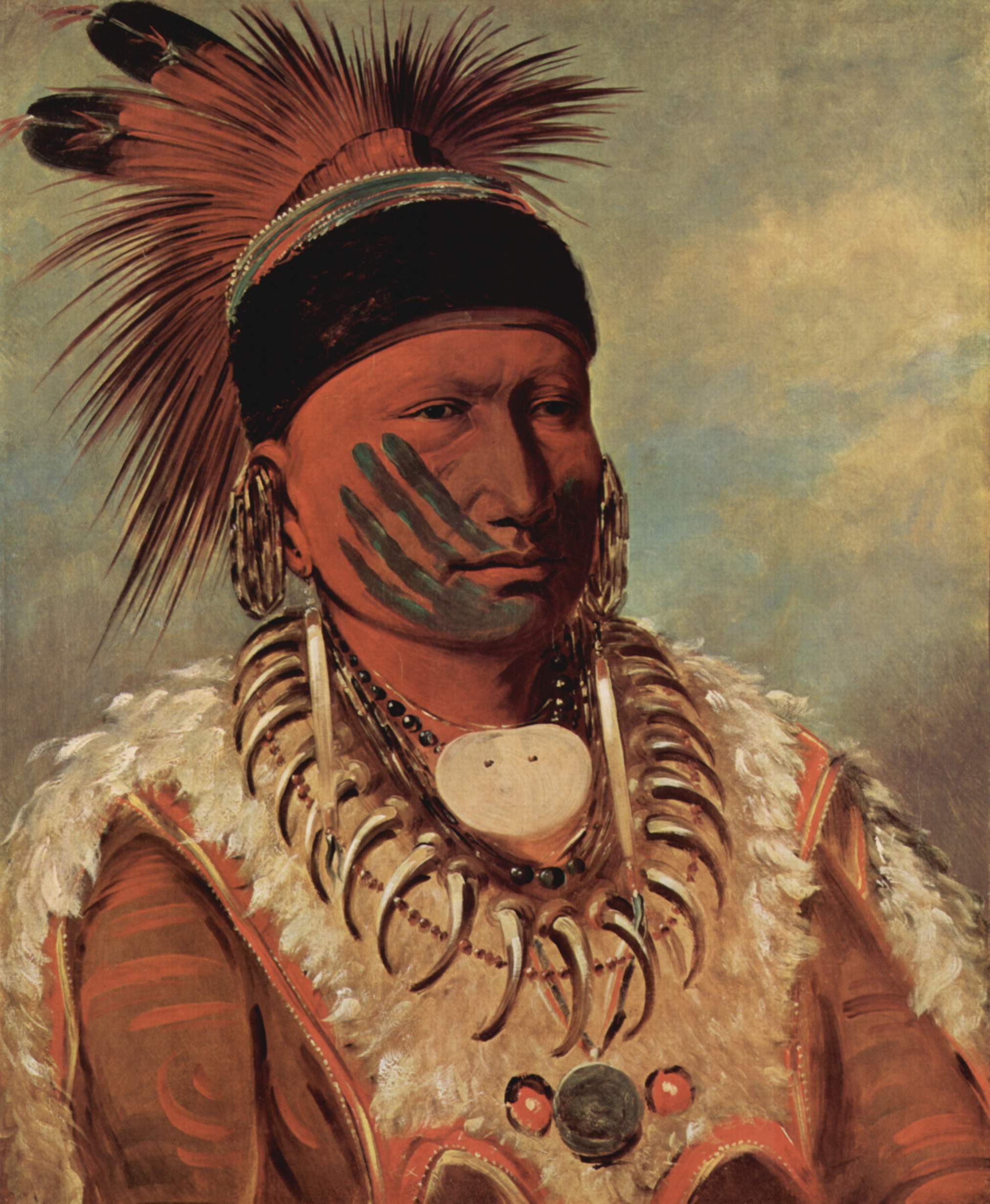
Across the many portraits George Catlin made while travelling among the Plains nations in the 1830s, most figures are shown in strict frontal or profile arrangement, a documentary approach suited to recording dress and regalia for eastern audiences who would never meet these leaders in person. The White Cloud, Head Chief of the Iowas departs from that formula in small but telling ways, the pose looser, the gaze more directly engaged with the viewer, so the sitter reads less as a specimen and more as a man aware of being seen.
The composition centres on the head and shoulders, with the painted face and ornaments rendered in close, careful detail against a plain ground that keeps every distraction away from the sitter. Catlin worked quickly in the field, often finishing a likeness in a single sitting, and that urgency shows in the directness of the brushwork even where the paint has been built up with evident care around the eyes and the line of the jaw. Colour is kept deliberately narrow, earth tones and muted reds carrying the weight of the image, so that the few brighter accents in the ornament and paint carry real force.
What holds a viewer here is the tension between speed and attention, a portrait made under real constraints of time and travel that still manages a searching, individual likeness rather than a type. A discerning eye will look for exactly that balance in a reproduction: the transitions of tone around the face kept soft rather than flattened, the plain background given enough surface variation to feel painted rather than blank, the ornament rendered with enough precision to read as observed detail. In a museum quality reproduction painted by hand rather than printed, those qualities survive because each layer of oil colour is built up the way the original was, not scanned and reproduced as a flat image. The canvas that results carries a real painted surface, with the depth and slight unevenness of hand-applied paint, so the object on the wall behaves like a painting rather than a picture of one. Owning that kind of copy is a way of keeping a documentary record made nearly two centuries ago in active, physical form, rather than as a print at a remove from the thing it depicts.
Empty walls flatten a room. A classical artwork restores structure and visual hierarchy. One painting defines the space, anchors furniture, and establishes identity.
Worldwide shipping included. Each painting is produced to order and safely packed for international transport.
All payments are encrypted and processed through trusted payment providers.
Real brushwork, layered oil paint, and durable pigments on museum-quality canvas.
If the result does not meet expectations, return it for a full refund.


Your artwork is painted on premium cotton canvas, then shipped safely rolled in a rigid tube with extra blank canvas border — ready for stretching or framing locally.
Select a handcrafted frame and we’ll deliver your painting fully assembled, protected, and ready to hang.
For safe shipping, framing is available up to a maximum size. Larger sizes will automatically disable the frame option.


Choose “Stretched” to receive your canvas mounted on wooden stretcher bars — perfect if you’ll frame it later or display it as-is.
Gallery Wrap is a deeper, 1.5" style stretcher. The canvas wraps around the sides and is stapled on the back for a clean, modern, frameless look.
We ship with UPS, FedEx, or DHL straight to your door. You’ll receive a tracking number as soon as your order leaves our studio. Typical delivery is 4–5 business days after dispatch; large, framed, or stretched pieces may take longer depending on the safest shipping route.


Unframed canvases are protected with a film, carefully rolled, and secured inside a rigid shipping tube.

Stretched, Gallery Wrapped, and Framed paintings are wrapped, cushioned with foam protection, and boxed for safe transit.

A note from the studio
Our studio is working through an exceptional number of commissions, so we have paused new orders for a short time. We will start taking orders again on 1 October.
Every painting is made entirely by hand, and we would rather pause than rush one. Thank you for your patience and your trust.
Leave your details and we will reserve your place: we will write to you as soon as orders reopen.
Thank you
Your request is saved. We will write to you on 1 October, and a confirmation is on its way to your inbox.