Loading cart…
No products in the cart.

Original price was: $518.00.$299.00Current price is: $299.00.
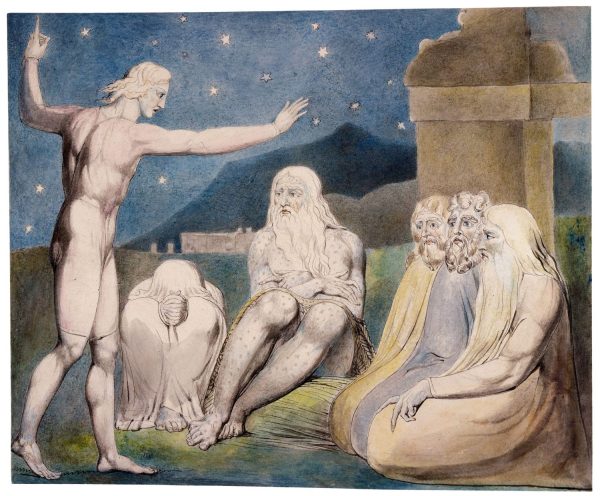
A hand-painted replica of The Wrath of Elihu by William Blake, rendered in oil to carry across the scorched palette and taut linework of the original scene from Job.
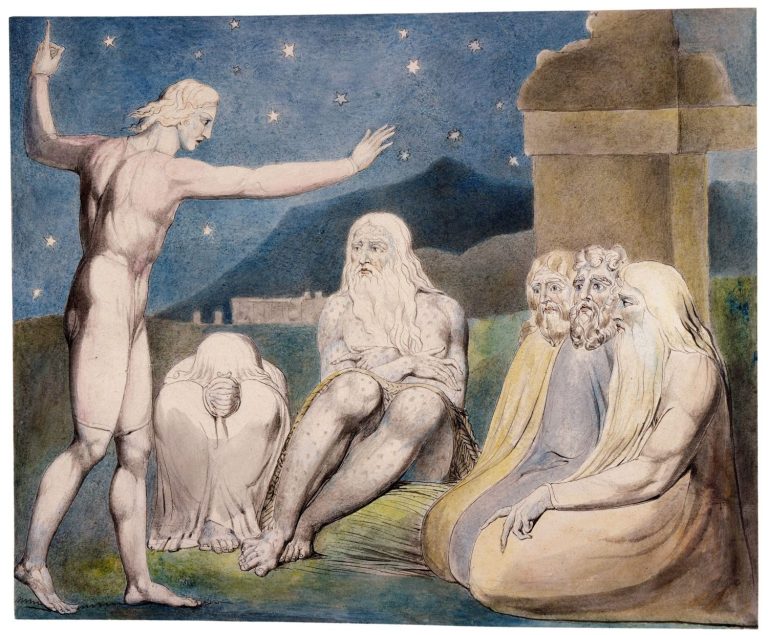
Deep umbers and scorched ochres collide with sudden flares of white and pale gold across this composition, as if the light itself were an argument. The colours do not blend so much as confront one another: a bruised red-brown grounds the seated figures of Job and his companions, while Elihu, upright and vibrating with indignation, is caught in a cooler wash of illuminated flesh tone that pulls the eye away from the shadowed group around him. It is a palette built on contrast rather than harmony, and that friction is the whole point.
The scene comes from the Book of Job, at the moment when Elihu, the youngest of those present, can no longer contain his anger at the arguments exchanged between Job and his older companions and breaks in with a rebuke aimed at all of them. Blake positions the figures so that gesture carries as much meaning as expression: arms raised, bodies twisted mid-motion, the older men slumped or recoiling under the force of the interruption. This is one of several treatments Blake made of the Job narrative across his working life, a text he returned to with unusual persistence, and the Elihu episode gave him a subject suited to his particular strengths, the outburst of prophetic speech rendered through line and posture rather than through faces alone.
The drawing is linear and taut, contours doing the work that modelling and shadow might do in a more conventional Romantic canvas, and the light falls with a theatrical abruptness that has more in common with the stage or with vision literature than with naturalistic illumination. Colour is used sparingly but decisively, laid in flat passages that heighten the graphic clarity of the composition rather than softening it, so that the emotional charge of the scene reads instantly even before the biblical context is known.
This oil painting reproduction is painted by hand, colour by colour, so the contrast between the shadowed group and the lit figure of Elihu is built up in actual layers of pigment rather than approximated through print. A trained painter works from close study of the original, matching the specific umbers, ochres, and cooler flesh tones, and preserving the directness of the linework that gives the scene its force. The result is a hand-painted replica with visible brushwork and a genuine paint surface, not a flat facsimile, which matters to anyone who intends to look at the piece closely and often rather than glance at it once.
Empty walls flatten a room. A classical artwork restores structure and visual hierarchy. One painting defines the space, anchors furniture, and establishes identity.
Worldwide shipping included. Each painting is produced to order and safely packed for international transport.
All payments are encrypted and processed through trusted payment providers.
Real brushwork, layered oil paint, and durable pigments on museum-quality canvas.
If the result does not meet expectations, return it for a full refund.


Your artwork is painted on premium cotton canvas, then shipped safely rolled in a rigid tube with extra blank canvas border — ready for stretching or framing locally.
Select a handcrafted frame and we’ll deliver your painting fully assembled, protected, and ready to hang.
For safe shipping, framing is available up to a maximum size. Larger sizes will automatically disable the frame option.


Choose “Stretched” to receive your canvas mounted on wooden stretcher bars — perfect if you’ll frame it later or display it as-is.
Gallery Wrap is a deeper, 1.5" style stretcher. The canvas wraps around the sides and is stapled on the back for a clean, modern, frameless look.
We ship with UPS, FedEx, or DHL straight to your door. You’ll receive a tracking number as soon as your order leaves our studio. Typical delivery is 5 to 7 days after dispatch; large, framed, or stretched pieces may take longer depending on the safest shipping route.


Unframed canvases are protected with a film, carefully rolled, and secured inside a rigid shipping tube.

Stretched, Gallery Wrapped, and Framed paintings are wrapped, cushioned with foam protection, and boxed for safe transit.
Romanticism
William Blake