Loading cart…
No products in the cart.

Original price was: $599.00.$299.00Current price is: $299.00.
An unsettling allegory by Hans Baldung Grien, setting the stages of a life against the figure of Death in warm flesh tones against cold shadow, hand-painted in oil on canvas.
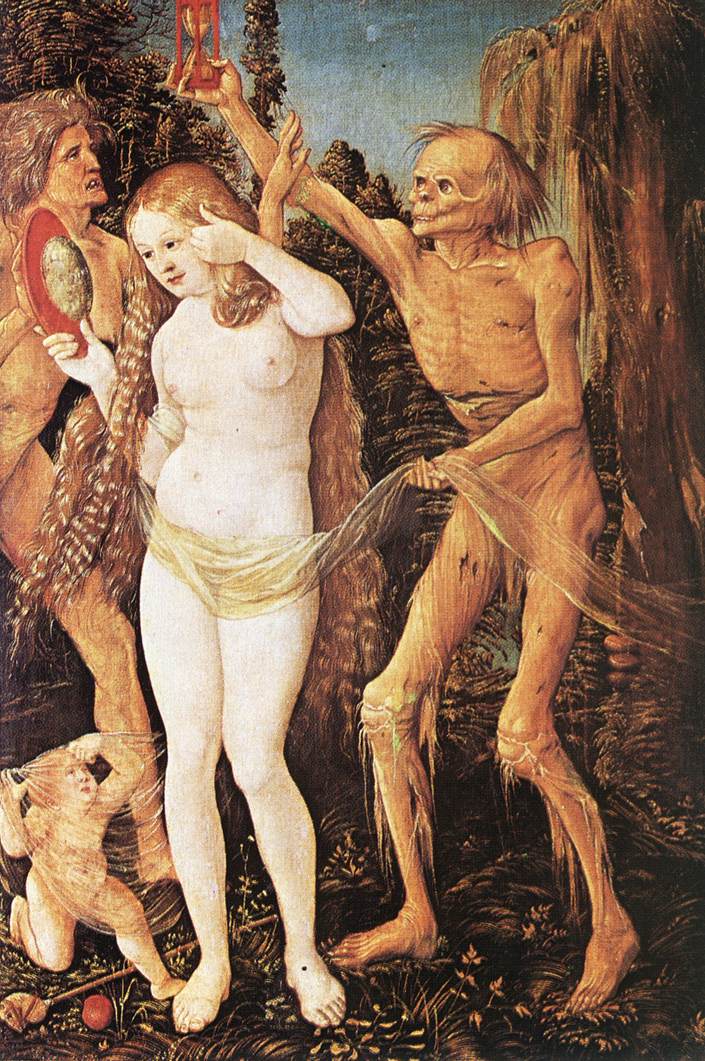
A single hand rests against a mirror, and the fingers holding it seem almost translucent against the dark glass, a passage of paint so quietly observed that it anchors the entire allegory in something tender and specific before the eye ever reaches the figure of Death. From that gesture the composition opens outward to the full arrangement of womanhood across its stages, youth beside maturity beside age, each body a study in how flesh changes under light.
Hans Baldung Grien built this allegory around a confrontation that Northern Renaissance painters returned to again and again: the living body set against its own eventual dissolution. The figures of the woman at different ages stand close together, their poses overlapping in a way that suggests continuity rather than separation, while the cadaverous form of Death threads through the group with a proprietary closeness that unsettles more than it startles. The palette does the argument as much as the drawing does. Warm, luminous flesh tones in the younger figures give way to grey and umber shadow around the figure of Death, and Baldung modulates this shift so gradually that the eye is implicated in the passage of time before it fully registers what it is looking at.
The picture belongs to a period in the career of Baldung when he was working through themes of mortality and female sensuality with unusual candour, a preoccupation that runs through much of his output from Strasbourg and that set him apart from the more decorous figure studies of his contemporaries. The brushwork is fine but never fussy, built up in thin glazes that let the underlying drawing show through, particularly in the transitions between light and shadow across the torso and face. It is a composition that rewards close looking precisely because so much of its meaning lives in these small shifts of tone rather than in gesture or narrative incident.
A hand-painted oil painting reproduction of this work is built the same way the original was, layer by layer, so that the gradations of flesh tone against the grey of Death survive as actual paint rather than as flattened colour. Painters working on an oil on canvas reproduction for ByMuseum study the original surface closely, matching the palette and reconstructing the visible brushwork so that the piece has real depth and texture when seen up close, not just at a distance.
Live with this painting and the mirror gesture keeps drawing the eye back before it settles on the wider argument of the composition, and the tonal shift from warm skin to the pallor of Death becomes more legible the longer it hangs, rewarding the kind of attention a collector gives a piece over months rather than at a single viewing.
Empty walls flatten a room. A classical artwork restores structure and visual hierarchy. One painting defines the space, anchors furniture, and establishes identity.
Worldwide shipping included. Each painting is produced to order and safely packed for international transport.
All payments are encrypted and processed through trusted payment providers.
Real brushwork, layered oil paint, and durable pigments on museum-quality canvas.
If the result does not meet expectations, return it for a full refund.


Your artwork is painted on premium cotton canvas, then shipped safely rolled in a rigid tube with extra blank canvas border — ready for stretching or framing locally.
Select a handcrafted frame and we’ll deliver your painting fully assembled, protected, and ready to hang.
For safe shipping, framing is available up to a maximum size. Larger sizes will automatically disable the frame option.


Choose “Stretched” to receive your canvas mounted on wooden stretcher bars — perfect if you’ll frame it later or display it as-is.
Gallery Wrap is a deeper, 1.5" style stretcher. The canvas wraps around the sides and is stapled on the back for a clean, modern, frameless look.
We ship with UPS, FedEx, or DHL straight to your door. You’ll receive a tracking number as soon as your order leaves our studio. Typical delivery is 5 to 7 days after dispatch; large, framed, or stretched pieces may take longer depending on the safest shipping route.


Unframed canvases are protected with a film, carefully rolled, and secured inside a rigid shipping tube.

Stretched, Gallery Wrapped, and Framed paintings are wrapped, cushioned with foam protection, and boxed for safe transit.