Loading cart…
No products in the cart.

Original price was: $518.00.$259.00Current price is: $259.00.
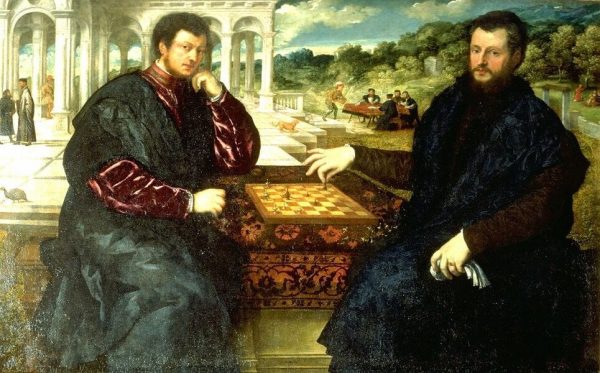
Two Chess Players by Paris Bordone, painted by hand in oil on canvas, brings the quiet concentration of a Venetian portrait scene into your room.
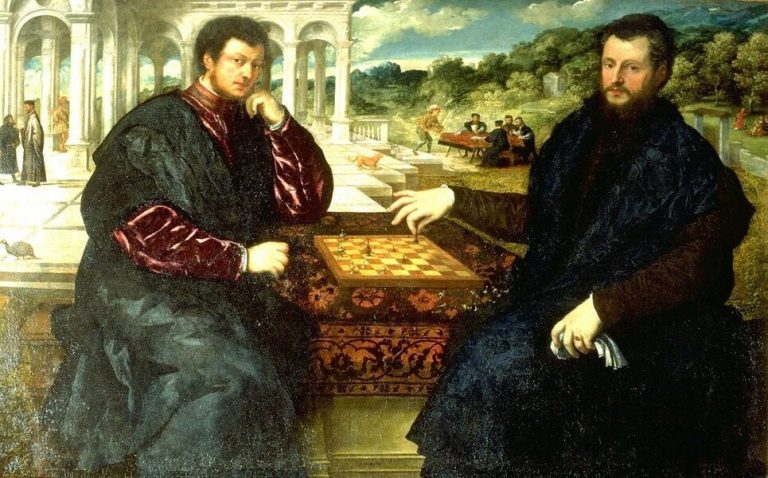
In the busy studio culture of sixteenth-century Venice, portraiture often doubled as a study of character caught mid-thought, and Two Chess Players belongs to that tradition. Paris Bordone, trained under Titian and active through the middle decades of the century, likely painted this scene for a private patron who wanted something more than a static likeness: a moment of concentration, wit, and quiet rivalry preserved on canvas.
The composition places its two figures close together, heads inclined toward the board between them, so that the viewer becomes a third presence at the table. Bordone builds the scene through measured shifts in tone rather than sharp contrast, letting warm flesh tones and muted fabric colours carry the eye from one player to the other and back again. Light falls unevenly across the table, picking out the chess pieces and the hands that hover over them, while the background recedes into shadow just enough to keep attention on the exchange taking place.
This handling of atmosphere reflects lessons absorbed from Titian but applied with a restraint that is distinctly Bordone: the drama here is psychological rather than theatrical, built from glance and gesture instead of gold and drapery. The layered oil surface, thin in places and dense in others, gives the faces a sense of interior life that a flatter technique could not achieve, and it marks this as the work of a painter confident enough to let subtlety do the heavy lifting.
ByMuseum recreates this painting as a hand-painted oil painting reproduction, worked by a trained artist directly onto canvas rather than printed by machine. The palette is matched passage by passage, the brushwork left visible where Bordone would have left it visible, and the surface built up in real paint so the depth of the original scene survives the transfer from studio to studio. The result is a fine art reproduction meant to be looked at closely, not glanced at once and forgotten; over weeks of living with it, the tilt of a head or the shadow beneath a hand tends to become newly visible, the way it might have to the original patron who first sat with these two players.
Empty walls flatten a room. A classical artwork restores structure and visual hierarchy. One painting defines the space, anchors furniture, and establishes identity.
Worldwide shipping included. Each painting is produced to order and safely packed for international transport.
All payments are encrypted and processed through trusted payment providers.
Real brushwork, layered oil paint, and durable pigments on museum-quality canvas.
If the result does not meet expectations, return it for a full refund.


Your artwork is painted on premium cotton canvas, then shipped safely rolled in a rigid tube with extra blank canvas border — ready for stretching or framing locally.
Select a handcrafted frame and we’ll deliver your painting fully assembled, protected, and ready to hang.
For safe shipping, framing is available up to a maximum size. Larger sizes will automatically disable the frame option.


Choose “Stretched” to receive your canvas mounted on wooden stretcher bars — perfect if you’ll frame it later or display it as-is.
Gallery Wrap is a deeper, 1.5" style stretcher. The canvas wraps around the sides and is stapled on the back for a clean, modern, frameless look.
We ship with UPS, FedEx, or DHL straight to your door. You’ll receive a tracking number as soon as your order leaves our studio. Typical delivery is 5 to 7 days after dispatch; large, framed, or stretched pieces may take longer depending on the safest shipping route.


Unframed canvases are protected with a film, carefully rolled, and secured inside a rigid shipping tube.

Stretched, Gallery Wrapped, and Framed paintings are wrapped, cushioned with foam protection, and boxed for safe transit.