Loading cart…
No products in the cart.

Original price was: $518.00.$259.00Current price is: $259.00.
A poet reads to a seated queen in this warmly lit classical interior by Alma-Tadema, offered here as a hand-painted replica for collectors who value surface and craftsmanship.
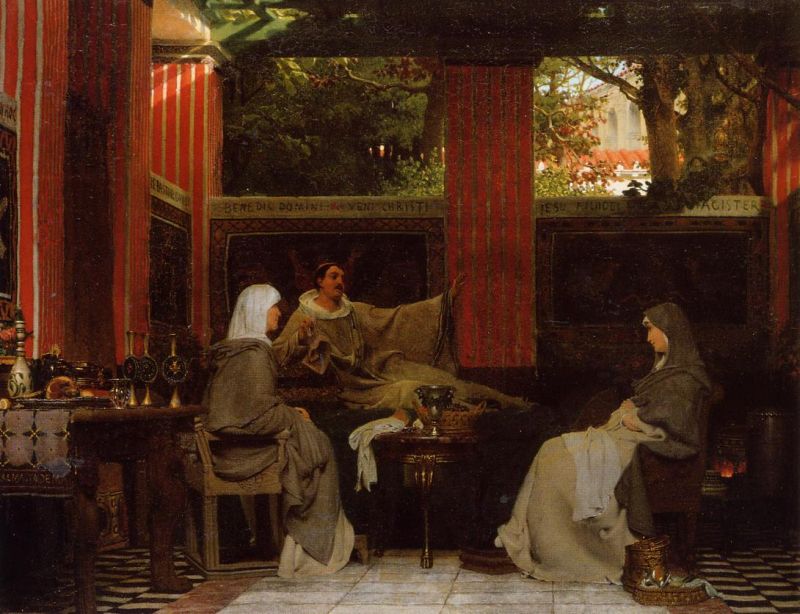
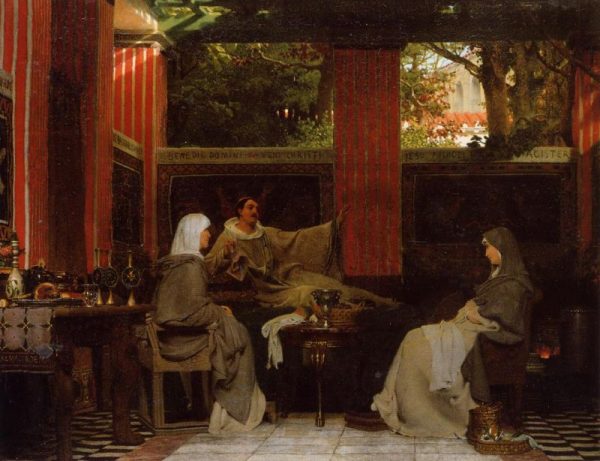
Since it left the studio of Lawrence Alma-Tadema, this scene of a poet reading before a seated queen has been prized less for drama than for atmosphere, the sense that a viewer has been let quietly into a room that existed centuries before either of them were born. Critics of the artist career often singled out this kind of composition as proof that classical revival painting could feel inhabited rather than staged, and that reading of the work has held steady across generations of collectors who return to it precisely for its stillness.
The picture sets Venantius Fortunatus in the act of sharing his verse with Radegonda, the moment built around attention rather than gesture. Alma-Tadema arranges the figures within a classical interior rendered with his customary command of surface: marble that seems cool to the touch, drapery that falls with real weight, and a warm ambient light that settles across every plane of the room. Nothing in the arrangement asks to be noticed first; the eye moves from the poet to the listener and back, held by the balance of the composition rather than pushed toward it.
What produces that quiet is technique as much as subject. Alma-Tadema built his classical scenes through patient layering of translucent glazes over careful underpainting, a method that gives stone its glow and fabric its softness without resorting to any theatrical flourish. This painting belongs to the mature phase of his career, when his reconstructions of antiquity had become less about archaeological display and more about mood, about letting a viewer feel the temperature and hush of a room rather than simply admire its furnishings.
A ByMuseum oil painting reproduction of this work is built the same way the original was thought through, by hand. A trained painter works in oil on artist-grade cotton canvas, matching the palette stroke by stroke and preserving the brushwork and surface texture that give the marble its glow and the drapery its fall. The result is a hand-painted replica rather than a printed copy, a painted object with its own depth of colour and its own raised passages of pigment, the kind of surface a discerning eye looks for when judging condition and craftsmanship rather than mere resemblance.
Empty walls flatten a room. A classical artwork restores structure and visual hierarchy. One painting defines the space, anchors furniture, and establishes identity.
Worldwide shipping included. Each painting is produced to order and safely packed for international transport.
All payments are encrypted and processed through trusted payment providers.
Real brushwork, layered oil paint, and durable pigments on museum-quality canvas.
If the result does not meet expectations, return it for a full refund.


Your artwork is painted on premium cotton canvas, then shipped safely rolled in a rigid tube with extra blank canvas border — ready for stretching or framing locally.
Select a handcrafted frame and we’ll deliver your painting fully assembled, protected, and ready to hang.
For safe shipping, framing is available up to a maximum size. Larger sizes will automatically disable the frame option.


Choose “Stretched” to receive your canvas mounted on wooden stretcher bars — perfect if you’ll frame it later or display it as-is.
Gallery Wrap is a deeper, 1.5" style stretcher. The canvas wraps around the sides and is stapled on the back for a clean, modern, frameless look.
We ship with UPS, FedEx, or DHL straight to your door. You’ll receive a tracking number as soon as your order leaves our studio. Typical delivery is 5 to 7 days after dispatch; large, framed, or stretched pieces may take longer depending on the safest shipping route.


Unframed canvases are protected with a film, carefully rolled, and secured inside a rigid shipping tube.

Stretched, Gallery Wrapped, and Framed paintings are wrapped, cushioned with foam protection, and boxed for safe transit.
Academicism
Lawrence Alma-Tadema