Loading cart…
No products in the cart.

Original price was: $599.00.$299.00Current price is: $299.00.
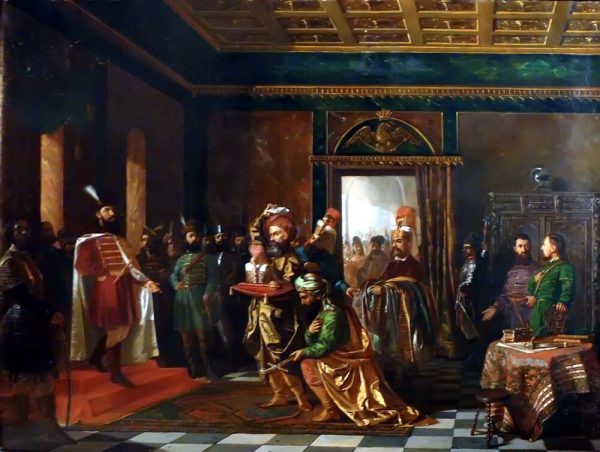
A hand-painted oil reproduction of Vlad the Impaler and the Turkish Envoys by Theodor Aman, painted on canvas with the tonal structure and brushwork of the original preserved.
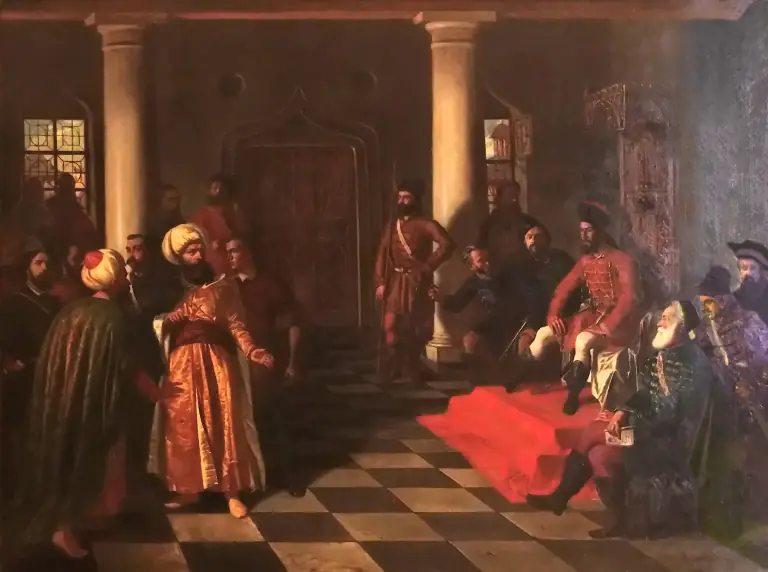
Romania in the nineteenth century was searching for a national history worth painting, and Theodor Aman gave it one. Vlad the Impaler and the Turkish Envoys reproduction returns to a scene drawn from Wallachian legend: the prince facing emissaries of the Ottoman court who have refused, by custom, to remove their turbans in his presence. Aman painted the episode as part of a broader effort to give Romanian audiences history pictures of their own, at a moment when he was building the visual language of a young national school.
The confrontation is staged with theatrical economy. Vlad occupies the commanding position, upright and still, while the envoys are caught mid gesture, their bodies compressed into the lower register of the canvas in a pose that makes the outcome of the story legible before a viewer reads the title. Aman uses a controlled, somewhat sombre palette, browns, deep reds, and worked blacks, broken by the brighter passages of costume and armour that mark out rank and consequence. Light falls unevenly across the group, picking out faces and hands while leaving the architecture behind them in shadow, a device Aman used often to keep a crowded scene readable.
The brushwork throughout is built up in short, deliberate strokes rather than smooth glazes, giving the fabrics and armour a worked, slightly rough surface that reads as history rather than decoration. This hand-painted oil painting reproduction is produced by a trained painter working directly in oil on artist-grade canvas, matching the palette of Aman stroke by stroke rather than transferring it as a printed image. The result is a hand-painted replica in the fullest sense: a physical object with raised paint and a visible hand behind it, not a flat surface pretending to depth.
What is carried across into the reproduction is the structure that makes the original work as a history picture: the placement of the figures, the exact tonal drop from Vlad into the shadowed group before him, and the passages of thicker paint that mark armour, cloth, and flesh differently from one another. A replica painting only earns the name if that structure survives the copying, and it is what the ByMuseum painter is trained to preserve.
Empty walls flatten a room. A classical artwork restores structure and visual hierarchy. One painting defines the space, anchors furniture, and establishes identity.
Worldwide shipping included. Each painting is produced to order and safely packed for international transport.
All payments are encrypted and processed through trusted payment providers.
Real brushwork, layered oil paint, and durable pigments on museum-quality canvas.
If the result does not meet expectations, return it for a full refund.


Your artwork is painted on premium cotton canvas, then shipped safely rolled in a rigid tube with extra blank canvas border — ready for stretching or framing locally.
Select a handcrafted frame and we’ll deliver your painting fully assembled, protected, and ready to hang.
For safe shipping, framing is available up to a maximum size. Larger sizes will automatically disable the frame option.


Choose “Stretched” to receive your canvas mounted on wooden stretcher bars — perfect if you’ll frame it later or display it as-is.
Gallery Wrap is a deeper, 1.5" style stretcher. The canvas wraps around the sides and is stapled on the back for a clean, modern, frameless look.
We ship with UPS, FedEx, or DHL straight to your door. You’ll receive a tracking number as soon as your order leaves our studio. Typical delivery is 5 to 7 days after dispatch; large, framed, or stretched pieces may take longer depending on the safest shipping route.


Unframed canvases are protected with a film, carefully rolled, and secured inside a rigid shipping tube.

Stretched, Gallery Wrapped, and Framed paintings are wrapped, cushioned with foam protection, and boxed for safe transit.

Man Writing a Letter
Gabriel Metsu, c. 1664
The gallery list
Every painting is already 50% off. Join the list and we will send you an extra $15 code, plus first access to new collections.
No spam. Unsubscribe anytime. · Privacy Policy
Welcome
Your $15 code is on its way. Explore the gallery while you wait.