Loading cart…
No products in the cart.

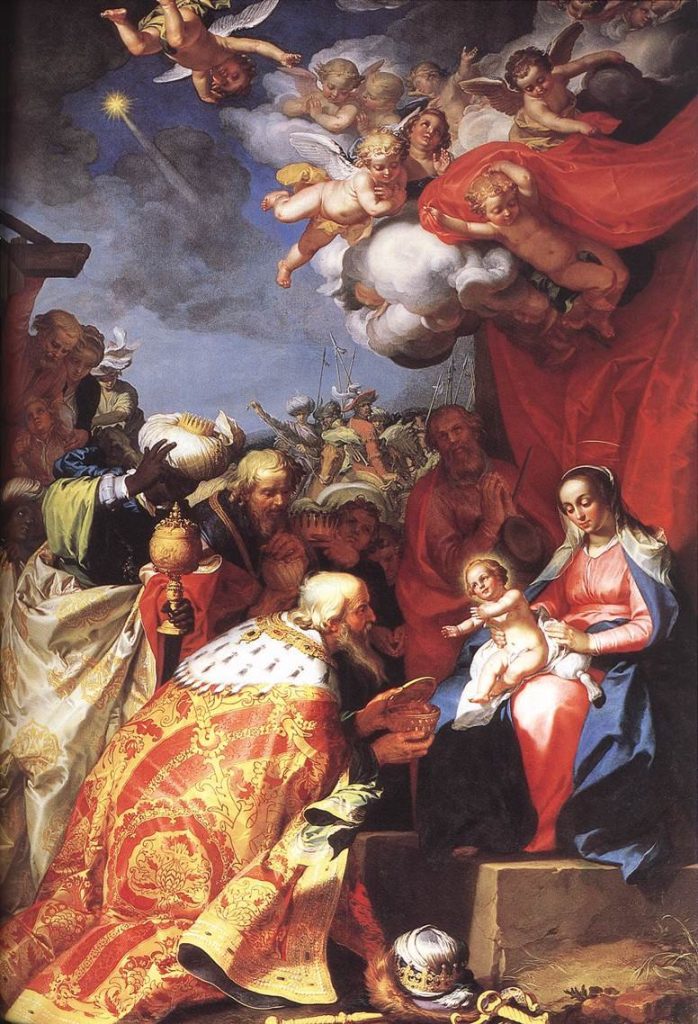
1623 to 1624 · Oil on canvas · Musée de Grenoble, France
Save articles to your collection
Log in or create a free account, and this article will be waiting in your Private Collection.
Log in or sign up Explore the artistAbraham Bloemaert →
The three kings have followed the star to Bethlehem and kneel before the Christ Child. Abraham Bloemaert, the leading painter of Utrecht in his day, painted this tall Adoration of the Magi in 1623 to 1624. At about four metres high, it was made to be seen from far away, above an altar.
The painting is in the Musée de Grenoble in France.
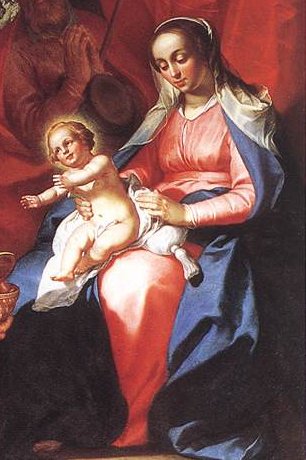
Mary sits at the right on a stone block, holding the Child on her lap. He leans forward and reaches out towards the old king, as if to greet him.
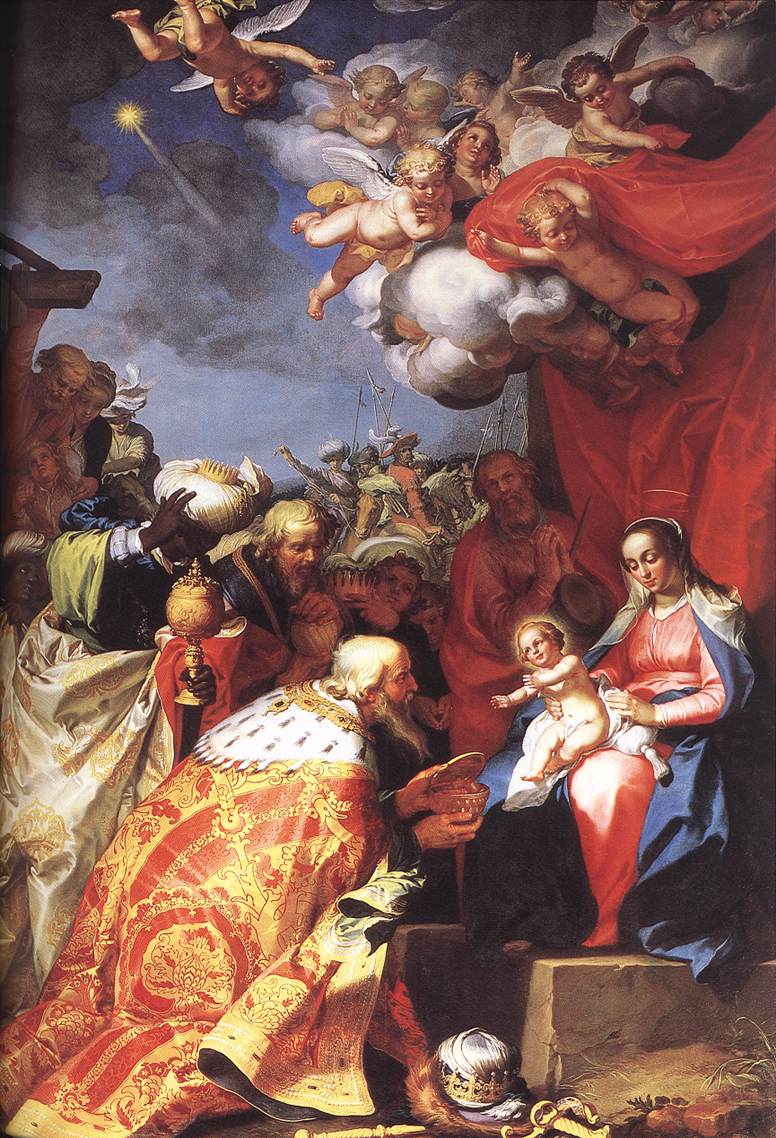
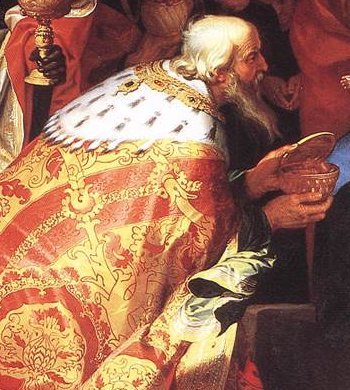
The oldest king kneels in a magnificent red and gold cloak trimmed with ermine and offers a golden cup. His crown lies on the ground at his knees, a sign of humility before the Child. Behind him, the other kings and their followers crowd in.
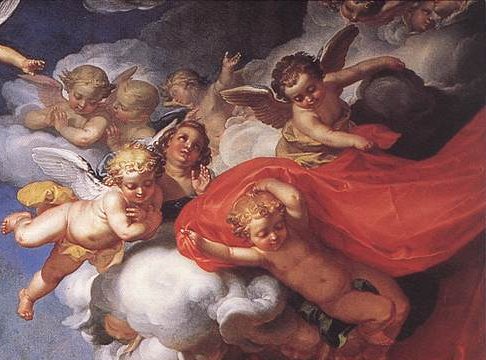
Above, plump angels tumble out of the clouds, and one pulls back a great red curtain as if to reveal the scene.
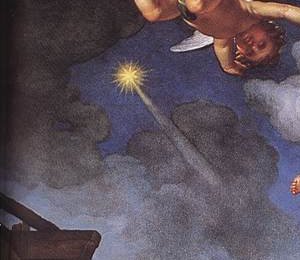
At the top left, the star that guided the kings shines in a dark blue sky.
The Gospel of Matthew tells how wise men from the East followed a star to Bethlehem to worship the newborn king of the Jews. They brought gifts of gold, frankincense and myrrh. Later tradition turned them into three kings, named Caspar, Melchior and Balthasar, representing the three known continents and the three ages of man: youth, maturity and old age.
Bloemaert follows this tradition. The old king kneels in front, the middle-aged and young kings behind, one of them African, as was usual in art from the fifteenth century onward.
Abraham Bloemaert (1566 to 1651) was the leading painter in Utrecht for half a century and a great teacher. His pupils included Gerard van Honthorst and Hendrick ter Brugghen, who travelled to Rome, absorbed Caravaggio’s style and brought it back to the Netherlands. Bloemaert himself was influenced by them in turn, and his later works show stronger light and more natural figures.
Utrecht remained a largely Catholic city in the Protestant Dutch Republic, and Bloemaert painted many religious works for Catholic patrons, both at home and abroad.
Bloemaert’s early work was in the elegant Mannerist style, with twisting figures and artificial colours. By the 1620s his style had become fuller and more natural, influenced by Rubens and the Caravaggisti. This Adoration shows both: the elegant poses and rich colours of his earlier manner combined with the warm, solid figures of the Baroque.
The Musée de Grenoble holds one of the finest collections of old master paintings in France outside Paris. Many works came through confiscations during the French Revolution and through gifts. Bloemaert’s Adoration is one of the museum’s most impressive Dutch paintings, its large size dominating the gallery.
The Adoration of the Magi hangs in the Musée de Grenoble. Our hand-painted oil reproduction follows this composition. You can also read about the work of his pupil in Van Honthorst’s Adoration of the Shepherds.
Abraham Bloemaert (1566 to 1651), a painter from Utrecht.
Musée de Grenoble, France.
About 420 x 290 cm.
The king has taken it off to kneel before the Child.
Gerard van Honthorst and Hendrick ter Brugghen, among many others.
Gold, frankincense and myrrh.
Public-domain reproduction of The Adoration of the Magi (1623 to 1624), via Wikimedia Commons. Detail images are crops of the same image; no reconstruction or upscaling.
Enjoyed this story?
Save articles to your collection
Log in or create a free account, and this article will be waiting in your Private Collection.
Log in or sign up
Man Writing a Letter
Gabriel Metsu, c. 1664
The gallery list
Every painting is already 50% off. Join the list and we will send you an extra $15 code, plus first access to new collections.
No spam. Unsubscribe anytime. · Privacy Policy
Welcome
Your $15 code is on its way. Explore the gallery while you wait.