Loading cart…
No products in the cart.

1897 · Oil on canvas · State Russian Museum, St. Petersburg, Russia

At School Doors was completed by Bogdanov-Belsky in 1897 and exhibited to immediate critical and public acclaim in Russia. The painting arrived at a moment when the question of rural education was a central subject of debate in Russian intellectual and political life. The zemstvo school system, a network of locally administered rural schools funded partly by regional councils, had been expanding across the Russian Empire since the 1860s, but access to education for peasant children remained deeply uneven and often dependent on individual patrons and educators. Bogdanov-Belsky had personal knowledge of this world, having himself been educated through the extraordinary rural school operated by Sergei Rachinsky in Tatevo, Smolensk Governorate. Rachinsky was a botanist, mathematician, and educator of great dedication who believed passionately in the capacity of peasant children to absorb rigorous learning, and his school became something of a model institution. Bogdanov-Belsky painted Rachinsky and his students on multiple occasions, and the schoolhouse environment was a recurring landscape in his imagination. The specific moment captured in this painting, that of a child who stands outside the door rather than within the classroom, speaks directly to the precariousness of educational access in late imperial Russia. The painting was acquired for the collection that would become the State Russian Museum in St. Petersburg, cementing its status as a work of national significance. It was received not merely as a charming genre scene but as a document of social reality, one that called attention to the gap between the ambition of rural education reform and the lived experience of children on the ground. The work brought Bogdanov-Belsky wide recognition and helped establish his reputation as the foremost painter of Russian peasant childhood.
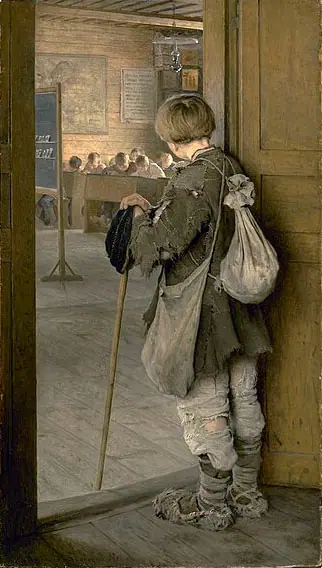
The composition of At School Doors is structured around a single figure set against the rough planked exterior of a wooden school building. The boy stands slightly off-center, his body angled toward the wall, one hand lightly touching it as if to steady himself or to feel closer to what lies beyond. The light in the painting is cool and wintry, the ground dusted with snow, and the palette of the scene is built from grays, pale blues, and the warm brown tones of old timber. Against this restrained background, the figure of the boy stands out with quiet clarity. His clothing is humble, his feet are bare despite the cold, and his face is turned in profile so that the viewer sees his expression from the side, catching the intensity of his gaze without being fully confronted by it. This oblique angle is a masterstroke of psychological positioning. It allows the viewer to observe without feeling observed, to share in the moment of longing rather than being asked to judge it. Bogdanov-Belsky handles the texture of the wooden wall with evident care, the grain and weathering of the boards rendered in careful brushwork that gives the scene its sense of physical reality. The gap in the wall through which the boy peers is a narrow vertical passage of warm interior light, and this contrast between the cold exterior and the warmth within is both a visual and an emotional device. The painting does not sentimentalize its subject through any obvious rhetorical gesture. There is no dramatic expression, no tears, no outstretched hand. The power lies entirely in the restraint. Own this image as a hand-painted oil reproduction and place it where its quiet intensity can work on the viewer over time.
The meaning of At School Doors operates on several interlocking levels, from the personal and biographical to the social and historical. At its most immediate, the painting is a portrait of exclusion, of a child who stands at the threshold of something he desires and cannot fully enter. But the painting refuses to present this exclusion as final or as defining. The boy in the doorway is not defeated. He is watching, learning, absorbing what he can through whatever opening presents itself. In this sense the image is also one of determination and of the particular resilience of children who pursue learning under difficult circumstances. For Bogdanov-Belsky, who had himself navigated poverty and social marginality on his way to artistic training, this was not an abstract theme. It was a lived one. In a broader cultural context, the painting became a touchstone image for discussions of education and social progress in Russia in the years before the Revolution of 1917. It was reproduced widely and reached audiences far beyond the gallery-going public of St. Petersburg and Moscow. The image of the child at the door became a kind of shorthand for the aspirations and the frustrations of a generation of rural Russians who understood that education represented the difference between one kind of life and another. More than a century after it was painted, the image retains its emotional force because the situation it depicts, of a child who wants to learn and is separated from that learning by barriers of poverty and circumstance, remains recognizable across cultures and across time. A hand-painted oil reproduction of this work brings that resonance into any space that values the transformative power of human aspiration.