Loading cart…
No products in the cart.

1923 · Oil on canvas · Solomon R. Guggenheim Museum, New York
Save articles to your collection
Log in or create a free account, and this article will be waiting in your Private Collection.
Log in or sign up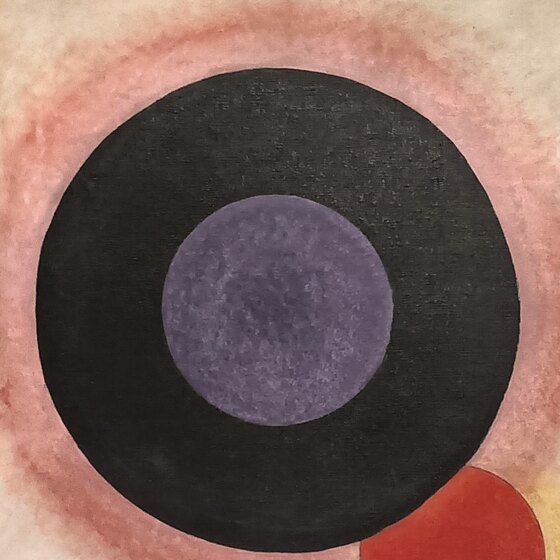
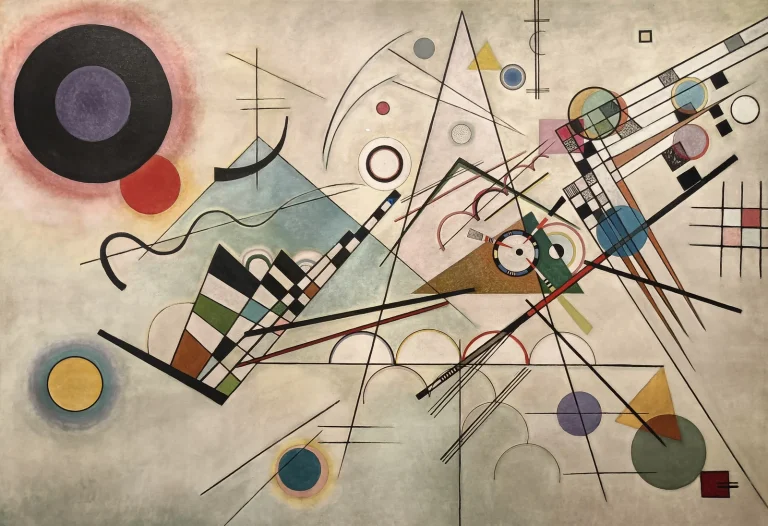
Start at the top left, where a big black disc with a purple centre sits inside a soft pink glow. It is the heaviest thing in the painting and Kandinsky put it in the corner, off balance, so that everything else has to lean the other way to hold it up. He had just fallen in love with circles. A few years later he explained why to a friend:
The circle is the synthesis of the greatest oppositions. It combines the concentric and the eccentric in a single form, and in balance. Of the three primary forms it points most clearly to the fourth dimension.
Wassily Kandinsky, letter to Will Grohmann, 1930
Composition VIII is where the circle takes over. Ten years earlier his paintings had been storms of colour with no straight edges. Now they are geometry: circles, triangles, straight lines, a chequerboard, set out on a pale ground like instruments on a table. Something had happened in between, and the something was the Bauhaus.
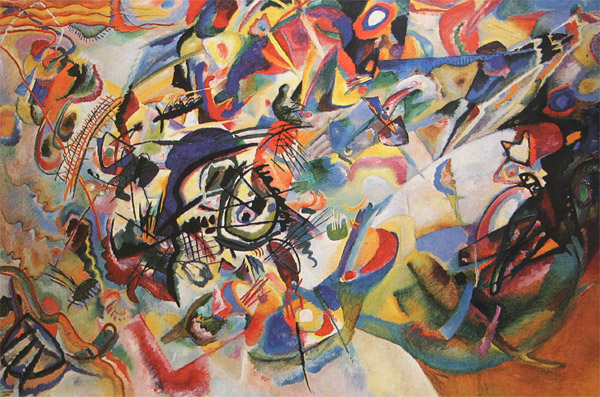
Kandinsky painted his seventh Composition in Munich in 1913, in four days, after months of studies: a whirlpool of colour with the Flood, the Last Judgement and the Resurrection dissolved inside it. It was the climax of his first abstraction, the kind that came from feeling and Russian church bells and the conviction that colour could be heard.
Then the war came. He went back to Russia, lived through the Revolution, taught, argued with the constructivists who wanted art to be engineering, and in 1921 left for Germany. In 1922 Walter Gropius hired him to teach at the Bauhaus in Weimar, the school that was trying to rebuild the world from the square, the circle and the triangle. Composition VIII was painted there in July 1923, and it is the first big picture of his second life.
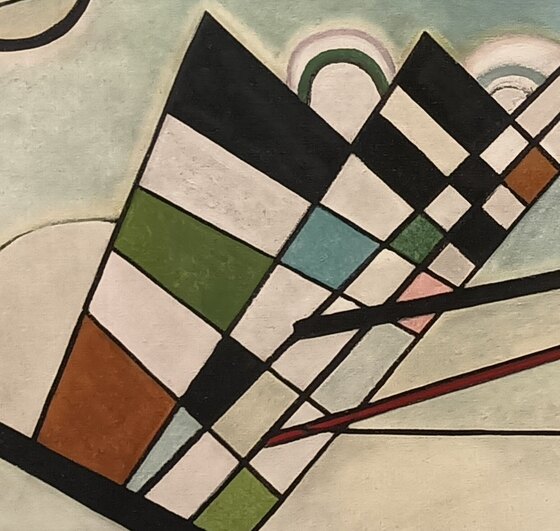
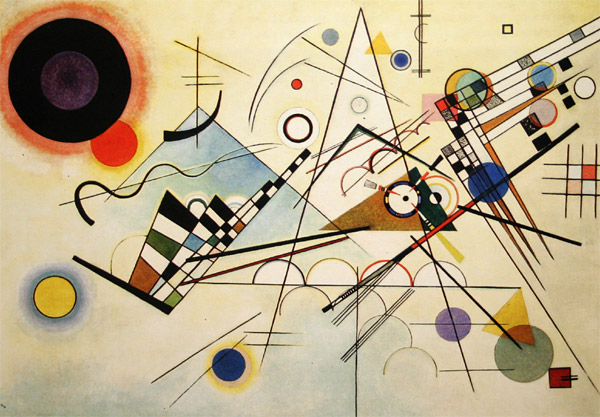
Look at the difference. Nothing in Composition VIII is a smear. Every line is ruled, every circle drawn with a compass, every triangle has three sharp corners. The colours are flat. The ground is a cool cream. It looks, at first, like a diagram of something.
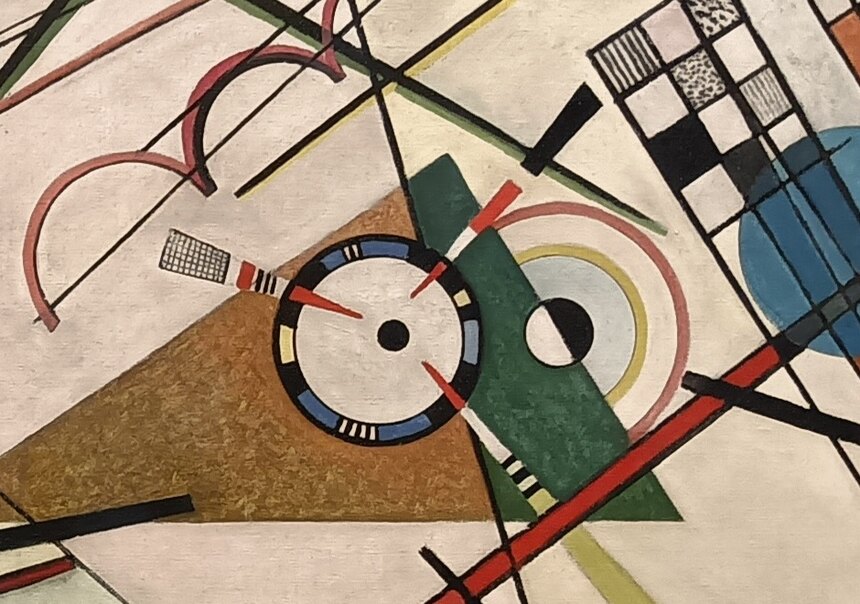
Nothing. That is the answer, and it is the hard part of looking at the painting. The circles are not planets, the triangles are not mountains, the lines are not roads. Kandinsky had spent a decade removing subjects from his pictures, and he was not going to put them back as geometry.
What the shapes are is forces. A circle, to Kandinsky, was calm and inward; a triangle was sharp and aggressive; a line was a point that had been pushed. He wrote a whole book about it at the Bauhaus, Point and Line to Plane, and Composition VIII is the book's frontispiece: the big circle pressing down from the corner, the triangles pointing up against it, the lines slicing through, the chequerboard tilting, and in the middle a target-like set of rings where the forces balance.
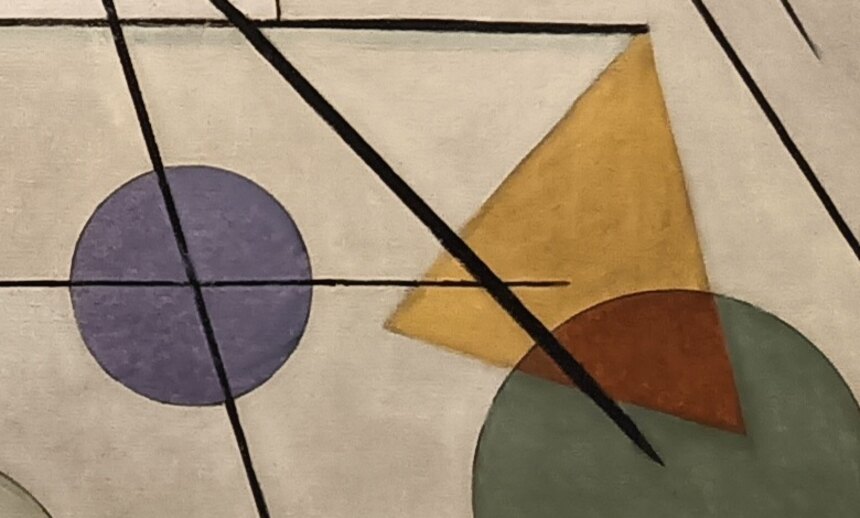
He also believed, and said, that he heard colour. Yellow was a trumpet, blue a cello, the deep blue of the great circle an organ. Whether that was a metaphor or a neurological fact, and there is evidence for the second, it means the painting was composed the way he named it: as music, with themes, counter-themes and a resolution. He gave the Compositions numbers, like symphonies, and made only ten in his life.
Kandinsky considered it the high point of his post-war work, and it is easy to see why. It is abstraction that has stopped apologising. The early paintings had hidden their subjects; the Russian years had argued about whether art should have any; Composition VIII simply sets out shapes and colours and says: this is enough, and it is not a decoration, and it is not a plan for a building. It is a picture.
It also means the Bauhaus, which is why it looks the way it does. The clean ground, the ruled lines, the primary shapes, the sense of a laboratory: this is the visual language that went from Weimar into every logo, poster and chair of the twentieth century. Kandinsky was one of the people who made it, and this painting is the moment he took it out of the workshop and hung it on the wall.
In 1930 an American mining millionaire, Solomon R. Guggenheim, visited Kandinsky at the Bauhaus, by then in Dessau, with the painter Hilla Rebay, who was steering his collecting toward what she called non-objective art. He bought Composition VIII on the spot. It was the first Kandinsky he owned; he ended up with more than a hundred and fifty, and the museum he built to hold them on Fifth Avenue is the spiral everyone knows.
Three years after the sale the Nazis closed the Bauhaus. Kandinsky left for Paris and never went back to Germany. His paintings there were confiscated as degenerate art and sold abroad or lost. Composition VIII was already safe in New York.
In the Solomon R. Guggenheim Museum in New York, where it has been since the founding collection was formed in 1937. It is oil on canvas, 140 by 201 centimetres, bigger than most people expect from reproductions, and it hangs in the museum's Kandinsky gallery with the other founding pictures.
It is the most popular abstract painting we make, and the most popular for offices, studios and modern living rooms, where its flat shapes and pale ground work with almost any furniture. Our hand-painted reproduction of Composition VIII is painted in oil on canvas from the Guggenheim original, with the lines ruled and the circles drawn with a compass, as Kandinsky drew them. A thin black or natural wood frame, or none at all.
More Kandinsky in our Wassily Kandinsky collection, and the wider Expressionism archive, where his first abstractions belong.
Enjoyed this story?
Save articles to your collection
Log in or create a free account, and this article will be waiting in your Private Collection.
Log in or sign upVisible details, documented facts and interpretation are kept separate throughout this article. Kandinsky's synaesthesia is reported as he described it and as later writers have discussed it.