Loading cart…
No products in the cart.

1903 · Oil on canvas · De Morgan Collection, London, England

Save articles to your collection
Log in or create a free account, and this article will be waiting in your Private Collection.
Log in or sign upThe Love Potion was completed by Evelyn De Morgan in 1903, during a period of sustained productivity and deepening philosophical engagement in her work. By this point in her career, De Morgan had fully developed her distinctive symbolic vocabulary and was producing paintings of considerable allegorical complexity. The work belongs to a broader thematic strand in her oeuvre that investigates the relationship between human desire, spiritual consequence, and the misuse of occult or hidden knowledge. De Morgan was deeply interested in Theosophy and Spiritualism, and these interests gave her a framework for exploring the idea that manipulating natural or supernatural forces for selfish ends carries a moral cost. The painting was not produced to a specific commission but reflects the sustained independence De Morgan maintained throughout her professional life. She and her husband William De Morgan operated largely outside the commercial pressures of the mainstream art market, which gave her the freedom to pursue deeply personal and philosophically rich subjects without concession to popular taste. The work has been held in the De Morgan Collection since the time of her death and has remained one of the most frequently reproduced and discussed paintings in her catalogue, attracting consistent scholarly attention for its layered iconography and confident technical execution.
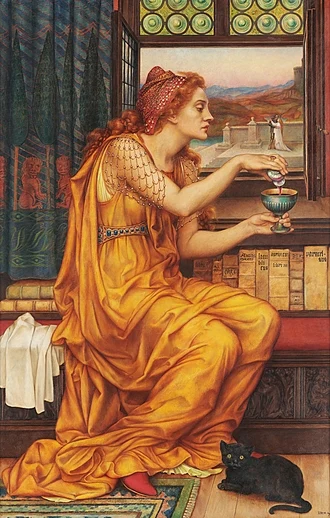
The composition of The Love Potion is arranged with great deliberateness around the central figure of the sorceress, who stands before a cluttered worktable and holds aloft a small vial of luminous liquid. The figure is rendered in the elongated, graceful manner that characterizes De Morgan at her most confident, with a posture that communicates both absorbed concentration and a troubling self-assurance. The interior space around her is dense with symbolic objects, including an hourglass that signals the passage of time and the irreversibility of fate, various alchemical vessels that suggest the blending of forbidden knowledge, and a cat that watches from the shadows as an emblem of the uncanny. De Morgan uses color with exceptional intentionality throughout the canvas. The warm amber and gold tones of the sorceress and her immediate environment are offset by cooler, more shadowed passages in the background, creating a visual tension between the seductive warmth of desire and the cold consequences that lurk beyond it. The luminous quality of the potion in the vial draws the eye as a focal point, giving it a quality almost of sacred light, which deepens the irony of its intended use. The brushwork is smooth and meticulously finished, consistent with the Pre-Raphaelite tradition in which De Morgan was trained, and the level of detail in the fabric, objects, and architectural setting rewards prolonged examination. You can own this remarkable painting as a hand-painted oil reproduction and bring the full symbolic power of De Morgan to your home.
At its core, The Love Potion is a meditation on the ethics of desire and the spiritual danger of seeking to control another person through supernatural means. De Morgan does not present the sorceress as a straightforwardly villainous figure. There is an ambiguity in her expression and bearing that invites the viewer to consider whether she herself is caught in the grip of an obsession she cannot resist, making her as much a victim of desire as a manipulator of it. This moral complexity is characteristic of De Morgan, who consistently refused simple moral categories in her allegorical work and instead created images that open outward into genuine philosophical questions. The painting draws on a long tradition of representing female magic workers in Western art, from classical representations of Circe and Medea to Renaissance images of witchcraft, but De Morgan reframes this tradition by granting her sorceress a dignity and interiority that resist the demonizing stereotypes of the genre. In the context of De Morgan spiritualist beliefs, the image also carries a warning about the misuse of hidden knowledge, a theme that recurs throughout her late work. The love potion becomes a symbol not merely of romantic obsession but of any attempt to bend the will of another to serve one self, and the consequences implied by the composition suggest that such attempts ultimately diminish the one who makes them. The cultural significance of this painting lies in its willingness to take a sensational subject and transform it into genuine moral philosophy rendered in paint. Own this as a hand-painted oil reproduction and engage daily with one of the most thought-provoking works in the De Morgan catalogue.
Enjoyed this story?
Save articles to your collection
Log in or create a free account, and this article will be waiting in your Private Collection.
Log in or sign up