Loading cart…
No products in the cart.

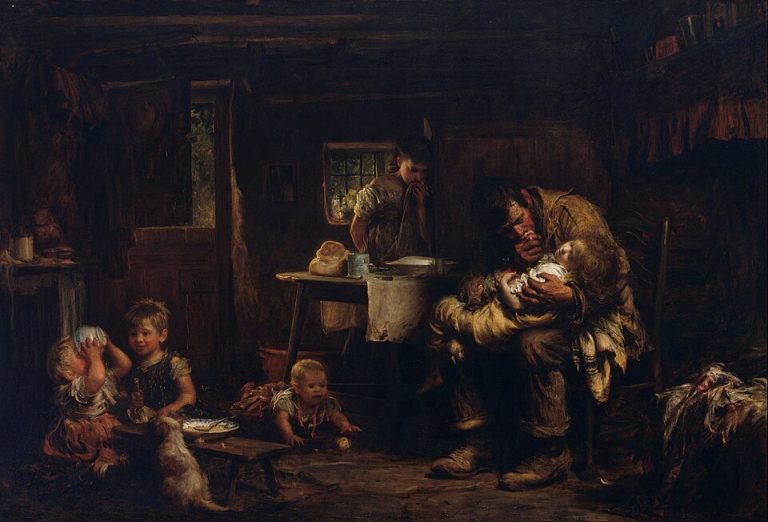
1876 · Oil on canvas · Art Gallery of New South Wales, Sydney, Australia
Save articles to your collection
Log in or create a free account, and this article will be waiting in your Private Collection.
Log in or sign upThe Widower was first exhibited at the Royal Academy in 1876 and drew immediate critical attention for its unflinching depiction of domestic grief within a working-class household. Fildes had already established a reputation for socially engaged subject matter through his earlier illustrated work for The Graphic, and this painting continued that trajectory by focusing on the aftermath of maternal death, a common and devastating reality for Victorian families of modest means. The subject was drawn from observations Fildes made of real communities, reflecting his commitment to grounding his art in lived experience rather than idealized sentiment. The painting was acquired by the Art Gallery of New South Wales, where it has remained a significant holding in the collection of Victorian British art. Its reception in London was broadly positive, with critics praising the restrained emotional tone and the careful attention to the material conditions of the subjects. The work occupies an important place in the broader trajectory of Victorian Realism because it refuses to moralize or sentimentalize its subject, presenting poverty and loss as facts of life rather than occasions for theatrical lamentation. Fildes returned to themes of working-class hardship throughout his career, and The Widower remains one of the clearest expressions of his sustained interest in the social conditions of ordinary people.
The composition of The Widower is structured around the central figure of the father, who sits in a domestic interior surrounded by his young children. His posture communicates exhaustion and sorrow without resorting to melodrama. Fildes positions the viewer as an unannounced observer, creating a sense of intimate proximity to the scene. The children are rendered with careful individuality, each absorbed in small activities that underscore their innocence and their incomplete understanding of their altered circumstances. The absence of the mother is made palpable through the visual organization of the space, which feels simultaneously full and empty. Fildes employs a muted palette dominated by warm ochres and earthy browns, punctuated by the softer tones of the children's clothing. Natural light enters from a single source, casting gentle shadows that reinforce the subdued emotional register of the scene. The textures of the domestic objects, including worn furniture, simple fabrics, and modest household items, are rendered with the same attention Fildes brings to the human figures. This careful treatment of the material environment is characteristic of his approach to Victorian Realism, in which the physical world carries as much narrative weight as the people who inhabit it. The painting rewards sustained looking because its emotional complexity is distributed across the entire visual field rather than concentrated in a single dramatic gesture.
The Widower engages directly with one of the defining social anxieties of Victorian Britain, namely the vulnerability of working-class families to the loss of a parent. In an era before meaningful social welfare provisions, the death of a mother could destabilize an entire household, leaving children without care and a father without the domestic support that the period regarded as essential to family life. Fildes presents this situation without offering consolation or resolution, which is itself a significant moral and artistic choice. The painting does not suggest that the family will be rescued by charity, religion, or community. It simply shows a man and his children at a moment of ordinary, unwitnessed grief. This refusal of easy comfort aligns The Widower with the broader humanist concerns of Victorian Realism as practiced by Fildes and his contemporaries. The painting asks its audience to sit with discomfort rather than to resolve it through narrative. In this sense, the work functions as a form of social witness, acknowledging the existence of suffering that polite Victorian culture preferred to overlook. The figure of the widowed father also complicates conventional gender roles of the period, placing a man in a position of domestic caregiving that was culturally coded as feminine. By centering this figure with dignity and without condescension, Fildes extends empathy across the boundaries of class and gender that structured Victorian social life.
Enjoyed this story?
Save articles to your collection
Log in or create a free account, and this article will be waiting in your Private Collection.
Log in or sign up