Loading cart…
No products in the cart.


The Victorian era in Britain was a period of sweeping transformation. Industrialization reshaped cities, the British Empire expanded across continents, and a newly prosperous middle class developed an appetite for art that combined sentiment, moral instruction, and natural beauty. It…
Save articles to your collection
Log in or create a free account, and this article will be waiting in your Private Collection.
Log in or sign upThe Victorian era in Britain was a period of sweeping transformation. Industrialization reshaped cities, the British Empire expanded across continents, and a newly prosperous middle class developed an appetite for art that combined sentiment, moral instruction, and natural beauty. It was within this cultural climate that animal painting rose to extraordinary prominence, celebrated not merely as a lesser genre but as a vehicle for exploring loyalty, heroism, and the relationship between humanity and the natural world. Royal patronage lent enormous prestige to painters who could capture animals with both anatomical precision and emotional depth, and no artist answered that call more fully than Edwin Henry Landseer. His work spoke directly to the values of his era, presenting animals as mirrors of human virtue and as inhabitants of landscapes that carried profound romantic weight.
Edwin Henry Landseer was born in London on 7 March 1802, the son of the engraver John Landseer, who recognized his child's exceptional drawing ability at a remarkably young age. By the age of thirteen, Landseer had already exhibited at the Royal Academy, and by his early twenties he had established himself as the foremost animal painter in Britain. He studied under Benjamin Robert Haydon, learning classical techniques and anatomical rigor that would underpin his entire career. His travels to the Scottish Highlands beginning in the 1820s introduced him to the dramatic landscapes and wildlife that would define his most celebrated works. Queen Victoria and Prince Albert became devoted admirers, commissioning numerous paintings and inviting him to Balmoral, a patronage that cemented his social and artistic standing. Landseer was elected a full Royal Academician in 1831 and was later offered the presidency of the Royal Academy, an honor he declined. He designed the iconic bronze lions at the base of Nelson Column in Trafalgar Square, a public commission that gave his artistic vision permanent presence in the heart of London. Despite suffering a mental breakdown in later life, his influence on British art and on the cultural perception of animals remained profound and enduring.
The technical foundation of Landseer's work rested on an extraordinary command of oil paint applied with a painter's understanding of both fur and flesh. He studied animal anatomy with the same dedication that figure painters brought to the human form, dissecting carcasses and sketching from life with relentless discipline. The result was a surface quality in his paintings that conveyed not just the appearance of an animal but its physical presence, its weight, and the specific texture of each coat or feather. His brushwork was varied and purposeful, using tight, directional strokes to describe individual hairs and broader, more gestural passages to suggest movement or atmospheric distance. Light in his compositions fell with theatrical precision, illuminating his central subjects while allowing peripheral details to recede into rich, warm shadows. This chiaroscuro approach owed a debt to the Dutch and Flemish masters he studied closely, yet it was deployed in the service of a distinctly British romantic sensibility.
Beyond technical virtuosity, Landseer possessed an unusual ability to anthropomorphize animals without reducing them to caricature. His animals exhibit postures, expressions, and behaviors that invite the viewer to read human emotions and moral qualities into them, yet they remain credible as creatures of nature. This balance between scientific observation and emotional projection was the defining characteristic of his visual language. His compositions were carefully staged, often placing a single dominant animal within a landscape that reinforced its symbolic role, whether that landscape was the misty Scottish Highlands, a stone-flagged kennel, or the intimate interior of a cottage. Color was used both descriptively and expressively, with the deep russets and purples of highland heather contrasting against the grey of cloud or the white of a hound, creating harmonies that felt emotionally resonant as well as visually coherent. This synthesis of observation, technique, and sentiment made his paintings immediately accessible to wide audiences while rewarding sustained scholarly attention.
Each card links to its own article with full analysis and reproduction details.
 #1
 #4
 #2
 #3
A print can reproduce colors. What it cannot reproduce is texture, depth, and the physical presence of oil paint on canvas. Edwin Henry Landseer technique depends on these.
At ByMuseum, every reproduction is painted by hand using oil on canvas. There is no inkjet, no digital print. The brushwork is real. The result looks like a painting because it is one.
Enjoyed this story?
Save articles to your collection
Log in or create a free account, and this article will be waiting in your Private Collection.
Log in or sign up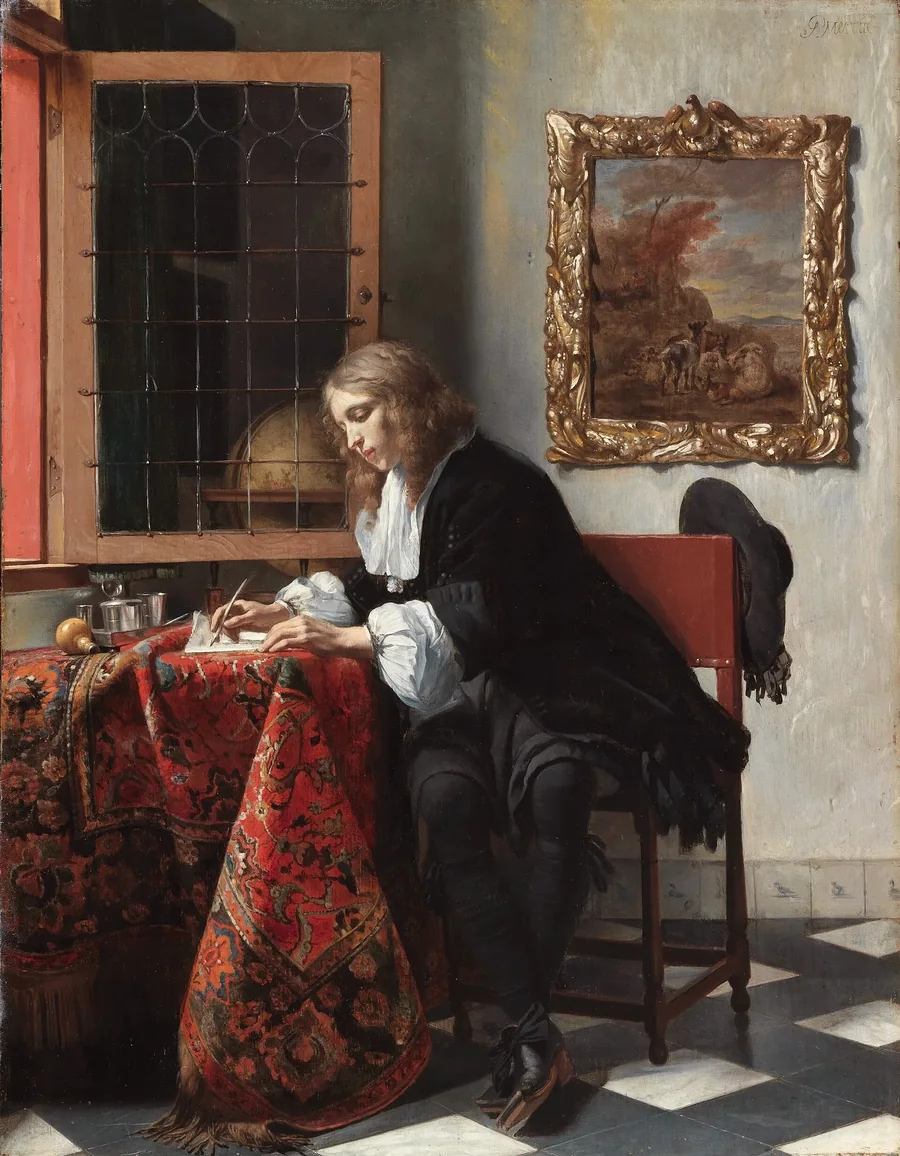
Man Writing a Letter
Gabriel Metsu, c. 1664
The gallery list
Every painting is already 50% off. Join the list and we will send you an extra $15 code, plus first access to new collections.
No spam. Unsubscribe anytime. · Privacy Policy
Welcome
Your $15 code is on its way. Explore the gallery while you wait.