Loading cart…
No products in the cart.

1865 · Oil on canvas · Musee d'Orsay, Paris, France

Save articles to your collection
Log in or create a free account, and this article will be waiting in your Private Collection.
Log in or sign upAlexandre-Louis Leloir completed Jacob Wrestling with the Angel in 1865, when he was just twenty-two years old, and he exhibited the work at the Paris Salon of that same year. The painting was received with considerable enthusiasm, and it established the young artist as a figure of real promise within the French Academic world. To create such an ambitious large-scale composition at so early a stage in his career was itself a significant statement, signaling that Leloir was not content to work his way gradually toward major subjects but intended from the outset to engage with the most demanding narratives available to a history painter. The subject is drawn from the Book of Genesis, chapter thirty-two, in which Jacob, traveling alone at night, encounters a mysterious man and wrestles with him until the break of dawn. The encounter ends with Jacob receiving both a wound and a blessing, along with a new name, Israel, meaning one who has struggled with God. This narrative had attracted painters for centuries, but Leloir approached it with a freshness and physical directness that distinguished his version from earlier treatments. The painting entered important French collections and eventually came to be held by the Musee d'Orsay, one of the preeminent institutions for nineteenth-century French art, where it continues to be viewed by visitors from around the world. The fact that a painter of only twenty-two years could produce a work now housed in one of the great museums of France speaks powerfully to the quality of Leloir's training and to the natural strength of his artistic vision. For those who wish to experience the force of this painting in their own home, it is available as a hand-painted oil reproduction through ByMuseum, allowing collectors to own this iconic image rendered by skilled contemporary painters working in the same oil medium as Leloir himself.
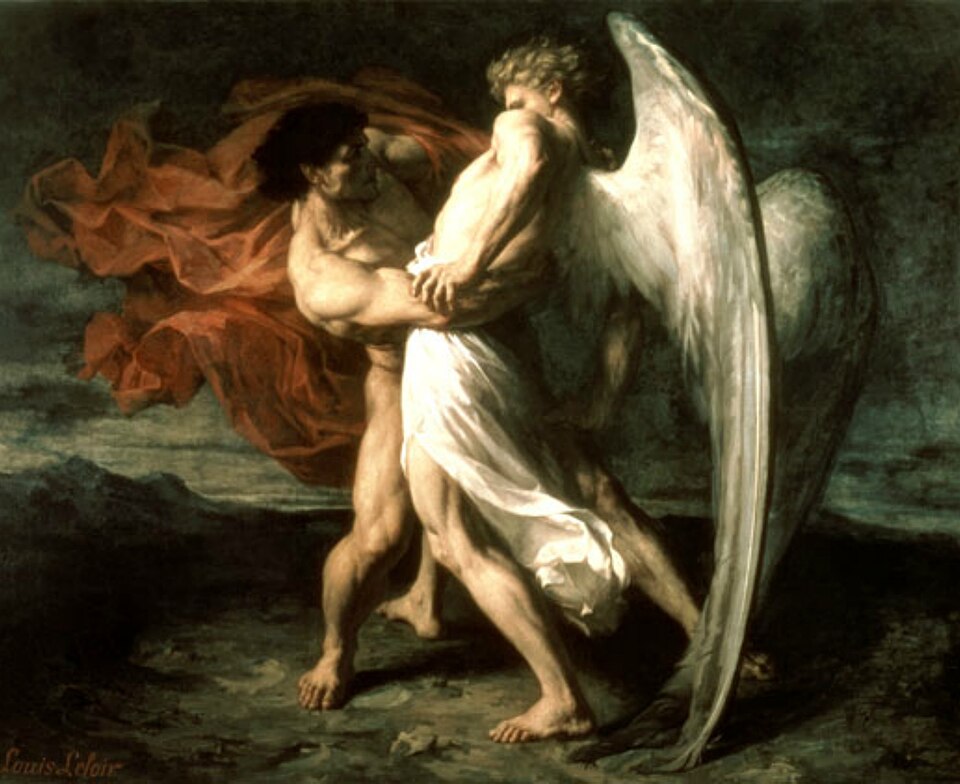
The composition of Jacob Wrestling with the Angel is organized around the locked forms of two powerful male figures, their bodies twisted together in a configuration that fills the lower half of the canvas with muscular tension. Leloir positioned the figures against a dramatically lit nocturnal landscape, the darkness of the night sky pressing down upon the scene and concentrating all visual attention on the struggling pair. The light source is ambiguous in the most deliberate way, suggesting something beyond a natural illumination and hinting at the supernatural character of the encounter. The angel figure is rendered with a physical solidity that might surprise viewers expecting an ethereal, weightless being. Leloir chose to emphasize the bodily reality of the struggle, giving the angel a form as muscular and present as that of Jacob himself, a decision that heightens the drama and makes the eventual outcome feel genuinely uncertain. The draftsmanship throughout the canvas is of an exceptionally high order. The anatomy of both figures is rendered with the precision of a trained Academic painter who has devoted years to the study of the human body. The foreshortening of limbs and the rendering of musculature under strain demonstrate Leloir's command of the figure in action, a skill that is among the most demanding in the entire range of Academic painting. The color palette is deliberately restrained, keeping the emphasis on form and value rather than decorative surface, a choice that gives the painting a gravity appropriate to its subject. The psychological intensity of the two faces, locked in mutual focus even as their bodies struggle, adds a further dimension of meaning to what is already a physically compelling image. Anyone wishing to own this remarkable work can commission it as a hand-painted oil reproduction from ByMuseum.
The subject of Jacob wrestling with the angel carries an extraordinary weight of theological and cultural meaning that French Academic painters of the nineteenth century were well equipped to appreciate. The encounter in Genesis is one of the most discussed passages in the entire Hebrew Bible, interpreted by Jewish, Christian, and Islamic scholars across millennia as a metaphor for the human struggle with the divine, with destiny, and with the deepest challenges of moral and spiritual life. Jacob emerges from the struggle wounded but transformed, bearing a new name and a new identity. The wound he receives, the dislocation of his hip, is a mark of the encounter that he will carry with him for the rest of his life, a reminder that genuine transformation involves genuine cost. Leloir engaged with this layered meaning thoughtfully, producing an image that functions simultaneously as a dramatic narrative scene and as a meditation on the nature of human struggle. Within the specific context of nineteenth-century French painting, the subject also carried resonances connected to the broader cultural moment. Questions of faith, identity, and the relationship between the human and the divine were subjects of intense public debate in France during the 1860s, and paintings that engaged with biblical narrative did so against a backdrop of genuine cultural urgency. Leloir brought to these questions both the technical authority of his Academic training and the earnestness of a young artist taking on a subject that mattered to him. The result is a painting that has retained its capacity to move and challenge viewers for more than a century and a half. Collectors who wish to bring this powerful image into their own lives can own it as a hand-painted oil reproduction, available through ByMuseum with the same care and attention to the original that Leloir himself devoted to the subject.
Enjoyed this story?
Save articles to your collection
Log in or create a free account, and this article will be waiting in your Private Collection.
Log in or sign up